Tampilkan postingan dengan label two. Tampilkan semua postingan

May 12 13 Last Two Lay Days in Washington No miles

No, not a Maritime Museum. This is one of the fishing boats used by the Danes in WWII to smuggle most of their 7000 Jews into neutral Sweden. It is one of the many artifacts in the United States Holocaust Memorial Museum.
I spent a whole day (10 to 5:15) here and did not see it all. Designed of the same beautiful pale yellow stone that is used in most other government buildings in this city, the interior has a long atrium around which the horrible history unfolds, as one starts on the fourth floor and works ones way down. This atrium is glass covered and reminded me of a railroad station  -- such an integral part of the Germans "Final Solution". I have been to such museums in NY, Jerusalem and smaller ones in many other cities but none that were as comprehensive, with a significant slant on US responses before, during and after the war. It showed how gradually Hitler came to power, consolidated his power and set to work first trying to drive the Jews out by making life unbearable and dangerous, then deporting them and finally, exterminating them. One huge wall of etched glass, has the names of the numerous European towns where Jews lived before Hitler, including my fathers birthplace, Untergrombach, middle row, right, with my imagined "RR Station" below.
The place was very crowded with lots of high school kids who were very respectful. I was quite moved by the experience. The museum repeatedly discussed the plight of the Roma (gypsies) and other victims. It also had exhibits on the three post-Holocaust genocides: Cambodias killing fields, the Serbo-Croation conflict and Rwanda. It seems humanity has not learned yet, despite the saying "Never Again! We had lunch in the museums cafe, located in a small building outside the Memorial.
Our final day was for Congress and the Library of Congress. We had planned to visit the adjacent Supreme Court as well. I had to be admitted to its Bar to oppose a Petition for Certiorari  in the late 70s. (Since about 95 to 99 percent of such petitions are denied, winning that one was rather easy.) But our tourism stamina gave out before we got there, which was a shame because Lene has never been there. On our way we passed the Frances Perkins Department of Labor Building.
Ms. Perkins was one of FDRs "brain trust" and the first female Secretary of Labor. She co-taught a seminar in labor history I took at Cornell in about 1964.
In 2008 Congress opened a huge underground entrance, visitors center, "Emancipation Hall," with Museum, gift shops, a large cafeteria and many restrooms to handle the throngs of tourists. We were shown an inspirational movie about how well Congress works, which is somewhat of a joke given todays hyperpartisanship. Leah, our assigned
tour guide was energetic and bright with the kids but the tour did not include either house of the Congress. We easily secured a pass to visit the House, which was in session, but just barely. The person acting as speaker recognized a stream of Representatives who rose to give speeches of up to four minutes. It was mostly women in red suits on the Democratic side and men in blue suits on the other side. Several democrats spoke in favor of refinancing the Highway Trust Fund and opposing yet-another bill to restrict abortion, which the Republicans are addicted to and will undoubtedly pass. The Republicans spoke in favor of the anti-abortion bill and in memory of slain police officers. They all spoke to an almost empty room. The speeches go into the Congressional Record and are fodder for the folks back home. "See how I represented your interests!"
After lunch we visited the Library of Congress through an underground tunnel which avoids having to go through security again. Our first time here.


The entrance hall reminded me of The Hermitage in St. Petersberg, with its staircase, marble, red, statuary and grandeur.


The main reading room is much smaller than the one in NY but more elegant.
A highlight of my stay here was a visit to the Geography and Map division, where I was given access to their collection of nautical charts published by the United States Navys  Hydrographic Office from about 1850 to 1950. The charts are numbered, to about 6500, with some omissions. I have been studying them and cataloging them, as a volunteer in the Map Room of the NY Public Library for about seven years now. They describe the coastlines of the world (excluding the U.S. and the Philippines which are the subject of a similar series of charts published by the Coast Guard. Each branch of the armed forces had its champions in Congress and back in the 19th century they worked out this geographic compromise.)  I had a good conversation with the director of the map room who invited me back. Maybe, by land, some day.
I also saw a German antiquarian map of the world, in Latin, published a few decades after 1492, purchased for $11,000,000 (less than half of it taxpayer dollars), an exhibition of Herblock political cartoons, and a recreation of Thomas Jeffersons circular library of Monticello (he sold it to the government) with mostly his original books. He was a well read man.
Read More..

December 1 3 Kingsley Plantation to Jacksonville and two Lay Days There 19 8 Miles

The passage, under motor, was uneventful. I was a bit disappointed to miss out on the tide up the St. Johns River. If we had started a bit later we would have caught more favorable tide.  This large suspension bridge had a high tech industrial appearance, less graceful than others, I thought.
 We passed a large cruise ship about ten miles before the city and waved to the passengers. I had not known that Jax was a cruise ship port. The trip up the river about 15 miles reminded me a bit of Norfolk with a large military presence, and huge commercial shipping. Watching the mammoth cranes at work -- sliding out and picking up or putting down shipping containers so quickly was rather amazing. They must have a computer program to tell it what to do because each trip out over the water between ship and shore involved two containers -- one off and one on.
Jacksonville was named after President Andrew Jackson who made his name by killing Native Americans in Florida, and is the largest city we have visited since leaving New York, almost two months ago.
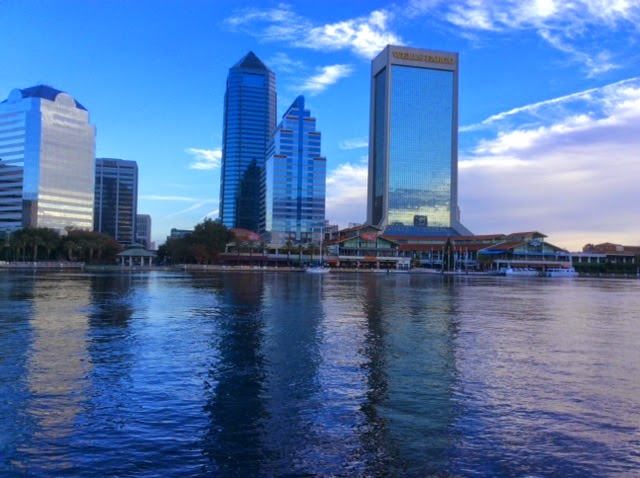
Jacksonville Landing, on the river, at the heart of the downtown area was apparently intended as a version of the commercial activities of New Yorks South Street Seaport Museum. But it has fallen on hard times and the stores are mostly fast food restaurants. (So we ate at Hooters, a first time experience for me as was eating a corn dog for lunch the next day).  But the City offers its seawall, perhaps 200 yards of floating dock -- free -- for up to three nights. And there is water so ILENE got a thorough bath, but there is no electric, showers or help getting on or off. The Landing has a bad reputation for subjecting boaters to petty crime and pan handling. An alternative is a different free municipal marina where one can also get electricity for $8.00 per night, and which is not near pan handlers. But it is 1.5 miles from the downtown area, we did not fear panhandlers and did not experience any problems.
They say you have to raft up to other boats -- up to five abreast!!  -- if there are more boats than wall space. This could be quite difficult considering the current that runs in the river. But we were the only boat there when we arrived in the early afternoon, and no rafting was needed during our three nights; and we could have stayed longer had we wanted. The photo was taken after we left, and the only boat is the one just to the left of where we were tied up, below the Hooters.
We visited the Cummer Museum. Not a bad try for a smaller city like this. It was in the Cummer mansion, with additional buildings and had three lovely formal gardens out back, fronting the river, English, Italian and the third by Frederick Law Olmstead, designer of New Yorks Central Park. The city has a municipal trolley- looking bus system. Its route is listed on the tourist maps and would have taken us to the museum $.75 per person, one way. We waited for almost an hour before some kind person showed us the inconspicuous sign which had been pasted up that said that service had been discontinued as of the day before. So we took a cab, walked to the new Fresh Market nearby and got another cab back to the boat.  I also visited a somewhat disorganized maritime museum located in JVille Landing, and we took the free skyway, an elevated railroad that connects different parts of the city (sort of like the systems at New Yorks airports) to an excellent and popular restaurant, B.B.s, at the end of the line on the other side or the river and walked back across the Main Street Bridge.
We were lucky to make this bridge opening on our way in. There was construction and all of the associated equipment had to be removed before they could raise the bridge, causing a delay that permitted us to avoid waiting almost an hour for the next opening.
We enjoyed visitors here: Michele and Manu, whose "TeePee" is in a marina at Green Cove Springs, another 20 miles up the St. Johns River, where they are readying her for the Bahamas. They came by car and after several hours of talking and eating we went to the  monthly arts walk including a free guided tour of the Jacksonville Theater, built in 1927 and renovated in the 80s, including its backstage and dressing rooms; sort of a mini Radio City Music Hall. The central business district was done up in booths with artisans and crafts people; many live music events reverberated in the streets.
We visited the Museum of Contemporary Art to see what all the controversy was about: The day before we arrived, a painting of a nude pregnant woman on display there had been denounced as pornographic by the city manager. It was not, but his criticism ensured large crowds and pickets defending the arts. Shades of Mayor Rudy Guiliani.  Then, back at the boat, Lene cooked up that sweet potato pasta as a prima vera for dinner aboard for the four of us. A good time. One Floridian described Jacksonville to me as "the armpit of Florida". We had only a few days there but his criticism seemed harsh.
Read More..

April 30 May 1 Two Lay Days in Portsmouth Zero Miles

Lenes finger, at the right, is pointing out our slip on F Dock at this Marina, a huge one. In 2012 and 2014 we stayed at a free dock by the Radisson hotel, a couple hundred yards to the upper left of the poster but this time we wanted repairs and might have had to haul the boat so a marina was needed.

Gaston showed up with his assistant promptly as scheduled. I had cleared out the aft cabin to give access to the area of concern. He laid a pencil on the shaft, so light that it would easily detect vibration. Nothing. It does not happen at the dock, even when, tied onto it tightly, we run the engine in gear up to 2500 rpms, trying to drag the dock. He dissembled the flexible coupling again, tested for alignment with feeler gauges, reassembled it and pronounced that it was within tolerance. So the problem is outside the boat, at or near the propeller end of the shaft. He suggested that we wait until the fall and when the boat is hauled, we check the cutlass bearing and remove the propeller and ship it to California for what will be an expensive reconditioning job. He said that we are not in danger from the current situation.
Then he lent us his truck and we visited the supermarket, the drugstore, and a law firm where I signed a document and got it notarized. I spent a few hours planning the places we could stop along the Potomac on the way up and down to Washington DC. It is slim pickins for anchorages and marinas with water deep enough for ILENEs 58" draft. I have asked the 6500 members of a "private group" on Facebook for more information.
Later Gaston came over and paid us a social visit. He was born in France, raised in Israel and is an excellent mechanic. He was affiliated with and sailed in the Caribbean 1500.

The weather has been rainy most of our two days here and so we did little. I had visited the nautical museum and lightship in 2012 and toured the historic district. It rained then too!
They also have a Childrens Museum and one honoring Virginia athletes. I took a pass on those. There is a small Jewish Museum and a historic 1812 house, both of which can be toured, but only in season, not now.
So we took showers, took on water, cleaned the boat, blogged, read, cooked, ate and watched the first two episodes of the PBS series Wolf Hall, based on a novel by Hillary Mantell, which my book group read a few summers ago, about Thomas Cromwell, an attorney in the time of Henry VIII.

We would have left the second of these two days but the forecast of rain and 25 knot wind in our faces deterred us and the forecast came true.
Read More..

July 2 to 13 Six Days of Sailing and First Two Nights Aboard

Yes, twelve fun filled active boating days (and two nights) for Lene and me. Six were sailing days which averaged only about 3.35 hours per day, plus a work day and two overnights. Before that, a fireworks party on the 37th floor of Devs apartment, which was great, including the fact that due to the distance from the event, the fireworks were like children should be: seen but not heard.
The first sail in this period was with two of the men from my Book group, Arthur
and Gary, Arthurs wife, Marie Genevieve (the photographer) and Rafael, their son, on his dads lap. This pic, like many others are taken on the launch because your correspondent is too busy sailing the boat to perform his photographic responsibilities, and because the bimini and dodger do too good a job of providing shade, which makes it hard to get good pictures.
So we had the Chief Librarian of a prestigious New York university, an Emmy Award winning Film Editor and a practicing Psychiatrist. They were my friends who have became Lenes friends as well. Marie is the sailor in the bunch, with lots of experience with her father in Europe, and took the helm most of the time, but her husband and son took stints. Rafa steered like a Navy Helmsman, taking orders such as "a little to the right" -- because at eight, he can not yet see over the binnacle.

Next up were four of Lenes friends who have become mine as well. Sheila, MJ, Christine and Heather, all repeat sailors whose pictures are in other posts. We put up less sail than normal and went at a slow stately pace that the guests appreciated. We started with reefed main and small jib but finished without the jib.

Then came Ilenes first sail on Bennett and Harrietts new Beneteau. Lene, as I had been, was quite impressed with the boat. I was able to whip the ends of all of her lines that terminate in the cockpit. Another day, not underway, will be needed to get the other ends of these lines. She has a lot less lines than On Eagles Wings.

A work day to get the top of the Genoa working and mostly sanding the cafe doors for another coat of varnish, which could not be applied because the varnish I had had jelled to a solid. I also got two spare fuel filters - expensive little buggers, which, in their boxes are now aboard in zip lock bags to prevent rust.

For the final three days and two nights of sailing, in addition to the human guests, Whitty and Alpha Girl got reacclimated to the boat. That process was hardly an event; they walked about like they owned the place and tried to get into the cabinet where their food is stored. Cats are smart, especially when their dinner is concerned. Alfie is quite at home inside the aft end of the stack pack, atop the boom, when ILENE is on a mooring. The red and black lines are the first and second reefing lines, respectively.
It is warm and quiet in there. But we have to remember always to make sure we see the little devils before we hoist the sails to avoid crushing them. Our human guests during the first of these three days were Jill and Ken, her boyfriend. She is the kitties Vet and he is a family therapist and soon to be published memoirist. Neither of their expert services were required for this voyage, just the pleasure of their company.
The most remarkable thing about this daysail was the tidal effect of the so called "Super Moon" -- which was full and at the point in its orbit closest to the earth, increasing its magnetic effect on the water. Coming north back toward the mooring we passed what is usually safely east of  Stepping Stones Light. The depth sounders beeping alerted us to the fact that the rocky seabed was only seven feet deep -- 16 inches below the bottom of our keel. I veered sharply to starboard to get further away -- toward deeper water. At high hide that day, the water would have been another eight feet deep. The same low tide problem almost prevented us from getting back to our mooring. Other members of our Club, who had intended to race that Friday evening, had to wait for the tide to rise a bit, being stuck in the mud.  We made a groove in the soft mud bottom for about ten yards of our approach to the mooring; inertia carried us through. Our keel is 5.66 feet deep and the water was only 5.6 feet deep. After dinner at the Club, I took our guests to the subway so they could get home and listened to our Clubs mostly amateur but great sounding six piece rock band playing. But it was already 9:30 and my bed time. A calm cool night.
Next day, after breakfast, our guest was Christine, a frequent sailor with us, here with Whitty.
We had the best sailing of the summer so far. We beat deeply into the south end of Little Neck Bay on eight tacks using Main and small jib, then ran out and through the passage behind Stepping Stones off Kings Point, which required three gybes, and finally turned south into Manhassett Bay to the M.B.Y.C. on a single starboard close reach. Lene had the helm most of the way and has mastered the art of taking advantage of puffs that round us up slightly. Our speed rarely dipped under six knots and on the broad reach we were making eight.
MBYC charges $60 for a mooring and has a lovely big pool. We got there late in the afternoon and lounged on the pools deck. It was not at all crowded and we just read. Later the pool attendant told us that our guest mooring fee did not include use of the pool. Apparently this rule resulted from an experience a few years ago when a boater with twelve souls aboard took a mooring and his guests clogged the swimming lanes. But MBCY has a great guest shower which we did use before an excellent dinner in their restaurant. From the restaurant deck, you see the pool in the foreground, their mooring field in mid ground and a wee bit of the east side of City Island under the setting sun.
Another good nights sleep and a good breakfast aboard before sailing back to the Harlem.


Before casting off, however, I finished the improvements that I had been working on. I hung the wool (or maybe cotton) wall hanging of a stylized sailboat that we got in Finland (dare I call it a tapestry?).  (Sorry about the color and underlined nature of this next paragraph; I didnt intend it and cant get out of it!)  I installed a new block at the base of the mast and a new fifth clutch on the starboard side of the coach roof, next to the other four of them there, so the winch there can handle the outhaul. From now on I can change the tension of the foot of the main sail and thereby trim it better without having to go forward to the mast, laying on my back there, having Lene steer up into the wind and hauling on the outhaul line manually. My only mistake was caused by Lewmar, which provided absolutely zero instructions on how to install their clutch. To release the four existing ones, I lift a lever that swivels up and forward on a pin at the forward end of the clutch. So I installed the new one with the lever moving the same way -- which was backward!!
All the others open one way; this new different one, the other!
In other words, when closed, the clutch did not hold the line when you want to lock it, but it did prevent you from tightening the line. But having done all the drilling and bolt and washer selection and grinding and snakeing of the line needed for the first installation, it took only ten more minutes to detach and reattach the clutch the right way. The clutch is fastened to the coach roof reinforced by strong washers, above this removable panel in the cabin ceiling.
This little job used an enormous number of specialized tools and I confess that I was pleased with myself. Thanks go to my rigger, Jeff Lazar, proprietor of Performance Yacht Management, who encouraged me to do it myself and gave me some helpful hints. He had also told me the size of the Allen stud which I installed myself (And I sorely regret that I did not bring my camera to the top of the mast to gain pictures of our clubhouse and mooring field from an altitude of 63.5 feet above sea level. Lene cranked me up and let me down gently. Another time for that photo.) While working from the top of the mast of a nearby boat Jeff also advised me to possibly shorten the strap at the clew of the Genoa to lower it a bit. The last step on the clutch job will be using a punch that Jeff recommended, and a hammer, to drive out a horizontal athwartship pin embedded in the forward end of the boom on which three thumb cleats rotate. They were used to hold the out haul line and the two reefing lines (red and black, remember) in place. Now, that the third and last of them is led to the cockpit, the thumb cleats are worse than superfluous --  they tend to chew up the lines.
Our sail home on Sunday in the late morning was via the shortest logical route on a variety of port reaches, from broad to close. It rained a bit en-route and with more and heavier  rain forecast for the afternoon,  and my shoulder getting sore from too much sailing, we made a short day of it.
Read More..

December 19 20 Dragon Point to Vero Beach and First Two Lay Days Here 32 4 Miles

Another day of motoring in the ditch with no wind. Passing Johns Island, near Vero, to port, we were impressed by the wealth invested in real estate there recently, lets say within the last decade, in large single family homes. The John Island stretch of the ICW was nice and deep, about 16 - 18 feet, compared with 10 - 14 feet most of the rest of the days passage. possibly the influence of money.
Dragon and Vero are very similar geographically. Both are on the eastern, barrier island side of the ICW, just north of a high, 65 foot bridge linking that island to the mainland. In both cases you continue south until you are almost at the bridge and then hook a sharp left around a green buoy into a small sheltered space.
Vero has a nice municipal marina with docks (at left in photo above) for those who want them and moorings that rent for less than $15 per night, including taxes, cheaper on a weekly, monthly or annual basis.
ILENE is third from right. Sailors on a budget joke that the place is called "Velcro Beach" -- people come here and seem to stick here -- living aboard for about $300 per month. The marina reserves the right to raft you up, as many as three boats on a mooring, but so far we (and all the other moored boats) have been alone. We told the marina to raft up only people who are not allergic or phobic about felines. They have no launch service but a very short dink ride in sheltered water to an ample and secure dinghy dock in a canal just off the harbor.
Good showers and laundry but the wifi is terribly weak: we retreated to ILENE where Lene finished Breaking Bad using most of our remaining monthly allotment of fifteen gigabytes on the last day of the subscription month.
Our neighbors:
The town has a free public transit system of fifteen mapped and scheduled routes. The marina is a stop on Bus Route 1 which runs both to and along the Atlantic coast, about a mile east, leaving at 10 minutes after the hour and west to the airport on the mainland side at 45 minutes after the hour. At the airport, or before, you can connect to most of the other routes but some destinations require three buses. So it is free and extensive but service is limited to once an hour, ending on weekdays at six, Saturdays at three and there is no service on Sundays.
We walked to the beach and back on our first evening (about two miles round trip) and had a mediocre Italian dinner. We took the bus to the mainland market and to the beach for a long walk on it the next day. We had some nice talks with some of the local people. Many jellyfish, about a foot in diameter when flattened, lay dead or dying on the beach, to be cleaned up by the authorities. The Beach is steeper than those at Daytona and Cumberland Island. This beachside town is the opposite of Daytona Beach. No honky tonk.  No cars on the sand. Banks and brokerage houses(insurance, real estate and securities) instead of head shops and tattoo parlors. And no or very few high rises. Moderately large suburban ranch style homes that I guess were built in the 60s.Modest compared to the Johns island megamansions. More older people. Development has been managed here. There are poor people in Vero but not in the beachfront side of this town.
We saw a sign advertising a diver, Peter, who lives on his boat here. He came to do our bottom, said it was rather clean, and replaced our zincs. I was surprised that he charged only $40.00. I topped up the water levels in the seven batteries, which were down very little, except for the group 27 starting battery where the level was too high, above the "fill to this line" mark, so I used an eye dropper (used to test the battery) to draw out the excess fluid from it. I wonder how that happened and what harm the excess acid-water may have done to the battery. Its charge seems better now.
We had planned to stay two days but some forecast  rain and strong winds from the south  may extend our stay until Christmas. It is a pleasant place to be detained and we plan to visit the Art Museum, which is an easy walk, on Sunday, and the Botanical Gardens and a movie at the mall using bus connections after that.
We have also been contacting present and former members of the Harlem YC who live in south Florida at least part of the year, and though some are going north to be with family for the holidays, we expect to rendezvous with at least some of them during the next few weeks.
Read More..

September 2 9 Two Wednesday Afternoons with the Old Salts

First, an innovation on an Old Salts Wednesday: a visit to Louies Seafood Restaurant in Port Washington in Manhassett Bay. Eleven of us motored over with light wind in our faces between noon and one. From left to right: Carolyn, Art, Klara, Dave, Morty and Art on the left side and then continuing: Bennett, Marcia, me, Mike and Sandy.
I felt a bit guilty not eating at the Clubs restaurant - the Club can sure use our business - but our group does eat there rather religiously on all the other Wednesdays. The only other problem was how long it took to serve the eleven of us, but the food was good, albeit pricier than at home.  In short, we did not get off Louies dock until three and had only two hours for sailing.
With winds continuing out of the south we had little difficulty, less than I had feared, backing off the south side of Louies dock, the wind aft the beam out of Manhassett Bay and then a close reach over to Throggs Neck. I had the genoa out until then and furled it there in favor of the small jib for a reciprocal course and then back to the mooring. On the prior Wednesday, Deuce of Hearts had been faster and this time it was the other way around. But with ILENEs handicap, she is supposed to be ALOT faster and this was not so. Can I blame this on my helmspersons, who are not as experienced in sailing my boat and more interested in having a good time than going as straight and hence as fast as possible? I think not. And it got worse the next week.
Once back at the mooring, the six of us on ILENE transferred to Deuce of Hearts for a libation of Margaritas, instead of the traditional G and Ts. See, it was an innovative Wednesday indeed.


The following week we reverted to our old fashioned ways as befits a group called Old Salts. Seven folks on ILENE, went slower than Larrys 31 Pearson sloop "Jubilee" with three aboard.
What a great name for a boat: signifying freedom. Larry brought a friend from many years and Morty went with them. On ILENE, in addition to me, it was Klara, Marcia, Art, Dave, and Ernie. Ernie of "BLAST", which was on the cruise and is so every year since before I joined the Club, has been a big help to me for many years. He is about the purest power boater one can imagine. We used ILENEs engine for the first five and last ten minutes of our 3.5 hour sail, and teased him about how much fuel we were saving. The wind was from the SSW, nice and we used the small jib compared to Jubilees use of the genoa. The result is that we stayed reasonably close together, almost to Execution Rocks and back. A rain cloud came up in the west. It looked like rain but not a big black thunderhead with sometimes punishing winds. But I felt literally four drops. Our only problem aboard ILENE was that the clips that hold the float of the pickup stick at the correct height slipped, causing the stick to ride low in the water, making for several passes before we were able to reach down low enough to grab it. No photos because I left my cell phone home!
No much sailing because we spent the four day Labor Day weekend in the Berkshires where climbing is fun but sailing cannot be done. Elevation 1700 feet, 700 above the valley floor. Good exercise.


We did go over to Hop-O-Nose marina in Catskill NY for a luncheon visit with Dean and Susan of "Autumn Born" on our way home. They are planning to head south in early October and maybe we can connect with them when they pass through NYC.

Read More..

December 11 13 Daytona Beach to New Smyrna and Two Lay Days There Only 16 Miles

It took only three hours with a fifteen minute delay at a bridge near our destination that opens only every twenty minutes. Cold but clear with more wind than yesterday so we used only the small jib. We passed the Ponce de Leon Inlet with its distinctive lighthouse by the sea.
There were alternate buoyed routes at two points in this short passage and we took the one officially marked as the "ICW route" which was inland from the light. The last time I was here was crewing on a northbound 74 foot motor yacht, m/v "Sea Leaf," in 2012. Then we stopped at a marina by the light before jumping out into the Atlantic for a romp up to Beaufort NC.
Today we could have gone another 32 miles to Titusville, but we broke the trip there from Daytona into two parts by stopping here because Lene heard or read that New Smyrna is a nice town.  This has emerged as our plan for the winter: We are going south in Florida slowly. We are already in Florida but have several hundred miles to get to the Dry Tortugas, which is as far as one can go in the U.S.  This involves a lot of the ICW because many of the ports are not easily accessible from the sea. The two hops from Lake Worth to Fort Lauderdale and from there to Miami Beach, will be out in the Atlantic, during good weather, because of bridges. There are so many bridges that you have to wait for in the first such hop and a fixed 56 foot bridge in the second that we just can not ever get under. And the trip in the Keys is planned as a mix of inside and outside jumps. Having stopped almost everywhere in Florida on our way south, we plan to skip a lot of these same stops on the way north by going outside. A plan that has sort of come to us and like all plans is waiting to be changed.
Anyway New Smyrna is a very nice cozy well run, friendly municipal marina with good showers but mediocre wifi.

We are at the furthest out slip, which, given how small this place is, was not a disadvantage. In fact it was an advantage because we had a clear unobstructed view of the Christmas Parade of lighted boats on Saturday night from our cockpit. About 20 boats, both power and sail, decked out in vastly colorful lights came up the ICW right past our cockpit. The photos do not do the spectacle justice.
They have a decent history museum here run by the historical society with interesting local artifacts such as the equipment used to cut "cats faces" (shallow "V" shaped slashes) on pine trees to collect the sap to make turpentine. The town got its name from the home town of the founders wife in Greece. The Marina is in the background, two blocks from the museum and between them is a 20 foot high plateau
on which is the ruins of the foundation of either the home that was shelled and burned in a naval bombardment from two US gunboats during the Civil War or a fort. The signage was more directed against vandalism than providing information. The museum has a copy (or original of an affidavit signed by a survivor, after the war, in support of a claim for reparations, asserting that no member of the family lifted arms in support of the Confederacy. I was interested in how the legal form of the affidavit has been relatively unchanged from then to today.
One thing I forgot to report from the museums in St. Augustine is that during the civil war, excluding the native Americans, the total population of Florida was less than 10,000, more than half of them slaves. But you cant believe all you learn in museums: In Fernandina I was told that the original native Americans here were a peaceable and matriarchal society; in St Augustine the story was about the chiefs and the wars between them. Because we can not talk to them directly anymore, each historian draws his or her own conclusions.
The main drag on this half of town, west of the ICW, is called Canal Street,


about six blocks long. We had dinner one night at Yellow Dog Eats on that street, which specializes in variations on pulled pawk. Saturday the street was closed for an antique and classic car show. My friend Jim would have loved the car show. Meticulously maintained and highly shined cars from the 30s through the 70s simply parked on the street, with their owners in lawn chairs nearby to answer questions. Some pride themselves on all original components while others have replaced the interior mechanicals with more powerful and efficient engines.
We took the shuttle bus that picked us up at the far end of Canal Street at Dixie Highway and took us to the beach.
The fare is $0.75 one way for a senior. After a stroll on the beach, we walked the two plus miles back through the main drag of the beach side of town, Flagler Street, and across the bridge that detained us on our passage into town.


Read More..

February 18 20 Hurricane Harbor to Belle Island Anchorage South and Two Lay Days There 8 6 Miles

Anchor and other problems.
Hurricane Harbor in Key Biscayne is well protected except from the Northwest, and that is where the wind was coming from in the morning of our departure. I went forward to remove the snubber in anticipation of hauling the anchor, and woah! we were dragging, beam to the wind, and fast -- toward the closed end of the harbor. We got out by prompt deft use of forward and reverse to swing our head around. Breakfast was deferred until after the two hour passage.
The 8.6 miles were easy, toward and past the City of Miami in an ugly cold grey wind with several periods of rain. A big sportfisher boat almost pushed us out of his way, overtaking us, as we headed for a 65 foot bridge; we slowed down to avoid him.

We anchored in the tidal "river" that was running south past the west side of Miami Beach. When we left her, ILENEs bow was thus pointed north, upstream, and was about 200 feet behind the stern of the boat anchored north of us.We actually picked up and re-dropped the anchor to find the perfect spot before taking a garbage/water/laundry run into town. I got a haircut during the wash cycle and we picked up some supplies on the way back. The tide was then flowing the other way, so our bow pointed south but our stern was only 15 feet from the bow of the boat behind us. How could this be?  He had used two anchors, one upstream and one down, to hold him stationary against the tides. Our single anchor let us move about 180 feet total, from south of the anchor to north of it. We were too close. So we picked up and tried to find another good spot. But with strong wind from the Northwest and tidal flow from the south, the boats were pointed in every direction. We thought that when we dropped back 90 feet from our anchor we would be fine but our neighbors swung too close to us --or we to them -- same difference. After several attempts, we went much further away from the more congested area and grabbed a spot off the outskirts shortly before sundown.
Our nearest neighbor to starboard was a young, Montrealer, live-aboard on a Bavaria, s/v "Paradigme 2.0".
 Nick complained vociferously about a catamaran on his starboard side which we could see was anchored, its crew absent, surging wildly back and forth almost hitting his boat. We invited him aboard for a beer but he brought his own; I guess that is the custom. He had his two Husky

rescue dogs in his dink and he told them to stay there, in French, of course. But they jumped from there to our dink and from there to our cockpit and gave our kittys a scare when they looked down into the cabin. Their tails got big and their backs arched. But no harm done. Here they are at a more placid time, on the porch; because I
have actually had a reader ask for more kitty pictures. Thanks, Kay.
The night was very windy. The wind would catch one side of the boat, heeling us as much as 20 degrees to leeward while the boat charged ahead as far as the anchor chain would permit, before turning her other side to the wind for the return trip leaning the other way. It seemed the howling wind was trying to rip out our slender tether to the earth. I checked our position frequently, instead of sleeping, but we were blessed   -- we did not drag. A wild night. In the morning, I looked out and saw a BIG problem: the dinghy was gone. Vanished. No where in sight. We called all boats and the Coast Guard responded and took a report. We called Nick who drove me in his dink through turbulent waters, over four miles, all the way to the seaward end of the breakwaters of Government Cut and back. We thought we might find the dink snagged at a waterside location, but I fear it was washed out to sea on the outgoing tide -- or stolen. Nick refused a financial recompense and offered to drive us to town but we stayed aboard the rest of the day and night to report the loss to the insurance company and the police and to shop by phone for a replacement. Like I said, days of problems. A bright side: once again we had the opportunity to experience the generosity that permeates the community of sailors.
Our guests were to arrive very late that night and Nick would have picked them up for us, but unaware of the dinghy loss they had elected to stay at a hotel the first two nights of their week here. On our second lay day here we worked in the aft cabin, transforming it from a storage locker to a guest chamber, largely by moving and arranging lots of stuff to the big lazarette in the cockpit. Then cleaning with Clorox, waxing with pledge and making the bed. Hey we run a four star joint, doncha know.
In the afternoon, we got a ride to shore with Nick and his two hounds and took him to lunch at Rosa Mexicana. Retired from the Canadian Air Force, he has a job offer selling boats in San Diego if he and his girl friend, who is currently in Canada because of a family death, can get their boat and car there. He is a very intelligent and personable young man who should do well with his extensive experience of sailing. Then we watched "Still Alice" at the Regal multiplex and did a shop at Publix before Nick, along with his friend David who is living on his own boat while trying to get work as a model,
drove us, our groceries and the two dogs home. We invited them for breakfast tomorrow after which Nick will pick up Christine and Heather at noon before we head for Coconut Grove with them.
We made arrangements to dock at the Coral Reef YC there for the next few days which gives time for the dink to be found. Jeff, of Lifeline Inflatables, is willing to defer our order and delivery until Monday, and to deliver in Coconut Grove.  So all told, except for the last lay day, these have not been the cheeriest or happiest days of this adventure but no one was physically hurt. Strong winds continued the next two nights, though not as strong as the first night. Ilenes anchor having held in higher winds, it held in the lesser and better sleep was enjoyed.

Read More..

October 21 23 Cape Henry to Yorktown and Two Laydays There 23 miles

The crossing was done by motor, all the way, without raising any sails, less than five hours. The wind was in our face but only five knots true, not enough to raise any waves. The only obstacle was this guy,
last seen in the sunset on the horizon from Cape Charles, who lay on anchor right on our course across the Bay. I caused another problem by accidentally turning off autopilot while trying to turn on the cockpit radio, which gave Lene a scare. The York River is wide and deep almost to its shores. We entered against the tide slowing us somewhat.

Yorktown County government runs the modern efficient Riverwalk Landing Marina here, which we visited in 2006 and 2012. We asked about staying on the outward side of the marinas floating dock (so easy to get on and off) but the friendly dock master said: "No way am I putting you there!" He was right. Both days we were here the wind howled, the river was filled with large whitecaps and the large excursion schooner, "Alliance", tied up on the opposite side of the dock from us, pitched up and down like crazy.
In fact I had planned to move to our next port on our second day here, and with the strong wind at our back and then at our side, we could have made it. But Lene and the kitties have had enough rough rides for a while and there is much here to amuse us.

The reasons we keep coming back to Yorktown is that our friends, Stan and Carol, live in nearby Williamsburg. I met Stan up at Cornell 52 years ago; he has been teaching at William and Mary for the last 36 years. They are such wonderful hosts and lend us their car, though which we provisioned and visited barbers and the drug store as well. They also shared with us two delicious home cooked meals, we took them to a French restaurant and we had mango-blueberry pancakes aboard with them and also did some sight seeing. Their home is decorated with the Carnival glass that Stan collects and the imaginative quilts that Carol makes.
I visited the Watermans Museum, located immediately adjacent to the marina, which is at the river side immediately below the cliffs where General Cornwallis surrendered to General George Washington, ending our Revolutionary War. Cornwallis surrendered after the French fleet under DeGrasse defeated the fleet of British ships containing the reinforcements that Cornwallis needed. The museum is housed in a large plantation house that was donated and transported to this site from the other side of the river on a large barge. Watermen are defined as anyone who makes his or her living on the water. As amateurs, Lene and I are not watermen. The battle of the Capes, which led to the end of our revolution is portrayed, as are piracy, fishing and shell fishing and wooden boat manufacture and repair. Here is the museums model of a fish trap,
also called a pole net. These run for considerable distances in an east-west orientation in the Bay. About half the fish that are brought up against it by the flowing tides will swim toward the trap and can be harvested periodically from the pen at the right. These traps are one reason to not sail in the Chesapeake at night. We came too close to one of them a few days ago, before turning away.  Running into this would likely damage both trap and boat.

I learned that a certain local Pirate, when captured and convicted in England, was fined 1000 pounds by the crown to be used to create a new school in Virginia, William and Mary. Thus unlike Harvard and Yale, which were funded largely on the basis of the profits of the slave trade, William and Marys founding moneys were the profits of piracy. I had only 90 minutes there and two docents latched onto me. Phil (wearing a "Tin Can Navy" hat) took care of me inside, followed by Bubba who filled my head with knowledge once I proceeded outside to the wooden boat sheds. Clearly, these knowledgeable gentlemen would have talked my ears off for several hours more if I had more time, which I would have enjoyed.

The next day, Carol took me to DeWitt Wallace and Abby Aldrich Rockefeller Museums of Art in Colonial Williamsburg, where I saw a lot of beautiful old quilts and wooden furniture, but found nothing  nautical to report to you.

Read More..

April 17 19 Redbird Creek to Beaufort SC and Two Lay Days There 66 5 Miles

We hauled the anchor at 7:15 to get to Hell Gate about 30 to 60 minutes before high tide at 8:40, measured at a tide station only 2.5 miles from that canal. It was cold and windy -- in the wrong direction -- but we passed through Hell Gate with no less than nine feet of depth -- about six more than would have been there at low tide. We got such an early start and partial favorable tides, that we changed our destination from Bull Creek to Beaufort SC, which had been scheduled as the next days destination; we got onto a mooring, rather than their dock where we had stayed our last two times here at 5:05 pm.  Generally the tides were running to the sea from high tide near Hell Gate for six hours and then rushed upstream. The course was so circuitous and involved going upstream on some rivers and down on others that it was always a surprise to us when we entered a new segment to find out which way the tide was flowing. With 2500 rpms on the Yanmar our speed varied from 4.8 to 8.4 knots depending on the current. Maybe some Comp Sci Ph.D. could solve the riddle of when is the best time to leave from point A to go to Point B, depending on your boats speed, unadjusted for tide, and the date in the lunar cycle. But I cant game nature. I mentioned hairpin curves and here is an early part of the passage
from the pliers at the right, through Hell Gate  at the screwdriver tip, upper right, past one hairpin curve above the big washer to just above the wrench jaw at the left. Overall,  the course for this segment was about 30 degrees, or north of northeast.
The portion of the days passage before we got to and crossed the Savannah River was new to us. It took us past Thunderbolt, the boating capital of Georgia. We had heard so much about this place, so close to Savannah, including that the marina brings you a free Krispy Kreme doughnut in the morning. Here are its boatyard and marina and a big beauty. I wonder how she got in this far from the sea with her mast vastly exceeding 65 feet in height.


We also passed Paris Island and Hilton Head, both of which I mentioned during our voyage south last fall.  We tried to motor sail in the afternoon, when we got to Port Royal Sound and the Beaufort River the last 14 miles, but the wind had died down and our speed brought it to our nose.
Our stay in Beaufort was quiet. Unlike our last two visits here, we took one of the marinas moorings. We used the marinas courtesy car to spend $290 at the Publix on Ladies Island, across the river. We off loaded several days of our garbage, filled our four one gallon water bottles, met with friends, including a pot luck dinner ashore. We had planned only one lay day, but the forecast weather seemed worse on the second lay day and we like it here so we stayed.
We made a date with Carla, co-owner of another Saga 43, "Reverie", as she was driving past this town between Charleston and Brunswick. But she had a friend as a passenger who did not want to stop, so our rendezvous had to be put off until the fall when, hopefully, Carla and John, who we have not yet met in person, will be driving through New York on a day when we will be there.
We spent some time discussing whether to divide the segment from Beaufort to Charleston into two halves, as we did on the trip south, but in the end decided to go almost all the way to Charleston and anchor in the Stono River, just south of the city. This solution avoids two problems. 1. It is hard to find a berth in Charleston due to Race Week. 2.  There is a strong tide under a bridge that is closed for rush hours which we have to pass at the end of another long day, just before Charleston.
We saw a matinee of Noel Cowards "Blithe Spirit", at the USC Beaufort campus theater. We sat next to Louise and Jim, nice folks, who recommended "Narrow Dog to Indian River" by Terry Darlington, which I am recommending to Dick and Elle.
Though in a university setting, the show was put on by the local theater group and funny, a farce: during a seance with a medium a mans wife comes back as a ghost visible only to him and torments his new wife. And only $20 per ticket for good seats.
And having had dinner and breakfast at Low Country Produce, located in the former City Hall, during our trip south, we had lunch there this time. Innovative inexpensive food in a place with cloth napkins  which also retails its food; one sits among display cases and racks.
The dink is hauled and we have to get underway early tomorrow to make the 7 am opening of the Ladies Island Bridge, less than a quarter mile away, or wait until 9:00.
Read More..