Tampilkan postingan dengan label 21. Tampilkan semua postingan

April 21 22 Charleston SC to Wrightsville Beach NC 155 7 Miles

We left at 10 as planned, but I screwed up reading the tide table so the tide was against us on the way out of Charleston, though weakly. We put up the main in the inner harbor and jibed it several times on the way out, past Fort Sumter where our Civil War began. Actually it began in SC, earlier, with the thinking of Calhoun, on the theory of states rights to "nullify" federal authority, a doctrine now becoming popular again among the lunatic right in this country.
We turned left as soon as we reached the first buoy after the end of the seawall and put up the genoa as well. This was before noon but the wind was too weak and too far behind us, to move the boat with  any speed, so we motor sailed, mostly motored, until about 1:30. I even had taken down the mainsail. I had not realized how much of the first 109 mile long part of this passage, was more easterly than northerly and so the projected five to ten knots of west wind was behind us. Then came wind, much stronger than projected and a gift to us. I was able to get up half the mainsail, with double reef in it, and continued with the genoa. The wind built behind us and we were screaming along at seven to eight knots with peaks at 8.9. And with the wind about 120 to 150 degrees from our bow, we rolled a lot from side to side, most unpleasant. Lene felt a bit nauseous though she did not lose her food. We had a delicious cold dinner -- no cooking with the rolling. It was warm and sunny by day and reasonably warm at night, with no rain. But during the night we got some slow speeds, less than four knots and even though I did not put up the genoa again until near daybreak, it was this night part, as well as the first few hours, where we lost time
After dinner, at 7:30, we replaced the genoa with the small jib, a safety measure for nightime sailing in big waves, and were still making over seven knots with just the small headsail and double reefed main. We had put on the preventer to prevent accidental jibe of the mainsail, and with the small jib sliding back and forth we took it in and sailed under just double reefed main. The preventer was a good thing because the wind had shifted from off our starboard quarter, to off the port quarter during Lenes watch. We were sailing "by the lee" -- the way you get that accidental jibe. When I got up at one (Lene let me sleep late) we jibed the main and continued on toward the turning point - off the tip of Frying Pan Shoals, which extend many miles out into the Atlantic from the Cape Fear River. We saw very little traffic: Two big freighters passed us at quite respectable distances -- closest point of approach being miles away -- and one sailboat overtook us, headed for Beaufort. I saw his lights and estimate he was 200 yards off our starboard side, moving a fraction of a knot faster than ILENE. Prior to the close passage I had a radio conversation with him to confirm what each of us was going to do.
Once around Frying Pan, at about 4 to 5 am, we turned north to Wrightsville (The Masonboro Inlet) and the wind came up from our port quarter to its beam and even forward of that. This second leg was only 32 miles and wind speed varied considerably during the leg, as, consequently, did boat speed.
It is hard to get good pictures of a night passage so at least I have the long awaited dawn.

Masonboro Inlet is easy, wide, well marked and flanked with seawalls. Once in, it is easy to get to the anchorage area and we dropped at 1:30, only 90 minutes "late" compared to our projected schedule that would have averaged 6.5 knots. Nice homes line the bay side of the barrier island.
We put out a lot of chain because there is lots of room and 20 knots were predicted for this evening. But by 4 pm it was howling at up to 40. We visited Wrightsville and made the reciprocal of this same ocean passage, to Charleston on our way south last fall and hence felt no need to lower and raise the dink to stretch our legs in Wrightsville. Tomorrow: Beaufort NC, about 80 miles and if the forecast comes true, a beam reach  or close reach from the port side, with five to fifteen knots.
I  tried to take a photo of the pod of dolphins playing under and around our bow, taking the Ipad up there, but they are way faster than ILENE at eight knots. I took maybe 50 shots and only one, a video of less than one second, caught a dolphin. These were not the slow graceful swimmers in the ICW but racers amidst the big ocean waves. I couldnt get the video into this post but it is on Facebook. I did manage to neither fall off the boat nor drop the camera.
Ilene is a true member of this crew and a solid citizen on overnight passages. She grumbles a bit and still relies on me, and I have to admit I like the  second part of that. She is even taking an interest in the charts, tides and weather. I couldnt make this trip without her, physically, mentally or emotionally. We have some chores that each of us do most of, but both of us do many of the chores. She said she liked our 25.5 hours together.
On our honeymoon on the old ILENE, in August 2002, we spent a pretty terrible 36 hours in a noreaster off the coast of Maine  The boat got beat up (torn sail, water inside through the dorades, compass light out) and we got beat up too. After a good nights sleep Lene asked, "Where do we go next?"  I replied "God, I married the right woman!"  And that has become truer with each passing year.
Read More..

HYC Cruise Day 5 July 29 Noank CT to Block Island RI 21 Miles

Calm conditions grew windier in spots between our 9 am departure and arrival at about 1:30. Blast passed us as usual. Our sails were up but not helping much. Tide was helping though. We heard from Bennett on "Ohana". He had left the Harlem at about five pm the night before and motor-sailed through the night;  he was only a few miles behind us.

When the winds filled in and strengthened we turned of the engine and sailed the last hour, including through the cut into the new harbor of the Great Salt Pond, making 6.5 knots. Maybe not the safest way to enter a crowded channel but thrilling. 

We were fortunate enough to capture an available chartreuse mooring, about fifteen seconds after a departing boat dropped its pennant in the water. And Ohana rafted to our port side.
Here is how the rest of the fleet is arranged in Block: North Star and Shanghai are on their anchors, and Blast is wedged into a tiny dock space at Paynes Marina. Good job Ernie!

Ohanas dink is not holding air so we used mine and efforts to find the hole have been unsuccessful so far. I took Bennetts three guests (niece Laura, her husband Rolo, and his son Chris) to shore -- to get snacks. While there we met most of the crew of Blast, after their lunch at the Oar. Then I took the three of them across the pond for a beach landing, so they could walk across the narrow spit and swim in the ocean from the beach just north of town.

A problem: while landing the three folks in the small surf,  the dinks painter got caught on its prop. When I put the motor in forward, it shut down. And I couldnt tilt the engine up to unwrap the painter from it because its ability to tilt was constrained by the painter. What to do: row! But lets just say that inflatables do not row well, especially into a stiff wind. If you put your back into it, the pads holding the oarlocks are likely to rip off. So Im making about two inches per stroke and have the best part of a mile to go. Plan C: hitched a tow from a friendly power boater with wife and small dog in his dink. When we got to his boat, about a third of the way to ILENE, and secured the dink to his boat with my spare line, he cut the painter with his knife. We were then able to tilt the engine, unwrapped the line from the prop and I was back in business! Back at ILENE the new painter was  installed.

The crews of ILENE and  Shanghai, with Bennett, went to shore for dinner and wandered to the restaurant at Paynes Dock. Food pretty good and not expensive. Waitress very friendly and helpful. And then the folks from Blast serendipitously wandered in and so there were nine of us.  No one goes hungry on a Harlem cruise.
Roger, Bennett, Marty, Ghennie, Ernie, Camille, Lene, Jennie and CJ

It was a windy night with high winds predicted for tomorrow so Shanghai elected to stay another day with the fleet.
Read More..

January 21 Rodriguez Key to Marathon 49 1 Miles


Sunrise at Rodriguez was with glassy water.
Lene took the next one without my knowledge. My left foot is holding the thin green rubber hose in place so it doesnt kink. My right foot is on the "UP" button of the windlass. The hose is squirting salt water on the anchor chain as it comes up to wash off sand, mud and rust.


This big ugly storm was east of us but once we rounded Rodriguez, we headed west, away from it.
The wind came up at 10:30 and we put up sails, but except for the next half hour, they were not strong enough to sail without the engine. We had shifted to our second fuel tank last night after running since Titusville on the first tank. We will fill both tanks before leaving Marathon.

Hawk channel has many small round crab trap floats. Not as many as Maine has lobster pots, but enough that one has to keep a careful watch to avoid hitting them. I guess the crabs like to live in water that is 20 - 25 feet deep, where we like to sail, because that is where the traps are. I have been told that the crabs, whose legs folks like to eat, have an unusual ability -- to regenerate lost limbs. So the watermen pull off one claw and throw the critters back into the sea to live another day and grow another claw.

We passed the 65 foot high Channel Five Bridge, under which we could have passed to the Gulf of Mexico side of the Keys, but for the fact that once we get there, the water gets too shallow for us. You can see the former low bridge, removed at the highest spans. And a crab pot is in the photo, the white dot.

Marathons municipal Marina has dockage for perhaps 20 boats and 260 moorings. But that is not enough, because we were placed as number 14 on their waiting list and told where we could anchor in the harbor. There was a low bascule bridge across the harbor that we had prepared to hail, but the bascule center span of that bridge has been taken down since our chart was printed. Im not really happy with the crowded nature of the anchorage area, and we may decide to go outside the harbor and anchor west of the island where there is lots of room for a longer scope, if stronger winds come.

We registered and paid for dinghy dock privileges for a week and got a paper wrist band that we attached to the dink showing that we have paid (to be credited against mooring fees is we get a mooring, pro rata for the number of days in each status). We unloaded garbage, bought and mailed a postcard to my grand daughter, got some Benadryl for Lenes sun rash, learned where to fill our propane tank, filled four of our one gallon bottles of drinking water ($.05 per gallon), and did three loads of laundry.  

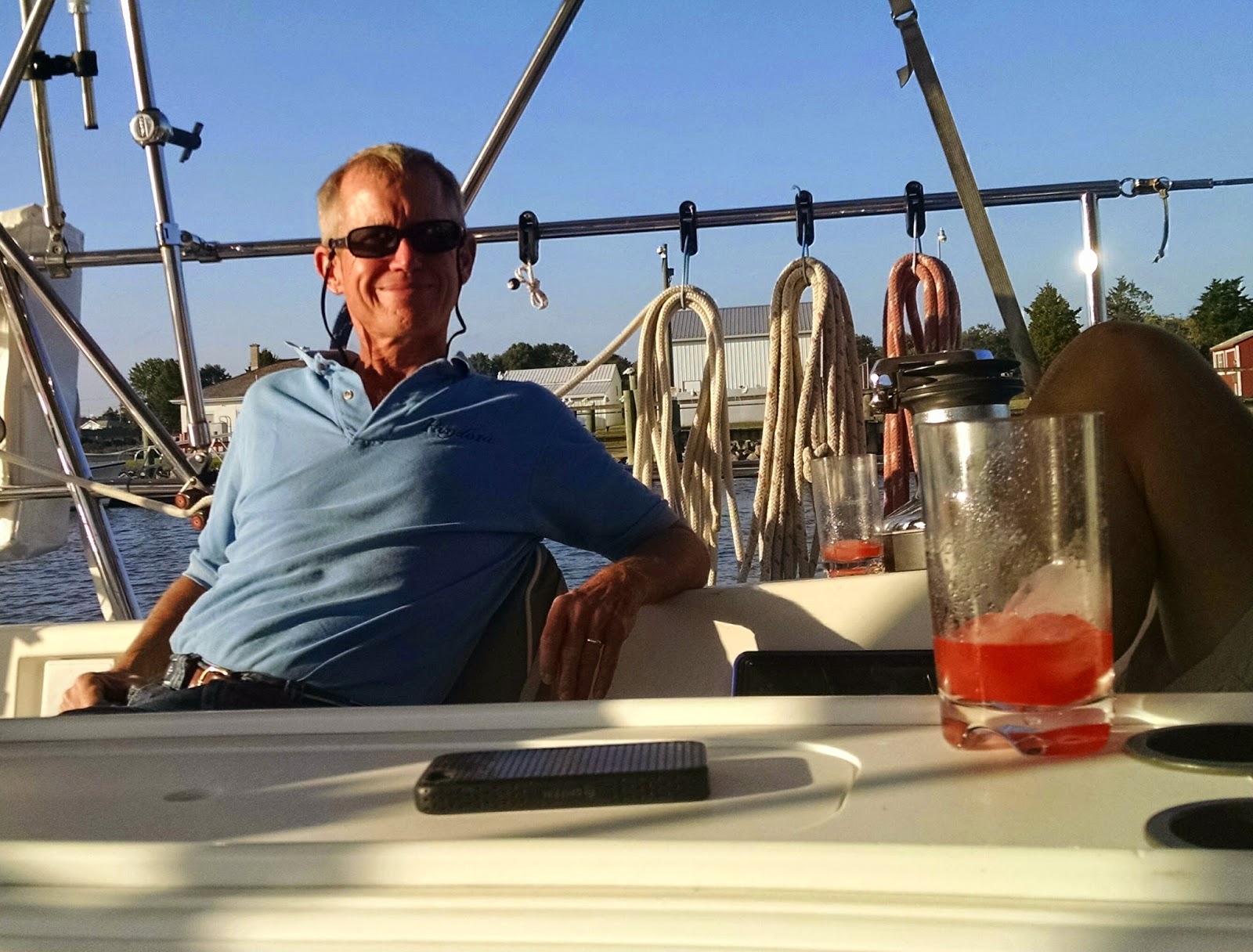
We met Katrina, from Annapolis, on the dock. She is aboard an Island Packet, "Sea Monkey" with her son for a week while her husband is doing his reserve duty. And while dinking back to ILENE we saw another Saga 43, "Remora," our first this trip, and introduced ourselves to the owners. More, later.

We have heard so much about this place from Dean and Susan of Autumn Born. They, as do many others, like to stay here for months. With a waiting period for a mooring, it pays to stay rather than give up your mooring to move on. A mooring rental of $300 per month is easy on the budget. This is not St. Maarten where egomaniacal big spending boaters go seemingly for the primary purpose of being seen by others. This is more a harbor for older and smaller boats. It has a "homey" feel to it. We will learn a lot more in the morning when the boaters all talk on a net on VHF 68 at 9 am.
Read More..

Directors Cut CRAB Delivery Skipper Freedom 21


Click here for information about CRAB (Chesapeake Region Accessible Boating).

It somewhat pains me to admit this, but Ive done more keelboat sailing over this past summer than dinghy sailing. Ive been volunteering at CRAB (Chesapeake Regional Accessible Boating - my long time sailing friend, Dick White, is sailing director there) and Ive been kicking around the Bay with various groups in CRABs keelboats, the Freedom 21s, which were designed specifically for handicap sailing.

The blogmeister had to make a singlehanded delivery of a Freedom 21 from the home-port of Sandy Point State Park down to Annapolis (the Freedom 21s were sailing in Boatyard Bar and Grill fundraising regatta off Annapolis that Saturday). I took my trusty pocket waterproof camera and shot a very short video of the 6-7 mile jaunt (including selfie).


I was delivering the Freedom 21 down to Annapolis for the annual Boatyard Bar and Grill fundraising regatta, where, as it turns out, US Sailing had decided to feature this years regatta, and CRAB, in this well done video.


The local Chesapeake Bay sailing rag, Spinsheet Magazine, captured the elusive blogmeister crewing at a previous Wounded Warriors Regatta.


Photo courtesy of Spinsheet Magazine


Read More..

October 21 23 Cape Henry to Yorktown and Two Laydays There 23 miles

The crossing was done by motor, all the way, without raising any sails, less than five hours. The wind was in our face but only five knots true, not enough to raise any waves. The only obstacle was this guy,
last seen in the sunset on the horizon from Cape Charles, who lay on anchor right on our course across the Bay. I caused another problem by accidentally turning off autopilot while trying to turn on the cockpit radio, which gave Lene a scare. The York River is wide and deep almost to its shores. We entered against the tide slowing us somewhat.

Yorktown County government runs the modern efficient Riverwalk Landing Marina here, which we visited in 2006 and 2012. We asked about staying on the outward side of the marinas floating dock (so easy to get on and off) but the friendly dock master said: "No way am I putting you there!" He was right. Both days we were here the wind howled, the river was filled with large whitecaps and the large excursion schooner, "Alliance", tied up on the opposite side of the dock from us, pitched up and down like crazy.
In fact I had planned to move to our next port on our second day here, and with the strong wind at our back and then at our side, we could have made it. But Lene and the kitties have had enough rough rides for a while and there is much here to amuse us.

The reasons we keep coming back to Yorktown is that our friends, Stan and Carol, live in nearby Williamsburg. I met Stan up at Cornell 52 years ago; he has been teaching at William and Mary for the last 36 years. They are such wonderful hosts and lend us their car, though which we provisioned and visited barbers and the drug store as well. They also shared with us two delicious home cooked meals, we took them to a French restaurant and we had mango-blueberry pancakes aboard with them and also did some sight seeing. Their home is decorated with the Carnival glass that Stan collects and the imaginative quilts that Carol makes.
I visited the Watermans Museum, located immediately adjacent to the marina, which is at the river side immediately below the cliffs where General Cornwallis surrendered to General George Washington, ending our Revolutionary War. Cornwallis surrendered after the French fleet under DeGrasse defeated the fleet of British ships containing the reinforcements that Cornwallis needed. The museum is housed in a large plantation house that was donated and transported to this site from the other side of the river on a large barge. Watermen are defined as anyone who makes his or her living on the water. As amateurs, Lene and I are not watermen. The battle of the Capes, which led to the end of our revolution is portrayed, as are piracy, fishing and shell fishing and wooden boat manufacture and repair. Here is the museums model of a fish trap,
also called a pole net. These run for considerable distances in an east-west orientation in the Bay. About half the fish that are brought up against it by the flowing tides will swim toward the trap and can be harvested periodically from the pen at the right. These traps are one reason to not sail in the Chesapeake at night. We came too close to one of them a few days ago, before turning away.  Running into this would likely damage both trap and boat.

I learned that a certain local Pirate, when captured and convicted in England, was fined 1000 pounds by the crown to be used to create a new school in Virginia, William and Mary. Thus unlike Harvard and Yale, which were funded largely on the basis of the profits of the slave trade, William and Marys founding moneys were the profits of piracy. I had only 90 minutes there and two docents latched onto me. Phil (wearing a "Tin Can Navy" hat) took care of me inside, followed by Bubba who filled my head with knowledge once I proceeded outside to the wooden boat sheds. Clearly, these knowledgeable gentlemen would have talked my ears off for several hours more if I had more time, which I would have enjoyed.

The next day, Carol took me to DeWitt Wallace and Abby Aldrich Rockefeller Museums of Art in Colonial Williamsburg, where I saw a lot of beautiful old quilts and wooden furniture, but found nothing  nautical to report to you.

Read More..

March 21 22 Lake Boca to the North Palm Beach Marina and Lay Day There 31 Miles 12 Bridges

We hauled our anchor at 7:15 for the 7:30 opening of our first bridge and motored all the way, tying up port side to, at this lovely marina at 2 pm. More mega houses (but this is not a real estate blog) and in Palm Beach, we saw the largest aggregation of mega yachts in one place since St. Maarten. This is another of the places where very wealthy people congregate. There is a boat show next week and this may have attracted some of the BIG boats. The last of the bridges, the Flagler Memorial in Palm Beach, was the site of the most congestion I have ever seen at a bridge: about thirty boats, half going north and half south, were traffic jammed near the bridge before its opening, trying to get through, one at a time, in the ten minutes that the tender allowed for the scheduled opening. We spent most of the passage with s/v Elle & I, from Vermont, a 35 foot Beneteau or Jeaneau. Alas, we never exchanged contact information with her people.
We missed one opening which cost us half an hour, because of my confusion. I made a list of the bridges, in consecutive order, with their names (because they wont answer your call unless you call them by name). I also figured out the distance between the bridges and the times between their openings such as some on the hour and half while others at 15 and 45 minutes after the hour. Most of the bridges open at such fixed times but some open on request. But some tenders try to accommodate boaters by delaying the opening for a few minutes while fast boats cool their heels, in order to let slower boats catch up, so both can get through with one opening and less disruption of automobile traffic. We were the beneficiaries of this practice at one bridge and the victims of it at another. These delays make it almost impossible to plan your speed between bridges since the time is shortened, but the distance is not.
North Palm Beach Marina was dredged out of the west side of the ICW and enjoys decent wifi and the best restrooms we have seen on this trip -- large, marbled, each with a large shower stall that does not drain into the drying area, a bench, lots of hooks and plenty of flow of hot water.
We had dinner at the restaurant of the marina with Erwin.
He has been such a huge help to me ever since I joined the Harlem in 1990 --Wow, that 25 years ago! The list of favors is so long that I couldnt include it here. But we talked about several of the prominent ones over dinner, including the time he spent two days taking the head off the Atomic-4 gas engine of my first boat, machining the surface smooth again and reinstalling it with gasket, all just days before a two week Club Cruise. He said he would help me but in fact he did the work and I handed him tools. Erwin was Commodore of the Club for an unprecedented two terms, organizes fund raisers for the club and the annual weeks charter in the BVIs, is an accomplished Bermuda racer and a master engineer, mechanic and designer of boating things and breweries. We had a lovely and lively dinner with him before he drove us back to ILENE.
Our lay day here was just that. We did a cursory washdown of the topsides and a shopping trip to Publix (with a stop at a discount hardware store - I would have spent a lot more there but most of the tools did not say "stainless"). We went via the marinas free taxi service. Other than that I didnt do much of anything but loll around.
On our way south we went outside from the Lake Worth Inlet at North Palm Beach to Fort Lauderdale, in a single day sail. But heading north we traversed a new part (for me) of the ICW with a stop at Lake Boca, and it took two passage days.

Read More..

May 26 to June 21 Its Been A Long Time with Little Sailing But

Normally the summer time is the busiest blogging time, but after 146 days afloat this calendar year before May 27, this is a decompression time. I do not feel the urgent need to get out on the water every day, not that nothing water related has taken place.

I have gone on two of the Wednesday afternoon sails with the Old Salts, the new name for the revived Old Farts. First on PC Marks "Deuce of Hearts", a catamaran, and then on ILENE.  Mark has been instrumental in reviving this group this year. Four people came the first time and seven the second (me, Mark, Mike, Richie, Dave, Morty and Clara). And the G and Ts are just as good as ever. Both days we were graced with moderate light wind after lunch at the Club. The food at the Club is a bit pricier than last year, and the portions a bit smaller (which is good for our health). The food is simply much better quality and better prepared. On ILENE we cut through the channel behind Stepping Stones Light where there was very light wind and we were near a run, before heading to the Throggs Neck Bridge and back to Hart Island before heading for home. The wind changed direction with the result that we only did one jibe and one tack.

I also had a pleasant afternoon with Ilene, and Bennett and Harriet aboard their Beneteau, "Ohana". She moved nicely in very moderate air. Come to think of it, we have had a lot of very moderate air for June. The four of us had a good dinner at the Club after, trying out our new chef, Ann, who does good things to food.

And I crewed for PC Mark on Deuce of Hearts
with PC Erwin, visiting from Florida, and PC and Ms. Bob and Laura in the Clubs annual Rear Commodores Regatta, which was set up as a pursuit race of slightly less than five miles.
Lene and I had won this race on ILENE back in about 2008, on a pursuit-destination race to New Rochelle with, miraculously, only one jibe. In a pursuit race, the handicaps are computed for the given course in advance and each boat starts at a different time, reducing the collision-inducing madness when several boats want to be at the favored end of the starting line at precisely the same time. So, if everyone sails as projected, all of the boats should arrive at the finish line at the same time. ILENE had the biggest handicap back then and hence started last and passed every other boat in the fleet on the way to the win.
Alas, this year we came in tenth of twelve boats because we made two mistakes. The first was not getting to the starting line until almost a minute after our time. Stuff happens and this has happened to me. The second mistake was using the small jib until the third leg of the triangular course. Deuce of Hearts is set up like ILENE, with a larger headsail set forward of the jib; it has to be furled between tacks. With the smaller headsail we were just too slow. Another great feature of Deuce of Hearts is that the tack of the big headsail is mounted on a track and can be moved to port or starboard  from the cockpit to catch wind without messing up the wind in the main. We were untrained crew and the PCs figured out how to use this neat trick, but too late. I think Deuce of Hearts has a lot of potential to be a fast boat on the race track.

Part of the reason for relatively little sailing was the visit by Lenes niece, Barbie, her son Trevor (who we hung with in Amsterdam last June) and Anna, a 16 year old exchange student from Denmark who lived in Barbies home for the school year. So we had five folks in our apartment and they made it very clear that their jam packed week in NYC did not include sailing. But we did see sailboats  -- at the MOMA -- Seurats pointillist masterpiece.

And there were several days of planning for the Club cruise plus a Club weekend excursion to Sheepshead Bay in August, and Club participation in the July 4th parade up the Hudson with a full wooden replica of "Le Hermione", which brought LaFayette to these shores and participated in winning the battle against the British fleet that was intending to re supply and reinforce General Cornwallis at Yorktown. When deprived of such aid, Cornwallis surrendered to General Washington, thereby ending the military operations of our war of independence.

And four workdays, pickling the water maker, which we will not need this year, cleaning out the refrigerators and the bilge, putting up the new plastic enclosure to the cockpit for measurement for straps to tie it up out of the way in the rolled up position when needed and snaps to mate it with the sides of the dodger. Finally I did work on the solid cherry batten that holds up the ceiling in the salon, to accommodate the new hatch screen enclosure.

And arranging some sail dates, sending back the new stainless steel snubber line hook which was replaced with a smaller one that fits and holds onto the anchor line, reducing the cruising area of our insurance policy to save money and other boating related chores.
Read More..

Deep River CT to Annapolis MD via the C D Canal September 18 21 on Pandora

Last time I sailed Bobs Pandora, another of the Saga 43s, was in 2011, from Norwalk CT to Mystic CT. (See "Local Peripateticms", posted July 3, 2011). That was our boatless summer while ILENE was on the hard in Grenada. This time, it was the start of Bobs trip south where we may meet up with them in Florida, and so the trip was a rehearsal for our making the same passage, early in October, aboard ILENE.

For this trip we were joined by Jim, who has more ocean experience than both of us, and is a very personable guy. Bobs idea was that his wife Brenda, should join him part way to Florida. This put Lene of the same mind: Why cant we do that too? Luckily, Jim has agreed to accompany me for this first leg of ILENEs cruise, next month, so Lene and the kitties will drive down and join me in Annapolis. Jim recently sold his Saber 38 foot and thinks he wants to buy a Saga; wanted to find out how these boats feel in the ocean. He got half of that experience on Pandora -- the motion she has when the wind is aft the beam. Yes, with excellent weather forecasting by Chris Parker, and a willingness to change our departure date twice, we had a perfect weather window, with following winds and seas except for light winds the last seven hours, the second short leg, from the anchorage in Chesapeake City, MD to Annapolis, where Pandora now rests in Jims slip. ILENE was also offered the use that "free" slip upon our arrival except that the condo has a very strictly enforced rule against pets, including guests pets and including cats. So we have made reservations at Bert Jabins Marina, across Back Bay from Jims place. This is where ILENE was when we bought her, back in November 2005. If we get so lucky with a weather window on ILENEs passage as we were this time, I will simply turn the boat around for a few minutes, so Jim can get the feel of a Saga beating to windward.

We left the dock at about 4 pm on Thursday. I had the helm down the Connecticut River into Long Island Sound passing old favorites that we did not visit this summer: Hamberg Cove, Essex and North Cove of Old Saybrook. We headed  a bit to port to pass through The Race and around Montauk Point, making the rounding at about 11:30 pm. My nighttime off-watch preference was honored -- from 8 to midnight, when I am at my most tired condition. So I awoke after we had rounded and had reefed the main. From Montauk to the buoy off Cape May, NJ, which we rounded at about 11:30 the next night, it was 198 nautical miles. The furthest we got off shore was a point about 35 miles south of Long Island, the same distance east of the Jersey shore and about 45 miles SE of the Verrazano Narrows Bridge.
 
The scariest part for me was as we were rounding Cape May:  I had just risen from my good sleep and my lack of familiarity with Bobs newer chartplotter, with many more functions, meant I really did not know where we were. Bob stayed with me until we got up to the clearly marked shipping channel up Delaware Bay and I hugged it, just outside its north side, all the way up the Bay, giving the big freighters coming the other way the entire width of the channel.

Thursday night it was quite cold but no so bad that a long sleeve shirt, fleece and foul weather gear were insufficient to be comfortable.  The second night was not so cold.  We all wore life vests with harnesses and were tethered to the boats strongpoints whenever in the cockpit. Bob figured that we averaged 7.1 knots which is quite impressive. Much of this time, during daylight hours, the winds were strong and we furled the small jib and ran under only the reefed main, at speeds of up to eight knots.
The wind built up the seas, which raced and overtook us from behind. The bigger ones were over my head standing in the cockpit, until they caught us and lifted us up out of their way while whooshing under us. A couple of them entered the cockpit from the rear, over the swim platform, which is only about 16 inches above the water, putting a few gallons on deck, which drained out immediately over the same open stern that admitted them. When my sneakers got wet during the first such wave, I switched to a dry pair of socks and my sea boots so it was no problem.

Here is  sunrise over the west coast of New Jersey, Saturday morning as we were sailing up Delaware Bay with the tide.


Bobs boat is meticulous and fully equipped. He is a self confessed obsessive perfectionist when it comes to his boat and it shows. When we stopped to refuel, Pandora got a washing. The dew was mopped up the next morning. Here is Pandoras new Rocna anchor, rolling on new rollers attached to the shiny new apparatus. It hangs lower but further aft than ILENEs starboard bow anchor.
Jim with a bit of the rum punch.
It held very well in the mud of Chesapeake City.  We stayed there from about noon on Saturday until our 07:00 departure on Sunday morning. We toured the tiny quaint old town, partook of some free food and wine at a wine and food festival, ate ice cream, tried to visit the museum (but it is closed on weekends), took naps, enjoyed some rum punch and had dinner ashore.
Bob with same.

One always learns from sailing with others on their boats. I also learned and have downloaded to our I-pad, a much better weather app called "Pocket GRIB".


We were very well fed throughout, (Thanks Bob!) including delicious boat baked dropped biscuits and honey with our morning coffee.

The only thing that could have been better for me was visibility.  Bob likes to keep the dodger front closed, and connected to the bimini with side flaps down when sailing. Despite excellent new clear plastic, this impeded visibility due to my older eyes. It required me to poke my head out the sides to check for approaching vessels. Also with the RIB inflatable dinghy inverted, mounted under the boom, partially deflated and lashed down securely there, while safety was improved (no chance for one of those big waves to fill the dinghy with a ton of water hanging off the back of the boat), forward visibility was further impeded.

The captain/owners decision is always right, but my personal voyage would have been even more enjoyable with better visibility.

I know that Ilene will want one of these customized non skid floor mats. It is not a rectangle but wider at the foot than at the top, to match the area covered. The only potential problem with this is that the cats will like it too -- as a scratching pad! Now back to myriad activities to get ILENE ready for her cruise.

Read More..

November 20 and 21 Overnight from Hilton Head SC to Fernandina Beach FL 102 NM

Goodby Hilton Head.


The only tricky part of this passage was at the beginning. South is to the left on this chart:
The deep water is shown as white and shallower is blue. We came from Hilton Head (the knife point) through Calibogue Sound and then had to cross over through blue water to Tybee Roads, the entrance to the Savannah River (beside the fork). The Roads is well marked by red and green buoys (purple dots to you) on the passage to the sea, lower left. But not many buoys in that blue water and some three foot depths. The fact that the sands shift make the chart not that accurate and we went at low tide so this was the scary part but we never saw less than ten feet of water.
The annoying part was how totally wrong the weather forecast was. Lene has become a bit obsessed about checking many sources to get it right and they all said the wind was from the northwest, behind us, but only five to ten knots, so we expected to need the motor, reduced our planning speed, left at 11 am instead of three pm and planned to get to the breakwater of the St. Marys River just after daybreak the next day. But the wind was much stronger, 15 to 20 knots, and from 220 degrees, the very direction we had to go. We played with tacking for a few hours with main and small jib, making great time but not in the right direction, so the remaining distance to the entrance was not diminishing much and the time remaining to get there on these courses would get us there in the late afternoon of the next day. So we furled all sails and motored directly into the wind, with each wave reducing our speed when the bow slammed back into the water after being lifted by the oncoming seas. No heeling, no rolling, just pitching and slamming.
During my after-dinner off-watch, 7:30 to midnight, the seas laid down a bit, increasing our speed. When I relieved Lene, the winds had come far enough westerly, the predicted direction, that we could sail, close hauled. But I was not about to try to put up the main in the dark, alone. So shutting off the engine I only used the genoa and it gave us, at various times, as little as three knots and as much as six, which was enough. The long and the short of it is that we turned into the St. Marys River entrance and Cumberland Sound, about 15 minutes after daybreak. It was cold, no moon, lots of stars in the clear skies. Sunrise:


Our choices at the end were threefold: north to an anchorage behind Cumberland Island, west up the St. Marys River or south to Fernandina Beach on the back side of Amelia Island, whose paper plant runs day and night and lights up the area at night for miles.
We chose Fernandina because our friends Dean and Susan of Autumn Borne were here, but plan to visit the other two locations in the next week. We took a mooring, our first mooring since we left the Harlem on October 8, grabbing it at about 7:30 am. The next hour, before breakfast, was devoted to putting away all of the stuff needed for an overnight passage and lowering and pumping up the dinghy. We are in FLORIDA at last! But it is still cold.

Well what to do all day? Lene liked the idea of my going ashore and leaving her with the kitties. On our way through the entrance from the sea we passed Fort Clinch on the northern tip of Amelia Island. A good place to explore, but, I was to learn that it was a far piece. A little more than a mile eastward on Atlantic Avenue, which runs the width of Amelia Island to the Atlantic,and then, after entry to the State Park that contains the fort, three more miles north through beautiful woods with nature trails, camp sites, observation points, a fishing pier and bike trails. I hitched a ride after about half a mile, with a man who it turns out is a park employee.
The fort, like many, was built after the British had bombed our cities in the War of 1812, but unlike most of those in the northeast, it was the scene of historic events, though minor ones, in later wars. It has a commanding position at the mouth of the St. Marys River, through which we had sailed this morning.
It was not quite finished when the Civil War began and the Union Army scrambled to try to get it ready but it was taken by the confederacy, without a shot being fired and surrendered to the North by General Lee, who gave up all of Florida to concentrate his forces in more strategic areas elsewhere. Fearing attack by the Spanish, it was again prepared, somewhat, during the Spanish American War, but that was the type of war we have sought but not obtained ever since: a decisive victory and over in a few months. So Fort Clinch was again not ready in time, and also, the Spanish were in no position to attack. And it was a Coast Guard observation base in the World Wars. It became a State Park and the fort was restored somewhat by the Civilian Conservation Corps, during the depression.
You can see the larger bricks in the lower half of the construction before the Civil war, with the second story added later of smaller bricks.


What made the visit memorable was the performance of Henry Work, a talented artist, in costume as a non-combatant who showed us arms, the infirmary, the storehouse and played the fife. He is a volunteer and has also volunteered to do such a gig at the fort in the Dry Tortugas if the National Park Service accepts his generous offer. I hope they do.


I got to talking with fellow tourists, Norma and Pierre, a retired couple from Montreal who tour the US almost six months each year in their truck drawn trailer. Such nomads are a lot like us, driving land yachts, sharing camaraderie and information with fellow travelers but unlike sailors, they can see the interior of the nation too. They drove me to see their campsite ($25 per night, compared to our mooring at $20) and then back to the marina, where I dinked back to the boat after buying fish, per the Admirals orders.


Aboard were Dean and Susan who had brought a bottle of red. We spent a pleasant few hours together before each couple cooked its own dinner on its own boat.


.


Read More..

October 10 21 ILENEs Floating Season Ends

All good things must end. Having lived aboard during the first 146 days of 2015, during last winters Florida adventure, 2015s boat days will be a good number. (See next post.) The twelve day period reported on in this post saw (A) ILENEs final three sails, (B) four work days and (C) GOC.
Lets start with the sails. One was with Rhoda and Lloyd, of the Harlem. We have sailed with many times in the past. We were underway about four hours, and I confess that due to poor note taking, the wind and our course regrettably escape me.
Next was with four residents of my apartment building. I started out planning to sail with Dorothy, who is a fellow client of our personal trainer. That morning he mentioned that another couple in our building who trained with him, Mort and Rollie, had said they would like to sail some time. "Call them right now and ask about today; we leave at noon!" He did and they are in! But Dorothy was not feeling up to it today and requested a rain check for next season. "Sure." And now, including me, we are down to three souls. But on my way back to our apartment I saw Max, who shares a wall with us; he is in the next apartment.  He had to check with Ellen and two minutes later, my bell rang and our party had grown to five. Max purchased a picnic lunch for us all and we ate aboard, before getting underway -- while waiting for wind. Then there was only a ghost of wind, but it built, out of the north, and we got almost to Execution Rocks before heading back. We enjoyed four hours underway and three of the four guests took a turn at the helm. Mort is a professional oenophile who praised the bottle I served aboard and brought another to my apartment to replace it. Rollie, Mort, Max and Ellen:
ILENEs final sail of the season was also the final gathering of the Old Salts, including several of the regulars, and two special guests. We were underway for 3.5 hours, and got about a mile past Ex. Rocks, peaking at 7.4 knots. This was rather amazing given how foul ILENEs bottom was. (See below.) Thanks, Larry, for the next two photos. Here are Dave, Marti and Marcia:
Next is Dave, doing what racers do: checking the sail trim, with Art at the helm
Readers of this blog will recall Marti, who I have named The Goat Lady of Grenada. She has a long history of animal care and is volunteering there to help raise goats to develop a chevre cheese industry. She showered us with such great hospitality there during 2011. I had known that she was coming to the Big Apple for a visit and saw that she had arrived via a Facebook posting. It turns our she was staying in a friends apartment only a block away. I did not have her phone number but instant messaged her at about 10 a.m., and picked her up an hour later. She fit right in and has the ability to do that wherever she is. Our other honored guest was Dave, an excellent racer and now in charge of qualifying members who want to use the boats that the Club owns. I have long desired that he sail on ILENE, figuring I would learn something, and I was not disappointed.

With Lene in Israel, I had no date for the Clubs annual end of season gala, and Marti was able to gin up a suitable outfit despite having left all her dressy clothes in "The G," as she calls Grenada. It was a cool Saturday evening, warmed by the camaraderie of our members. Memorial plaques were set in the flag pole base for Al, a loyal Old Salt who moved to Florida two years ago, Tom, whose death I had not heard about, and Vinny, who I sailed with up the Hudson at the end of the season, perhaps ten years ago. The cocktail hour was long and delicious with good quality wines, and the sit down dinner was also great except for the perennial problem we experience: our kitchen is just not adequate to serve that many people at the same time. Our servers brought eight plates at a time to serve all the people at one table at the same time, but the last table was not served until amore than an hour after the first. The trophies to the winners of the races were duly warded. As Fleet Captain, I described the highlights of the Clubs cruising activities, thanking Bruce and Diane for designing the Club Cruise itinerary. I regret that I forgot to summarize the Old Salts season and to thank Mark for his help in reinvigorating the group.

(The next day was chilly and I escorted Marti on a tour of lower Manhattan via rented CitiBikes, my first experience with this program. I got an appreciation for the problems of cyclists in the City, with the paint marking the bike lanes significantly worn away and motorists infringing them even when marked. The thirty minute time period causes tension - finding the docking stations, though they let you take another bike two minutes after you drop off the last. We used three bikes to get from Tenth St to the Brooklyn Bridge and Chinatown, to the Hudson and Freedom Tower and back, stopping for a warming lunch in Chinatown.)


The first of the work days was the Clubs annual fall work party. I got enlisted into a group of four who painted the yard car,
by which boats on cradles are transported around in the boat yard (parking lot). After about twenty years of service it looks like new. I love these work parties because you get to know people who you only vaguely recognized before. And a delicious free lunch is always served.
Having loaded the two pieces of ILENEs canvas winter cover from the locker to the cart to the launch and to the boat, I motored from the Harlem to the Huguenot, about five miles, in no wind to speak of, entering through the western passage, passing the NYACs club house. After docking I stripped and bundled up the two headsails and removed the battens from the mainsail.
Next day I stripped off the main and after tying it to itself, heaved each of the three huge sail bundles from the boat onto the dock. Then they are, one at a time, lifted into a dock cart, wheeled about 150 yards to the parking lot, lifted into my car and driven to the Doyle sail loft on City Island, for repairs, cleaning, proper folding and winter storage. That same afternoon ILENE was lifted from the water revealing the terrible condition of her bottom.

Keel is bearded! Too many sandy landings in the last 18 months.
But power washing by Orlando and scraping that I did cleaned it off and she sits blocked and steadied by jack stands. Some of the black bottom paint is completely gone, with the blue paint underneath showing through.

The fourth work day, five hours, began with an inspection of a blasting of the bottom paint using tiny glass particles (except for the aft portion that I barrier coated two winters ago). David, using a powerful air compressor, did the forward three quarters of the hull in two hours for a very well spent $1175. Based on how long it took me to do the back end two winters ago, I saved about 25 days of back breaking, dirty and dangerously unhealthy work. A bargain. A photo of the newly white bottom will be added to this post soon. That same day I tried to winterized the engine, air conditioner, heads and fresh water system, which was very frustrating, because I had done this in the past but kept getting stuck. I also removed the lifelines and stanchions and rigged the "ridge pole" for the canvas cover (whisker pole, boom and a board from the aft end of the boom to the radar arch) in preparation for installing the cover. The next post will describe a sail from Essex CT to Hampton, VA, which kept getting delayed by equipment problems and weather. Many work days are ahead.

Read More..