Tampilkan postingan dengan label last. Tampilkan semua postingan

May 12 13 Last Two Lay Days in Washington No miles

No, not a Maritime Museum. This is one of the fishing boats used by the Danes in WWII to smuggle most of their 7000 Jews into neutral Sweden. It is one of the many artifacts in the United States Holocaust Memorial Museum.
I spent a whole day (10 to 5:15) here and did not see it all. Designed of the same beautiful pale yellow stone that is used in most other government buildings in this city, the interior has a long atrium around which the horrible history unfolds, as one starts on the fourth floor and works ones way down. This atrium is glass covered and reminded me of a railroad station  -- such an integral part of the Germans "Final Solution". I have been to such museums in NY, Jerusalem and smaller ones in many other cities but none that were as comprehensive, with a significant slant on US responses before, during and after the war. It showed how gradually Hitler came to power, consolidated his power and set to work first trying to drive the Jews out by making life unbearable and dangerous, then deporting them and finally, exterminating them. One huge wall of etched glass, has the names of the numerous European towns where Jews lived before Hitler, including my fathers birthplace, Untergrombach, middle row, right, with my imagined "RR Station" below.
The place was very crowded with lots of high school kids who were very respectful. I was quite moved by the experience. The museum repeatedly discussed the plight of the Roma (gypsies) and other victims. It also had exhibits on the three post-Holocaust genocides: Cambodias killing fields, the Serbo-Croation conflict and Rwanda. It seems humanity has not learned yet, despite the saying "Never Again! We had lunch in the museums cafe, located in a small building outside the Memorial.
Our final day was for Congress and the Library of Congress. We had planned to visit the adjacent Supreme Court as well. I had to be admitted to its Bar to oppose a Petition for Certiorari  in the late 70s. (Since about 95 to 99 percent of such petitions are denied, winning that one was rather easy.) But our tourism stamina gave out before we got there, which was a shame because Lene has never been there. On our way we passed the Frances Perkins Department of Labor Building.
Ms. Perkins was one of FDRs "brain trust" and the first female Secretary of Labor. She co-taught a seminar in labor history I took at Cornell in about 1964.
In 2008 Congress opened a huge underground entrance, visitors center, "Emancipation Hall," with Museum, gift shops, a large cafeteria and many restrooms to handle the throngs of tourists. We were shown an inspirational movie about how well Congress works, which is somewhat of a joke given todays hyperpartisanship. Leah, our assigned
tour guide was energetic and bright with the kids but the tour did not include either house of the Congress. We easily secured a pass to visit the House, which was in session, but just barely. The person acting as speaker recognized a stream of Representatives who rose to give speeches of up to four minutes. It was mostly women in red suits on the Democratic side and men in blue suits on the other side. Several democrats spoke in favor of refinancing the Highway Trust Fund and opposing yet-another bill to restrict abortion, which the Republicans are addicted to and will undoubtedly pass. The Republicans spoke in favor of the anti-abortion bill and in memory of slain police officers. They all spoke to an almost empty room. The speeches go into the Congressional Record and are fodder for the folks back home. "See how I represented your interests!"
After lunch we visited the Library of Congress through an underground tunnel which avoids having to go through security again. Our first time here.


The entrance hall reminded me of The Hermitage in St. Petersberg, with its staircase, marble, red, statuary and grandeur.


The main reading room is much smaller than the one in NY but more elegant.
A highlight of my stay here was a visit to the Geography and Map division, where I was given access to their collection of nautical charts published by the United States Navys  Hydrographic Office from about 1850 to 1950. The charts are numbered, to about 6500, with some omissions. I have been studying them and cataloging them, as a volunteer in the Map Room of the NY Public Library for about seven years now. They describe the coastlines of the world (excluding the U.S. and the Philippines which are the subject of a similar series of charts published by the Coast Guard. Each branch of the armed forces had its champions in Congress and back in the 19th century they worked out this geographic compromise.)  I had a good conversation with the director of the map room who invited me back. Maybe, by land, some day.
I also saw a German antiquarian map of the world, in Latin, published a few decades after 1492, purchased for $11,000,000 (less than half of it taxpayer dollars), an exhibition of Herblock political cartoons, and a recreation of Thomas Jeffersons circular library of Monticello (he sold it to the government) with mostly his original books. He was a well read man.
Read More..

Last Stop Amsterdan

Four days here in Amsterdam, after leaving Celebrity. Mike had arranged for an apartment at 402 Singel.
Singel is one of the rings of canals in the fashionable west side of town. An even house number so it is on the west side of the canal, very close to the main drag on which three of the trolleys run from the main station.  Most of the streets are one lane wide and one way, but are traversed both ways by many bikes and motor scooters.
So you have to look both ways, carefully, before stepping off the curb.

Here a treat was that we were joined by Mike and Lindas grandson, Trevor, from Austin via a year abroad in Spain for his sophomore year of High School. The only problem was the injured list grew worse. Mike and Linda flew home to get care for Lindas wrist two days early and Ilene was feeling punky too, maybe bronchitis, so we were not as active as other we would have been.

One nice thing about cruise ships: they visit port cities. Pretty obvious but important to a water lover. Amsterdam moves on its canals, like Venice, except here freight moves by land rather than exclusively by canal boat, and here they do have a land based trolley system rather than rely on the vaporettos --canal bus-boats -- for passengers.

They have a museum of canals, which I visited, -- flying the Amsterdam flag, not the Red Light District flag, despite its XXX appearance.
It spoke about how planned the city was and how it expanded in planned stages, with walls built around it before each new expansion, walls that are useless in the face of modern warfare. The drive to the airport with our driver, Abe, shows that most of the city is now outside the walls. But most tourism remains within. This museum also showed how the houses were built on platforms mounted on myriad pine pilings, imported from Scandinavia, reinforced  (recently in the long history of the town) with cement filled steel piles. So too did the Harlem YC have to be reinforced during the early 90s. It was very cleverly done with visuals shown against the sides of model houses and internal projections inside the windows of a big doll house to show life inside such a house. But this museum, only two blocks from our apartment, was ultimately more about the houses than the canals themselves.

More instructive as to the canals was a boat tour ride, about five miles in a counterclockwise loop. The canals have no tides, the city being separated from the sea by locks and depth is  7 to 15 feet. The annual fee for a canal side tieup for a small boat is very inexpensive but if you want to live in one of the many houseboats that line some of the canals, you have to buy one; there is no more space available.


We boys strolled about the red light district in the evening which I found garishly unpleasant with coed mobs roaming the streets, Dam Square with the City Hall, left, and its adjacent cathedral,center,


the courtyard of the Beguins, a community of religious Catholic women who wanted to live together but not to become nuns,


and the Van Gogh museum.  None of these had any watery references. Though I did see Van Goghs painting of this bridge. or one like it, that we passed under on the canal tour.


Better luck, for those interested in things nautical, was at the Rijsmuseum,


which was built late in the 19th century and recently reopened with the courtyards  covered


which provide spaces for this Calder which was being assembled while we were there.


It was built as a secular cathedral to the art of the Dutch rather than for religion. Nice library, restricted for scholars.


Off to the side of the great hall filled with famous works by Rembrandt, Hals and Vermeer was a salon of naval scenes.
I learned of the antagonism between the two great rival trading nations of the day (the 1600s). We all knew of the British taking of New Amsterdam from the Dutch West Indies Company. But I had never known of the context of the larger war including the Dutch Attack on Chatham. They sailed up the Medway, a tributary to the Thames, near its mouth, and blasted the heck out of the town and the British fleet at anchor there. There is so much non-American history that I did not know about.

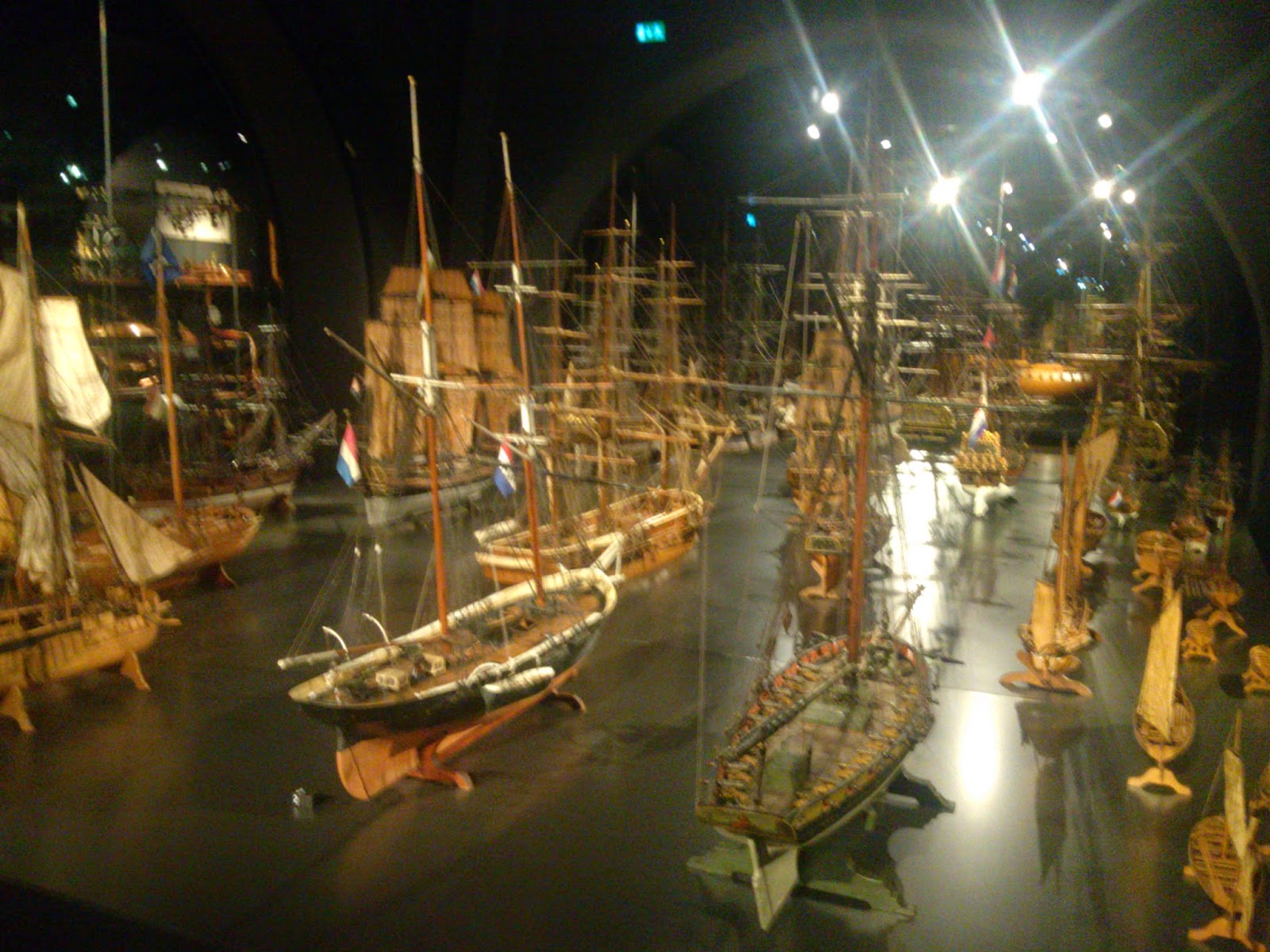
They also have a nautical room in the basement with models and artifacts related to the sea.

A highlight of our visit was the Anne Frank House where we waited on line outside for about 80 minutes, along with a horde of others who felt this was an important place to be visited.
I was moved and now have added her diary to my reading list. I learned in the canal museum that Anne Franks family had lived next door to us at 400 Singel until they went into hiding.

Trevor is really a great kid, who patiently stayed with me in the museums, most of the time. Except for his eating habits. He is the third generation (at least) of Whitmans (with Ilene the sole exception I know of) who lets just say do not have adventurous palates. So Rijstaffel (rice table -- an Indonesian delicacy from when the Dutch East India Company owned that area of the world) was off the menu. Our apartment had a kitchen and we cooked a few times and no one went hungry.

The flight home was uneventful. And now for some real sailing!!
Read More..

Last Winter 230 Days A Compilation

Avid readers of this blog (are there any?) knew that this post was coming. It is based almost entirely on information contained in the 91 posts that described our activities during the period October 7, 2014 to May 26, 2015, compiled for statistical purposes.

We devoted about 1.5 months transiting from City Island, NY to the northern border of FL and the same amount for the return trip, with the remaining 4.5 months in Florida, almost two thirds of the 7.5 months total.

We made 85 passages. These took 89 days because a few were multi-day passages. This means 141 lay days. So on 61% of the days we just stayed where we were. The longest stay in one place was in Ft. Lauderdale, 17 days between five on our southbound and 12 on our northbound stops there. Though given the number of places we stayed in Miami (Miami Beach, Coconut Grove, and on Key Biscayne, all in Greater Miami, we spent 24 days there. And we stayed in many places only overnight, with the longest number of consecutive passage days being five, from Portsmouth VA south through the Dismal Swamp to Whitaker Creek, Oriental, NC.

The furthest ILENE got from City Island was Marquesa Keys, an uninhabited atoll about 25 miles west of Key West. This was 1063 miles (all miles are nautical miles unless otherwise indicated) from City Island, as the crow flies, for a crows round trip of 2126 miles. But we cant sail as the crow flies -- over land -- and we made several side trips up rivers such as to Jacksonville and Washington DC. So our total mileage for the round trip was 3561.5 (equal to about 4095.7 land miles). Average mileage per passage was 41.9 miles, ranging from 268 miles for the first passage, from City Is. to Annapolis MD, to only 1.5 miles from an anchorage at the south east corner of Coconut Grove to the Coral Reef YC, in the NW corner. And the median mileage per passage was only 34. Of the 89 passage days, only 22 were outside, in the Atlantic, though another twelve were in Chesapeake (11) and Delaware (1) Bays, where, with a little luck, one can sail. All the other 55 passage days were in the ICW or on rivers, where sailing is an iffy proposition at best. In fact, the lack of opportunity to sail is the biggest drawback to Florida as a cruising destination as compared with Maine, the Bahamas or the Caribbean. And we were underway for 577 hours, thus averaging 6.1 knots of speed overall.

Destinations: by State:
New York.         1 (City Island)
New Jersey.       2. On the way back
Maryland.          9
DC.                    1
Virginia.             8
N. Carolina.      11
S. Carolina.        6
Georgia.             4
Florida.             31
This adds up to only 73 ports, rather than 85, and the difference represents arrivals in the same port for a second or third time. And significantly, 57 of the ports we visited were "new" ports to us, with the other 16 being places ILENE had visited on prior cruises. In my opinion a new port is many times more challenging than a return visit.

How did we attach to land?
Five nights were at sea - overnights, with no attachment.
Of the rest, 38 were on moorings, 89 were on our anchor, and 98 were at docks. Unlike the kitties who see docks as roaming opportunities, we prefer less docks and we could have had a few less dock nights except for rough weather in some places and the desire for electricity to get heat in others.  Our stops were as different and varied as a few hundred yards off the back side of Miami Beach in the middle of a bustling harbor, to quaint towns like Swansboro NC, and anchorages in tidal creeks where we saw no one and beside islands in the Atlantic such as Rodrigues Key. So it never gets boring.

Dining?
230 days makes for 690 meals. Altogether, 140 of them, about 20%, were taken off ILENE, some on other boats, some in friends homes, but off ILENE. But we had the most dinners off - 88, and only 31 lunches and 21 breakfasts. Our grocery bills exceeded our restaurant tabs

Our ashore activities, in addition to cleaning, shopping, cooking, laundry, haircuts and the usual activities of life maintenance were many and varied:

The Annapolis Boat Show
Sightseeing by auto on Islands in the Chesapeake off the Eastern Shore
Stand up paddleboarding
Car tour of a proposed bike tour
Fast Ferry to the Dry Tortugas and visit to Fort Jefferson there
Evening lectures on Dorothy Parker and on the history of Miami Beach
Snorkeling from a catamaran on a reef off Key West
Concert  by band led by Cab Calloways son
Power boat ride through Miami Beach harbor
Sabbath prayers at synagogue near Fort Lauderdale
Hospital visit to Lenes cousin Naomi with broken pelvis
H.S. Class Reunion (Lene only)
Radio controlled model sailboat racing
College graduation at St. Marys College, MD, because we were there
Tour of monuments on the national mall in DC
Tour of the Capital building and the Library of Congress
One science museum
Twenty seven history museums
Six art museums
Six art gallery tours
Four maritime museums
Three hospital, doctor or vet visits
The Kennedy Space Center
Universal Studios
Two wildlife preserves
Three botanical gardens
Five beaches
Twelve movies
One ballet
Four live plays in theaters

Lene read 30 books and I read ten,

And the best thing about Florida is the number of friends who we met along the way. I counted 28 persons or couples who we had the pleasure to meet on our travels, several more than once, such as going south and coming back. Some we met both in Florida and at their summer homes in Maryland. Connections included family, grade school, college, the navy, work and of course, boating. Nine of the 29 are current or former members of the Harlem Yacht Club. None of our other sailing trips came close in providing access to people from home who you know.


Read More..

February 8 10 Last Three Lay Days in Key West Zero Miles

We ended up with eleven days in Key West or west of here and found we liked a lot in this town. Ilene was here in the late 70s and fondly remembered snorkeling on the reef a few miles south of the Island. We were told that, running from Miami to here and beyond, it is the third largest coral reef in the world with Australias being first and I dont know about the second. And we have had remarkably little time in the water and no snorkeling since October due to coldness, dirtiness or windiness. We booked passage on the catamaran Sebago,

with its severely raked 70 foot mast. Captain Neil
took her out to his mooring near but not on the reef. Anchoring would destroy the coral. Neil is from Zimbabwe, married to a Kentucky girl and has lived in Key West for 18 years. I enjoyed talking with him during the ride out and back.
Sara was the cruise director who welcomed the 30 of us, took care of us and taught folks how to snorkel and poured the wine on the trip back. I regret I did not take her photo earlier, before her sweatshirt blocked the view of her lovely bikini.
The snorkeling was fun though not nearly as luxuriant of fish or corals as several sites in the Caribbean we have visited. Im thinking that we saw about eight species of tropical fish including the brilliantly multi-colored parrotfish. And one more species. About 2.5 feet long, round in the body, about 4 inches in diameter and silver colored with a down turned mouth: yes, barracuda! First a pair and then a single one later.


I visited the old Custom House, near Mallory Square,
now the museum of art and history. The new Custom House is part of the "Post Office -- Customs house - Court House" which looks to have been built in the 1930s.
The museum had a lot about Hemingway and fishing, but I stayed with the history section in the little time I had available.  For one thing, Flaglers railroad, now the bed of Route 1, operated  only from 1912 until it was washed out by the hurricane of 1935. It being the depression, a lot of folks were put to work on rebuilding it as a roadway for cars and trucks, which was completed by 1938. Flagler, former partner of John D. Rockefeller, had to borrow money to complete his Railroad and never came to Key West again after the gala opening, dying at his mansion in Palm Springs a few years after that.
And the USS Maine
which was sunk after an explosion in Havana Harbor, had followed a familiar route: From New York, where she was commissioned in 1895,  to Key West to her last port, Havana, in 1898. She was 324 feet long, with a beam of 27 feet and her maximum speed was only 17 knots. Hammerbergs figures were 306 in length, 30 wide and she could do 30 knots, albeit for only a minute, all out, with most everything shaking itself to bits. Only 91 of her 350 men survived, some of them in being nursed in hospitals in Key West.

Dinner at El Siboney, Cuban and named after a native American tribe. It was such a lovely evening to stroll back to our boat across half of the west end of this island; warm but not hot, groups of folks walking peaceably, music wafting out from bars and private homes. Our menu selection was a mistake, however.  Or was it?  Paella Valenciana. It was quite tasty but it required an order for two ($42), with an hours advanced notice, was the most expensive item on the menu by far and is not Cuban. The problem was that they served enough for six people! So we had our next two dinners from doggie bags. Six can dine for $42; quite a bargain!
We took in the sunset at crowded Mallory Square and saw the schooner Hindu sailing out through the sunset.

This was followed by an inexpensive dinner at Carolines, at Duval and Caroline Streets, a block from this landmark.
Amazing how many of the places have live music, blaring out into the streets.
I toured the USS Ingham, the most decorated Coast Guard cutter in history. Launched in 1936, she was not decommissioned until 1988, 52 years later. She was well served by her officers and crew, and better still -- lucky. The Maine was not lucky! Hammerberg (only very slightly smaller) lasted only about 20 years and was constructed very cheaply. I had not known this but Coast Guard cutters were used like destroyers on convoy duty in WWII. Ingram killed a German U-boat and was then reassigned to the Pacific. With her 5 inch 38 gun,
she also served off Vietnam and helped save lives during the Mariel exodus from Cuba. The familiar, pleasant, characteristic odor of a naval vessel remains in her, 79 years after her birth!  She served as McArthurs flagship in the Philippines, which may account for her uncharacteristically large Captains quarters.
 I searched for the Sonar School I attended. I learned that it closed in the late sixties and its function transferred to San Diego.  Only the air branch of the navy now occupies the island. The MP guard was very polite and interested in my story but no one is allowed on the base without active duty military ID.  Later I learned that when the navy left, the building had been torn down.
My navy friend, Hugh, inspired by my burst of nostalgia, posted an article with photo on Facebook about how he and a sonarman won the Key West inter-service sailing regatta of 1967.
Walkng through town as we did daily we noticed a sign on St. Pauls church on Duval announcing that the Friends of the Library were having a speaker, David Garrard Lowe, on Dorothy Parker, the acid penned female member of the Algonquin Club between the world wars. I love that sort of thing and we went and enjoyed the lecture. "Every morning I brush my teeth and sharpen my tongue." Or maybe you will like this one better: " If all the women who attended the Yale prom were laid end to end, it wouldnt surprise me a bit."
Next day we visited the Tennessee Williams Exhibit at the Gay and Lesbian Welcome Center. He was born in Mississippi, educated in the Midwest, traveled the world, died in New York and is buried in Missouri. But as an adult he made his primary home in Key West  where he had  a long standing relationship with a younger Italo-American man, who died shortly before Williams did.
So we ended up staying here eleven days and met Ernest Hemingway, Dorothy Parker and Tennessee Williams. Lene was blah at first but ended up loving this two by four mile island.

Read More..