Tampilkan postingan dengan label and. Tampilkan semua postingan

December 25 31 Final Work Day and 2015 ROUNDUP A Great Year!

I had planned on more than one final work day before the end of the year, what with such good warm weather so late this year but a wrenched back put the end to that. The last work day was devoted to the cabin sole. I want to check out how good the pieces I have done look, before committing to do the rest. I have been doing the bottom side of this flooring to encapsulate the wood in plastic to avoid a softer surface on which mildew could potentially grow, not that mildew has been a problem for ILENE.

Another non-boat day for calling Dave to make an appointment for January to work with me on cleaning and lubricating the winches and steering gear and fixing some pesky wires that no longer transmit sound to the cockpit speakers, etc. And then I had to figure out what parts and supplies I need for these jobs which involves a lot of calling and computer searching before ordering. But the non-boat water relatedday involved some play too: While my two favorite ladies, ILENE the boat and Lene, her mate, are thoroughly land locked on the hard in New York in late December, I had fun with Dames at Sea:

And while laid up resting the lumbar-sacral region I have been reading this months selection of my book group (all right, it was my suggestion): Jules Vernes "20,000 Leagues Under The Sea". So avid readers may expect another book report soon.

So what can I say about 2015. I sure got a grand dose of sailing and boating related activities - a lot of water under our keel. It was a very satisfying year, the year that my beloved Lene finally lost her ability to continue to claim "Im really not a sailor.".
We began the year in Fort Lauderdale, Florida, to which we returned on March 5, after a lovely multi-stop visit to Key West Florida and 20 miles past that. Next were a lot of great passages and ports until we got back to the Harlem on May 26, the 146th day of this calendar year. Also: a two day trip down to Gravesend Bay to sail with LHermione, 17 days on the Club Cruise to Block Island, five days with Bob on s/v Pandora from The Connecticut River around Montauk Point to Hampton Virginia and 22 additional days of day sailing from our mooring and back for a total of 190 sailing or living days. My career high total, and possibly a number that what with aging, may never be equaled or exceeded. And as they say in the infomercials: "But wait, theres more! Add on 21 days involving the water that are not related to living, sailing or working on a sailboat, and 25 work days on ILENE. (Or course, many of the cruising or living days also involved some boat maintenance and repair, but those are not counted as lowly work days.) So the grand total this year was 236! A goodly percentage of the 365 available. I have nothing to complain about.

The way I have looked at it, sailing is a social activity with much of the fun coming from sailing on other peoples boats and inviting them onto ours. Most of the sailing days, including the first 146, were aboard ILENE. But 5 were on Pandora, 4 on Deuce of Hearts, 2 on Ohana and 1 on Pas de Deux, totaling 12 -- 178 out of the 190 were aboard ILENE.

Continuing my lifelong desire to share my boat with present and future friends, a total of 38 different people in addition to Lene sailed with me on ILENE, at least once day this year. Some sailed multiple times and others, not counted among the 38, did not sail, but came aboard for meals. Friends of mine, of Lene, from the Yacht Club, from our Synagogue, and from our condo.

And 2016, with a three month cruise to Nova Scotia as a goal, starts in a few hours. Before Nova Scotia comes after both a week with Bennett and Harriet (in whose home we will celebrate the New Years arrival) on s/v On Eagles Wings in the Virgins in early April and a week with Lenes family on a cruise liner from Galveston Texas in the Gulf of Mexico in early June.

On the macro level, the world may be going to hell in a hand basket with democracy threatened by big money at home, climate change destroying the world, gun nuts (both domestic and foreign) running amuck, a certain redheaded egomaniacal reality show star trying to move us from love toward hate, educational standards low and sliding, etc. But all I can say is that focusing in on the micro level I am blessed to have such a great life. And I recognize and am very grateful for the bounty bestowed upon me and my family.
Read More..

Rhode River to Cambridge and Three Lay Days in Cambridge October 13 17 38 7 Miles

First the passage: The wind was predicted at 5 knots, building to 15, in our face. Not pleasant, but manageable. It came from the predicted direction, a bit east of south, but at  20 to 25 knots and one has to add five to that to account for our boats speed into it!  And with Chesapeake Bay running generally north-south, the wind had time to work up large stiff waves of up to five feet. ILENE was pitching in these waves, some of them breaking over her bow, throwing spray back onto us. And with both these waves and the wind pushing us backwards, we were making only about four knots over the ground -- making for a long day to cover the 34 miles involved.

What to do. We changed course by 35 degrees, with the engine still working at its high speed for continuous use, 2500 rpms, and put out the small jib. Now less pitching, speed up to over six knots and a whole lot of heeling. The Saga owners network is having a discussion of the merits of adding  a ton of extra lead at the bottom of the keel (a sole under the keels foot as it were) and with Lene reporting this was on her "ten worst passages" list, I think the time has finally come to bite the financial bullet and do this -- next winter, when the boat is hauled. I thought of taking photos for you, or video, which could have shown the excitement, but decided to keep the salt water off the iPad, which was in a ziplock bag.

Turning a bit east, into the Choptank River, the wind was 60 to 80 degrees off the starboard bow and our speed was over seven knots with the throttle turned way down.  But this wide but shallow river twists and turns and when we came to a point where tacking in the channel would have been required we elected to furl the small sail and motor the rest of the way.  The trip took seven hours, from 11 to 6.

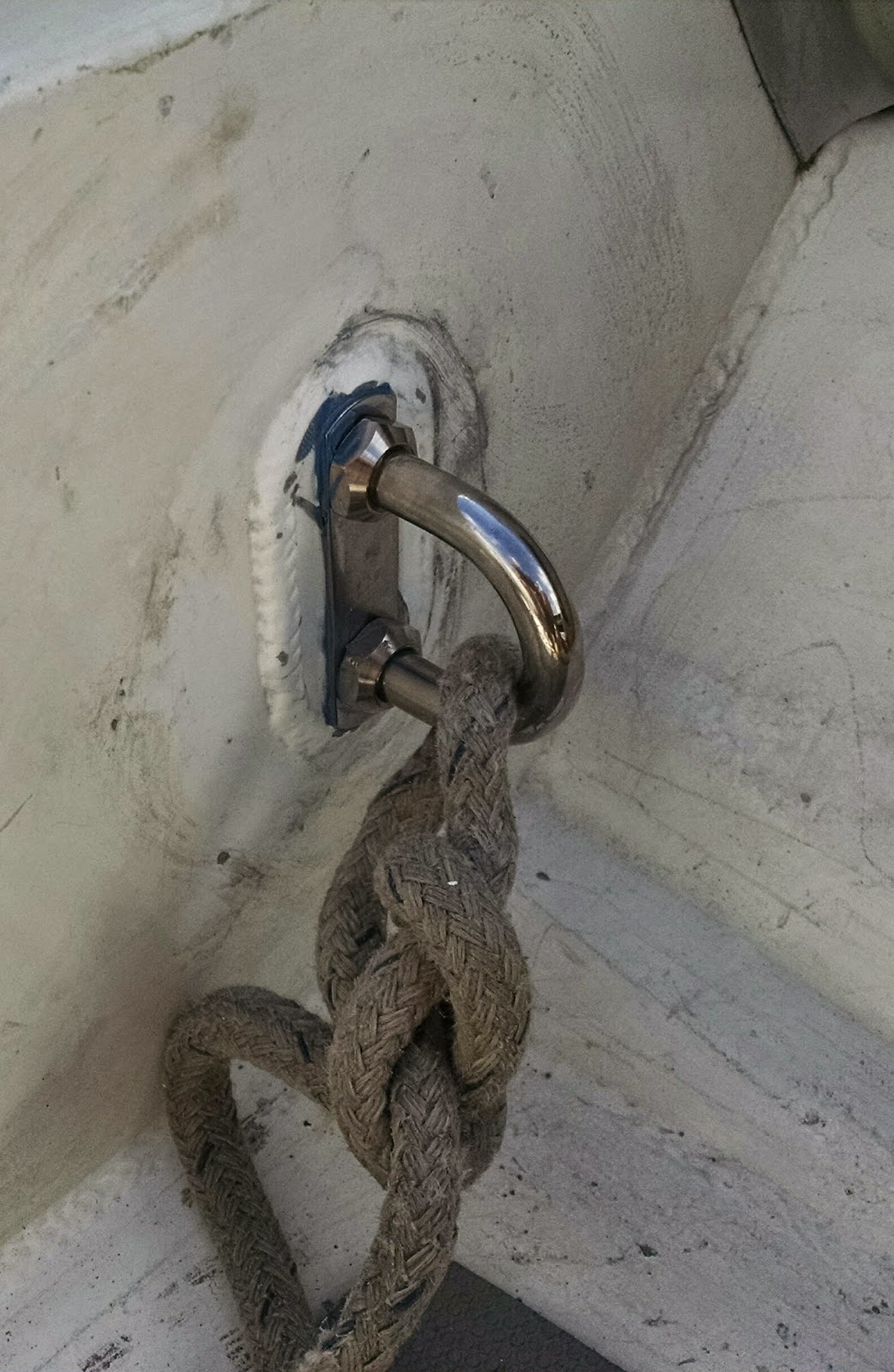
The landing at a dock in the Cambridge YC was very poor due to Captain Roger forgetting an important rule: always check the wind direction when attempting a landing at a dock. Maybe I was tired -- a reason but not an excuse. Anyway, the wind blew us onto the dock. We should have aimed further away from the dock, stopped and let the wind blow us to the Tee dock. Instead, with some way still on, we crashed our starboard quarter with the dinghy, hanging from its davits athwart the stern and protruding a few inches out past the side of the boat on each side, catching the dinks bow on one of the pilings that support the fixed height dock.  The painter, which is one of three lines used to snug the dinghy to the boat, parted (here reattached and a foot shorter),
and one of the welded aluminum


 padeyes holding up the bow ripped open.
But we landed and enjoyed three days at the YC, though the first of them was rainy.


On the sunny days that followed we enjoyed this view from ILENE of a replica of a screwpile lighthouse at the adjacent marina. I visited our friend, Johns meticulously maintained 28 foot S2, "Hearts Content" there.
 John, a former New Yorker and Harlemite was the best host one could find and our reason for staying in Cambridge. He has many talents in boating and as a mechanic, and he has a whole lot of power tools and the knowledge of how to use them. He rebuilt the interiors of the Plaza hotel and Columbia Universitys Butler Library as well as working for 15 years in NY theater, both on the stage and behind it. A gentleman and a pleasure to be with who put himself at our service. 
He drove us all around the town (population 12,250) showing us where everything was, took us to the post office to mail time sensitive mail, to the hardware store where we got a stainless steel padeye, bolts split washers, to the supermarket, several times, for provisions, to his home where we hacked off the extra length of the 1/2" bolts of the padeye and chamfered the edges, did our laundry and printed out a letter that was on our computer. He lent us one of his cars. He came to the boat and "helped" (lets just say he did the jobs with me as helper/learner/doer of the easy parts). He ground off the remnants of the old aluminum padeye, drilled the 1/2 inch holes for the new bolts
and we attached the new stainless padeye -- stronger than before!
We also replaced the old carburetor with the new one which had been fedexed to his house and he showed me how to adjust the idle and it works again!


We spent our days here with John and actually stayed the fourth night, when it was much calmer, at the wall of the town basin, rent free.
For our stay in the basin, he suggested the creation of the fender board, shown here, which uses two fenders and a hanging board to keep the pilings from harming the boat.
We watched Johns TV. He took us to his favorite restaurants and bar, Leaky Petes, where we had Natty Bos (National Bohemian beer). We tried scrapple, and crab, oyster and fish.


Cambridge is a very sleepy town, which has seen better times, especially its downtown district, which was devastated by suburban stores, fires, the recession and greed. We toured its Arts Center, and visited its Maritime Museum
and the Harriet Tubman Museum, but  the last two were closed.


Here are the kitties exploring a neighboring boat at the YC; maybe they smelled fish.
And I just loved this one, which I call "Still Life with Boat".

On our last day John took us on a long car ride to the southernmost of the three Hoopers Islands, connected by road and only a few feet above sea level, and populated mostly by watermen (crab and oyster harvesters) and their families. These islands were reached after driving through the Blackwater Wildlife Preserve, a huge swampy expanse.  We had lunch at Old Saltys

which has this wonderful view of mainland Maryland, the thin line at the horizon, across the Bay,
where we will be going next. John and I are planning the next leg of the cruise, I wish we could have persuaded him to come along for a few days.
Read More..

April 25 26 Beaufort to River Dunes Marina Oriental NC and Lay Day There 28 7 Miles

At 8:10, we had help from the Beaufort Docks staff  "springing" us off the docks so our stern was swung out and we could back out safely. (They hold a line from our stern on the end of the dock while we go in reverse while trying to steer out. It works!)  This was the time of my choosing, but about 10 minutes too soon, resulting in a wait of that duration for the 8:30 opening of the Beaufort Bascule Bridge.
Once clear of the bridge we went perhaps a hundred fifty yards and then aground in mud. There is a fork in the watery path, of which we have to take the right because the left fork was silted in years ago. Mindful of that, I was so vigilant to to not take the right that I took a left, but at  earlier fork, and into a channel that was too shallow for ILENE at low tide. It was low tide so I knew we would float off eventually. But after half an hour I tried another trick. I swung the boom far out to starboard and hung my weight way over the side of the boat to heel her, just a few degrees, to break the contact of the keel with the mud, while Lene gunned the diesel. We were off again, delayed by half an hour, but no worse for wear. It seems I make more mistakes first thing in the morning. This is something to watch out for.
From then on, the only problem was the tide which slowed our progress up the Beaufort River, and through Adams Creek. With low tide at Beaufort at about 9, I thought we would have the help of a flooding tide pushing us on our way up. No such luck. About ten miles up is a high bridge and there the low was at 10:30. I put up the small jib but furled it soon, when it was obvious that there was NO apparent wind to breathe life into it. Even in the broad Neuse River, which we beat down in 2012, there was no wind. Our depth sounder stopped working for about ten minutes but then came back to life while entering River Dunes off Broad Creek. This place was dredged out of the pine forests since our chart was published and has about 160 docks constructed, less than half the number when it is fully built out. They try to make it feel like a Yacht Club, with its own Burgee and Clubhouse with library.


ILENE is at extreme right

We took on a load of fuel at their fuel dock at 3:30, having motored a lot since Jekyll Island, and got on our dock at 4:00.  The rain which had looked threatening all day, held off until the evening and night and during our lay day.
I washed the topsides, cleaned off the rust stains leading from the anchor chain down the outer edge of the starboard side of the deck, where the salt water washdown pump washes the rust particles it takes off the anchor chain, and then waxed this strip to try to keep the rust out in the near future. One shouldnt wax the nonskid deck; it is made rough on purpose. But this narrow strip is now waxed and I have to be careful to tell Lene not to place her feet at the outer edge.
We met some interesting people on our neighboring boats, including a Canadian man on a Catalina 42 with a 185 pound Pyrenese. We dined at the River Dunes Clubhouses dining room, only serving ten dinners that night, in addition to those for a wedding party above. Good food here.
On our day day we were picked up by Bill and Sandy, and served a delicious brunch of baked french toast with ALL the trimmings in their home, with its commanding view of the Neuse. They picked us up at 9 and brought us back at 2:30, so we had a good long time for discussing boats, destinations, books, politics, families, etc.
River Dunes is a relatively new marina, with good wifi and showers. They have an exercise room, pool and sauna. It is very well maintained, only $1.50 per foot and we cashed in the one-time-only Annapolis Boat Show special offer of two nights for the price of one. We liked it here when we visited at about this time of year in 2012 and just as much this time. We hope Bill and Sandy will visit us in NY, perhaps on their way on the loop around eastern Canada aboard m/v Lucille. From NY they would go north on the Hudson, through the Erie Canal, into the Great Lakes, east through the Thousand Islands, down the St. Lawrence River and, after Nova Scotia and Maine, back to North Carolina.
Read More..

February 15 17 Marathon to Rodriquez Key to Hurricane Harbor on Key Biscayne and Lay DayThere 46 4 and 47 4 Miles

Well the good news is that I did not screw up the screw -- i.e., the transmission still turns the propeller. But the bad news is that the rattle is still there. I guess its time to have a professional take a look. And with all the contortionism required to muscle bolts with wrenches in a terribly cramped space, I got a back pain though it was a little better the second day and gone the third. Its just that so many tasks require throwing your weight into it or reaching or bending -- everything except typing a blog -- that one notices such pains. But ibuprofen helps.

And I started the first day with a mistake, though not a harmful one. I recalled that some of the three passage days from Biscayne Bay to Key West were 20-25 mile days and others were 40-50 mile days, but I guessed wrong on the trip to Rodriguez and we lallygaged about and made a late start at 8:45 for what was a longer day, arriving after five. Some of the trip was good sailing, some motor sailing and during the last hour and a half the wind was directly in our faces and rather than tack back and forth we furled all sails and just motored slowly. We were passed by a boat. I could not read the boat name because it is in a fancy script- more later.

We anchored on the west side of Rodriguez Key; we stayed on the other side when going south;  it appeared to provide some shelter from the wind, which was quite strong.
But the oblong island is aligned from north to south and so neither side gives much protection from a wind that was mostly from the south. But we put out 110 feet of snubbed chain in ten feet of water, with plenty of room behind us. Our nearest neighbor, 100 yards away, was the unnamed boat that had passed us. I awoke from the wind at 2 a.m. and sat up worried the rest of the night in fear of dragging. The anchor alarm suggested that we had slowly dragged but in the morning light
it appears that we did not. Not a good nights sleep.

Next day after a great french toast breakfast, thanks Lene, we set off at 8 am. We gradually caught up with that boat that had passed us the day before, who had left before us. They passed us the day before because I did not want to push the engine with its rattle. But now, I saw, via the binoculars, that she was a Catalina 34 with hailing port Oriental NC. I called them on low power on channel 16, and we switched to 17 to not impede the Coast Guard: "Catalina 34 hailing from Oriental; this is the sailboat ILENE on your port quarter." I learned that their boats name was "RagTop" and they were making the same two passages as we were and planned to stay in No Name Harbor on Key Biscayne as we were. ILENE is longer and hence faster under sail. When we passed them we wished each other a good passage and said we would try to meet up in No Name. I still did not know the peoples names.

The wind was in the low 20s and on our starboard bow. It was on shore yet the waves were not large. The Keys, heading for Key Biscaye through Hawk Channel are arrayed in a curve and as we got closer we were able to gradually steer a bit more north and a bit less east so the wind came from near close hauled to near our beam. We had full main and small jib and were heeled quite a bit,
though Witty wasnt upset by it.  We were doing near seven knots on average the whole way up Hawk passage and hit eight for a few minutes. We could probably have gone faster with less heeling if we had reefed the main but the forecast called for 10 to 20, not 20 to 25.
 We accomplished  in one day the mileage that  took us two days on the way south, going directly between Rodriquez Key and Biscayne Bay without the stop at Pumpkin Key. This was in part due to the free open speedy passage in Hawk Channel and was necessitated by the fact that we passed the entrance to Angelfish Creek way before high tide and waves were pushing on shore there. We entered through Biscayne Channel which is wide, deep and well marked.
Still with the wind and waves and tide all pushing us in, and never having been there before, and with the course involving some jibes, and channels always looking narrower on the charts than in real life, we dropped the main before entering and used the small jib, the tide and the engine at low rpms to make 5 to six knots on the way in. The channel is marked by 20 day marks and several fishing camps, houses built on stilts, on its sides. You can occasionally see shoals that line the sides, but mostly they are under water so you cant see them; it was like Boca Grande. Once through the channel into Biscayne Bay, we turned to starboard for No Name Harbor, which the book says is horribly overcrowded on weekends. This was Presidents Day and it was quite overcrowded, so we went to Hurricane Harbor, where the entrance was shallow, 62" at mid tide, but it quite deep enough at fifteen feet once inside.
And there was plenty of room for ten boats with only three present. I called RagTop and told them we were in Hurricane and they were anchoring outside of No Name due to the crowd so I suggested that they come over. There are NO waves in Huricane Harbor and precious little wind. The advantage of No Name is that though they charge you $20, they have a dinghy dock, restaurants and access to beaches etc. This harbor is completely surrounded by private homes.

and there is no shore access at their private docks, but we do not need shore access every day. In the second photo, on the right, through the harbor entrance, you can see the skyline of Coconut Grove, about four miles across Biscayne Bay.

Our neighbors here have left us alone, which is better than some of Floridas wealthy waterfront land owners have behaved. We exercise our legal right to anchor, for free, in the navigable waters of the USA and do no harm. And ILENE is a pretty boat, at least in our opinion and enhances their view. But some have tried to use legal means and sheer harassment to exclude boats from the waters near them. They dont own the water but they like to think they do. One guy moored a fleet of his own small faux miniboats in front of his house to "use up" all the available space. The idiot spoiled his own view with those ugly things.

When they had anchored we invited  Rag Top for wine and thereby finally learned their names: Don and Trish. They live four hours inland by car from Oriental, and this is their first extended cruise. They were part of a rally of new cruisers who went from Hampton VA to Florida, sort of like the Caribbean 1500, but via the ICW, so they partied most nights.  They are pretty good sailors in that they only gave a few tenths of a knot to ILENE. We enjoyed talking with them about cruising and boats in general.

The lay day was devoted to cleaning, -- the spots that we dont get to very often. Benny of s/v ""Rhianna", who we met in Beaufort SC, alerted to our nearness by Dean, of s/v Autumn Born, called and we might meet up with them soon. Three of four boats came into this harbor during the day but left within hours. We were also very close to Bob and Brenda of s/v "Pandora", which I helped sail from Essex CT to Annapolis in September. Our last night in Hurricane they were in No Name, only a mile away. Now back to Miami Beach where we have guests coming from NYC.
Read More..

Header Photo Sabre Dinghy and the Return of the Retro Singlehanders


The previous header photo is of Aussie Matt Kiely sailing the Australian singlehander Sabre class dinghy. The photo was lifted from the South Gippsland Y.C.Facebook page.

Probably the major trend in dinghy racing over the last 30 or so years has been the growth of singlehanded racing at the expense of doublehanded or triplehanded classes. And the trend since the millenium has been the explosive comeback of  what I call the retro hiking singlehanders; those other singlehanded classes designed before, or around the date of the introduction of the Laser (1969). For the most part, these classes are not international (excepting the OK Dinghy and Europe Dinghy); they are popular country-by-country or region, and they attract fleets of thirty, forty or more boats at major championships. They have a builder or two turning out modern hulls, some have carbon masts, many have aluminum. They seem to fill a need in the marketplace that the Laser does not.

I have compiled a list of retro singlehanders. I have excluded the Olympic Finn - 1949 (which has a huge Masters scene) and singlehanders with hiking assists (trapeze, sliding seat). Feel free to add your thoughts about this list in the comments section. (Before the Sunfish sailors jump all over me for excluding the Sunfish from the list - let me state the Sunfish has maintained high levels of popularity in parts of North America and parts of South America for many, many years - I dont see a comeback in popularity - they just maintained it.):
  • Solo (U.K.) - 1956 - aluminum mast, stayed rig, full battens
  • OK Dinghy (Den.) - 1957 - carbon mast, unstayed rig, short battens
  • Streaker (U,K.) - 1975 - aluminum mast, stayed rig, short battens
  • Phantom (U.K.) - 1971 - carbon mast, stayed rig, short battens
  • Lightning 368 (U.K.) - 1977 - carbon mast, unstayed rig, short battens
  • Sabre (Aus.) - 1974 - aluminum mast, stayed rig, full battens
  • Impulse (Aus.) -1975 - aluminum mast, stayed rig, full battens
  • O-Jolle (Ger.) - 1933 - aluminum mast, stayed rig, short battens
  • Larken-Klasse (Ned.,Ger.) - 1920s - wood mast, stayed rig, full battens 
  • Europe Dinghy (Moth) - 1960 - carbon mast, unstayed rig, short battens
  • Zephyr (NZ) - 1956 - aluminum mast, stayed, full battens
Despite the recent introduction of the "modern" RS Aero, or Devoti D-Zero, with lightweight hulls, mylar sails (correction - the Aero has dacron sails), carbon rigs, it seems the singlehanded market is marching in the other direction. (I must admit the North American market is an anomaly here with not a lot of singlehanded classes under the Laser - still king by a long-shot-, and the Sunfish - a solid runner-up, The other singlehanded classes in North America - like my Classic Moth - are mustering small numbers...Oops! I forgot about the MC scow, now very popular in the U.S.)


Read More..

November 9 and 10 Overnight from Wrightsville Beach to Charleston 162 Miles

To plan arrival times from overnights so as to coordinate with tides, marinas being open and daylight, one has to assume a speed. Divide the distance in nautical miles by speed in knots and you get hours. Several questions in the Coast Guard Captains licence exam involve this fact and an assumed constant speed, which power boaters can more or less maintain. For overnight passages, we assume ILENE will make an average speed of 6.5 knots. We left at 9:30 am with a plan to arrive in mid morning the next day.

But sailboats have only moderate control over their speed, which is largely wind dependent. And it takes a minute or two of going the wrong way while putting up and lowering the mainsail, and relatively slower motoring speeds for the miles of the going out at the beginning and coming in at the end. And our course was lengthened when, due to the wind being directly behind us too slow, we took a wider turn around Frying Pan Shoals to avoid a dead run. That shoal extends quite a few miles out from the north side of the mouth of the Cape Fear River. Conversely, our course was shortened slightly when we cut the last buoy, R2, and passed near Rattlesnake Shoals off the entrance to Charleston. (That shoal is 16 feet below the surface so we could go directly over it, but why take even theoretical chances.) But the greatest variable is the wind. We had a few hours where the wind gave us less than four knots, and two hours in which we made a thrilling 8.5.

We had about three hours of very light rain in the late afternoon. One cant get rainbows without rain.


Some dolphins played with us at dusk.
Our dinner was a delicious and filling hot bowl of peppers, onions, sausages, pasta, red sauce and cheese that Lene had partially cooked before we left; we ate in the cockpit in the dark. Lene maintained the watch from 7 to midnight and I came on for the rest of the trip. It got cold during the wee hours but full foulies and gloves kept the chill out -- no pain. When Lene took over we were going only 3.5 knots on a very broad reach so I authorized the engine at 5 knots and we hauled the mainsail to midships to be a stabilizer. This was a mistake, in the sense that we wasted fuel and engine hours: sometime during Lenes watch the wind came back, and just aft of the starboard beam. So at midnight I eased the mainsheet out and we jumped to six knots. I shut down the engine and let out the genoa to play as well and our speed built to seven and eventually to variations over nine for several consecutive minutes. Eventually, we furled the genoa for the last three hours to delay our arrival. We had a beautiful sunset,

but the sunrise took place "off camera"  because heavy dark clouds blocked the eastern horizon during that event. The night time watches were quite boring due to the absence of even a single other boat out there to be seen, much less to worry about; we really had the ocean to ourselves.

The high speed portion was thrilling. ILENE seemed to be saying "I was born to go fast and Im having fun out here!" Comparatively little heeling, and not big waves, just an exuberant dash through the open seas, out of sight of land with enough light, after the moon came up, to be able to see a bit. "Thanks, Dad", she seemed to be telling me.

In my last post I worried about the auto pilot but it performed very well during this passage. We expect minor variations in our heading among strong forces out there and auto steered admirably, though noisily, with a soft squeaking/beeping sound that I need to investigate.
This bridge is just a bit upstream from us.

Im getting the spring lines in place for our arrival; end of the bridge, right.
Bottom line: we arrived in the Charleston Maritime Center at 10:30 am, 25.5 hours after we left, with an "average" speed of 6.35 knots over the assumed 162 nm.
Read More..

May 25 26 Cape May to Atlantic Highlands to Our Home Mooring at City Island 115 and 34 6 Miles

Johns boats chartplotter, though the same brand, is different from the one installed on ILENE. John never got comfortable with mine: He asked "Dont you have pages and scroll between them [question mark]". "No John, but by hitting "display"and two other buttons you get the same effect." This put me in mind of my own discomfort in using the more advanced plotter on Pandora last fall, which was unfamiliar to me. Familiarity breeds comfort.
John and I had several debates during the day. He is more cautious and prevailed upon me to adopt the plan which appeared to be safer. I am not an autocratic captain. I welcome and listen to suggestions from others, especially knowledgeable sailors like John, and while responsible for making the final decisions (such as the passage around Cape May right off the beach), I frequently adopt the suggestions of others. I had plotted out the distance and figured that at the 6.5 knot planning speed, if we left Cape May at five in the afternoon, we would be leaving by daylight and arriving at a buoy off Sandy Hook, 109.8 miles away, in daylight at ten the next morning in time to catch the incoming tide through New York Harbor. RThis gave us plenty of time aftr sunrise in case we were going too fast, and we could always slow down by reducing sail. John listened carefully to the weather reports. They predicted stronger winds at night as compared to by day, though both from the south so they would be pushing us and not requiring us to beat. He said that if we motor sailed and could make eight knots and left at 5:30 in the morning, we could get in before dark at 8:30 to an anchorage behind Sandy Hook marking the southern entrance to New York Harbor. I agreed to this plan and we got underway at 5:30 AM for a daylight passage.
In fact, we did not anchor until sixteen hours later, at 9:30 PM, about an hour after dark, because of three factors: First the wind was too light, at first, to move us at quite a fast enough speed, even with the motor.  We were running away from the wind on almost a dead run, with the big ocean waves rolling the boat and shaking the wind out of the sails, reducing apparent wind speed. In fact we took down the main because it was useless and proceeded under only the small jib and motor. Second, all of a sudden the engine shut down and it took me about five minutes to switch from the tank of fuel we had been using to the other tank, locate the hand lever on the engine which is used to pump fuel to the engine, pump this lever 30 times and restart. That lever is small and in a wickedly devilish location: I can reach it but not see it and have to grope blindly around the starboard side of a very hot engine to find it. We could not be out of fuel in the first tank having filled it only two days before, so a bit of impurity in that tank, such as water, must have been shaken up by the rough seas to cause the problem. Third, about three PM, out of nowhere (though we were passing over big ocean roller waves), the propeller rattle reappeared suddenly, with a vengeance, and we cut the engine speed from 2700 rpms to 1500, which slowed us considerably. I immediately replaced the small jib with the genoa and with the wind picking up considerably, we got most of our speed back.
In the morning we saw this rig,
with a pipe floating on the water between the two vessels. This may have been an oil spill containment operation or dredging. Just dont cut between the two vessels! [An astute reader has advised that it is dredging  -- not to make the ocean deeper but to recover sand blown away by Hurricane Sandy to rebuild the beaches. Thanks for the input Jeff!]
I had studied a recommended anchorage off the Coast Guard Station on the west side of Sandy Hook near its northern tip. This was recommended for easy access, not far from the route between NYC and the Atlantic coast of NJ, except in westerly winds, which could build up a big fetch crossing Raritan and Sandy Hook Bays. John said, "Yes, but it is also exposed to southerly winds if they are as strong as 35 knots, which are predicted." So again I listened to the wisdom of my cautious crewmate and we traversed the three miles further south to the anchorage behind the seawall which runs EW along the southern coast of Sandy Hook Bay, protected from the southerly winds by the massive Atlantic Highlands. We had rigged up and tested the million candlepower flashlight to have it readily available if needed. Arriving at the seawall there was what appeared to be a large dredge in its entrance and we could not determine whether to try to pass north or south of it, so we anchored outside the seawall. This would have been foolish in northerly winds which would be trying to push us into the seawall, but the southerly winds made this an easy roomy anchorage. Seventy feet of snubbed chain in 13 feet of water. A sixteen hour day, followed by leftovers, which tasted even better a day later.
The next morning was the final passage of this winters cruise. We had a big leisurely breakfast and I gathered many of the things I planned to take home before a 9:30 departure. This departure was half an hour before planned and 2.5 before ideal, due to a mistake I made in reading the currents in Eldridges great tide book. I used data from Sheepshead Bay rather than from Sandy Hook,  and they differ. And we had up only the small jib and double reefed main in anticipation of heavy winds from the south in the crowded twisty upper harbor. But those winds had not arrived yet, the tide was adverse, and with low rpms, it took us three hours to get to the Battery.
 Along the way we saw West Bank lighthouse, one of several in New Yorks lower harbor, two massive DDGs departing from fleet week in the city, and a good looking Coast Guard Cutter.


A NYC fireboat was giving the Navy and Coast Guard vessels a full water cannon salute. We thought that we might benefit from this display as a welcome back but as soon as they passed, the Fireboat shut down and moved off.


The high speed ferry ripped past us, returning to Atlantic Highlands for another load of commuters to wall Street.


And of course the unmistakable skyline with the Freedom Tower towering above all the other skyscrapers from the background.
About then the flooding tide cut in, whooshing us up the East River and through Hellgate. Once past the Gate there was plenty of wind on a beam reach for the last half hour or so of glorious sailing to ILENEs mooring. We arrived at 2:30 and were off by 4:30 driving to our apartment in Johns car by six and a delicious dinner at a Greek restaurant in the neighborhood. Grilled octopus salad anyone? I love the fact that my longest cruise ever ended with such a terrific sail with the small sails giving us all the speed we could handle.

Cruising is great but Ah Home! Stay tuned, this blog will continue during the summer season and, God willing, beyond.
Read More..

May 2 3 Portsmouth to Yorktown and Lay Day There 34 9 Miles

Well it was not our fault, and no harm done at our 9:15 departure from the Tidewater Marina. The lovely young lady who works in the office came to help us off the dock. It is obvious that she had never done such a task before, though we did not know this. I asked her to take the bow line while Lene undid the stern line. We were port side to the dock with the wind blowing from that side. What our willing and cheerful helper should have done was hold the bow line and walk aft as we backed out after which she should have tossed the line on deck. The wind would then have blown our stern to starboard, so we would be able to back up a little further, turn left and motor out. But she just threw off the line on our deck immediately and when we backed out we drifted sideways to starboard in the narrow lane. Fortunately there was a turning basin down a bit, which she pointed out to us, and we were able to turn around in it and head out.
But the wind gods were not cooperating. The first part of the passage was essentially north, where the wind was coming from, and about 15 knots actual, (20 apparent). Also, we had a batten problem. The Velcro strap that holds the batten (flexible rod that stiffens the sail) in its pocket in the sail, was partially torn off and not holding. So the batten was sliding out and this was not good for the sail either, so no main sail use today.  We passed the Navy Bases Destroyer Pier from which I did my
Midshipmans cruise in 1964, aboard the USS Dewey. DLG 17. As time passes destroyers get bigger and bigger.
Aboard ILENE, we cut across the Thimble Shoal. But our course gradually curved around to the west till we were heading west up the mighty York River. We got to where we could put out sail and put out the small jib which gave us an extra knot. But when we got to the river itself, where a beam reach could have helped us, the wind gradually died, so it was a motoring day -- again!
Once on the mooring, Roger the Tailor sprang into action and the batten problem is fixed. I lowered the dink for the first time since Beaufort SC and connected the two parts of the new, stronger, wider, easier to use ratchet strap.  We dinked in, paid for our mooring and had dinner with Stan and Carol, at the Restaurant in the Marina. We celebrated his retirement after almost 50 years of teaching Genetics, most of them at William and Mary. I called it fine dining based on service, taste and presentation, but Lene, who likewise relished the food, says that fried food cant be fine dining though it was mighty fine to me. I did have a "wardrobe malfunction" trying to get properly shod before dinner. Both are red, they are jumbled in a locker and I didnt notice this until after dinner.
Our friends again drove in their two cars and left one for our use for the next day! They also brought us the box from Doyle Sails with the five plastic panels with which we can now enclose the cockpit. A very peaceful night.
In the morning, we dinked in, brought the box with the panels from the car via the dink to the boat and installed them. It will take some getting used to for me to be comfortable sailing with them on. The rear one has to be removed to lower and raise the dink. When the dink is down, one has to crawl out under the rear panel to the swim platform to board the dink. With the side panels on, the handles for the big winches for the Genoa sheets can only go half way around, slowing operations. Many of these issues can be resolved when we get back and Junior, of Doyle Sails, puts straps on from the top so that the panels can be rolled up, and fasteners between the aft end of the dodger and the forward end of the new cover need to be attached.
It was beautifully warm and sunny and the adjacent beach in the river got a lot of use. There was also a food festival on Saturday and one for art on Sunday.

We did laundry, bought some gifts, and did the shopping.


Lene dressed for dinner and I shot her by the two green excursion schooners docked at the marina.


In the evening went to dinner at the home of David and his family.
David is Stans son, who I saw last when he was an adolescent and an avid player of Dungeons and Dragons.
David, Lene, Me, Davids wife Wendy, their son Josh, Carol and Stan. Their daughter, Sam, soon  to graduate, is the best looking of the lot of us, by far, but she was the photographer.

Three generations were enjoying each other and we enjoyed them all. They did the best dry rubbed ribs I have ever had, corn bread etc., and it was a delicious home cooked meal. And another very quiet night on the mooring with a full moon.

Read More..

Jet Propulsion for hydrofoil or maybe a prop and flex shaft

Very cool control system


The drive with the angle reduced improves losses 20% 4.3 Amps idling so only 300mA losses from the shaft. I think the steering should be integrated as a kitchen rudder behind the prop.


Reversing the shaft on a Turnigy D3542/4 Aero drive It a 1450 KV and should deliver loads of torque at 14,000 RPM on as 3C


Battery: 2~4 Cell /7.4~14.8VRPM: 1450kvMax current: 48A No load current: 4AMax power: 690WInternal resistance: 0.019 ohmWeight: 130g (including connectors)Diameter of shaft: 5mmDimensions: 35x42m


Above is a 47 mm prop I have a 57 to once I have the motor attached to the shaft sleeve I will do a power test in a tank see what thrust and Amps I get. With the fat end of 1 HP it should have plenty of clog to lift  it up on the foils.


The shaft is running in a good quantity of copper slip. Ran it on a 4C for a minute an the brass only got warm.


I think the body of the hydrofoil will be a lunch box. I think I will have the prop shaft attached to the rear foil

Perhaps the prop on the above can be placed in a tube like these designs


An interesting jet outboard very high outlet must cost power


Jet Propulsion for hydrofoil  


One thing as there is no transom the bulky scroll will always be in the flow and the outlet will be under water which will reduce the trust considerably.


If the outlet was up high it would work better also the riser would need to be streamlined


Or what about an EDF pumping air into a venturi like below


Read More..