Tampilkan postingan dengan label Sailing. Tampilkan semua postingan

More Aluminum Sailing Dinghies

In response to my post about the aluminum Gouget Moth, several readers sent in some aluminum sailing dinghies they have come across.

Australian "R.L". sent two photos of a welded aluminum version of the Australian 11 Aquanaut Dinghy, masterfully crafted.


Mike Scott owned a prototype De Havilland 12 aluminum dinghy during his time in Australia. His story:
"Im not sure who designed that alum dinghy I had, could well have been built as a prototype for the Vagabond, and therefore designed by Alan Payne. They maybe figured that alum was not the best way to go and so built the 3 class boats in glass. The 16ft Corsair is still going strong all over Oz, but the 12ft Vagabond and 10ft Gipsy seem to have faded. When I worked at Miller and Whitworth (Bob Miller and Craig Whitworth, sailmakers, Flying Dutchmen champs, and of course the legendary Bob Miller (aka Ben Lexcen). They became the agents for the 3 classes, and we would place an advertisement in the local paper for Free Sailboat rides, and we would take out prospective customers and then try to sell them a boat....was a fun job, but didnt get to see my kids much....that was 1966. Check out De Havilland Marine. I also worked there - that was where this boat came from. I bought it for scrap value, one of the perks of the job, I guess. In those days I was an accountant - ha...!


In the U.S, Grumman remains the most famous firm for their line of aluminum small boats and canoes but their most enduring aluminum sailboat is their dink, much sought after by the cruising crowd.


Tom Price pointed out that Grumman, in the late 1960s, built a 15 racing dinghy, called the "Flyer." Tom came across it at a Baltimore Boat Show. It doesnt appear many were made as this is the only image I could dig up about this dinghy on the InterWebs.


And finally, the aluminum sailboat I came across at Bobby Mullers yard? After digging around it appears it was the Pelican class, a 12 footer design by Philip Rhodes, of which over a thousand were built by the Aluminum Company of Canada - Alcan. More info about the Pelican can be found at this blog post here.

A nice roomy 12 footer.


A video walk-around of a Pelican.


Read More..

Early Season Sailing June 20 to July 1

My first sail out on Eastchester Bay this season was on Bennetts new boat. This means that the first 11 of sailing the calendar year were all on Bennetts two boats: The first eight of these in the BVIs on On Eagles Wings, plus the two days bringing his new Beneteau back from RI and finally, the eleventh, a day sail arising from a chance meeting with Bennett and his friend, Will, in the parking lot on a day when I had planned to work aboard. OK! I admit it. I confess! Yes, I am weak to the siren call of sailing, and strapping me to the mast would not help this weakness. We sailed for about three hours and then spent a few more on the mooring investigating two possibly related problems: a rasping knocking sound when the rudder passed 15 degrees to starboard and the auto pilot steering off course rather sharply to port when activated. I under stand that both problems have already been fixed.

Two nice social events in peoples homes as well: a party to honor the naming of YC friends Mark and Marcias new grandson and a birthday party to celebrate Bennetts birthday.

Then came two five hour days -- cleaning the boats interior, putting things away, putting things back together. It all payed off: my severest critic, Admiral Ilene, said the boat looked "clean" when we finally went sailing. Dont worry, I know where the remaining dirt is hidden and will get to it soon.

Our first sail of 2014 on ILENE was four hours with Dev and her boyfriend, Vin, who we were very pleased to meet.
An intelligent gentleman. It was his first sail and with the wind Gods not having provided enough, I had the pleasure of inviting them back for a day with more wind so he can enjoy the true thrill of sailing. So we did some motoring though we did get up to 4.8 knots Speed Over Ground for a while during one brief puff. We got into Little Neck Bay before turning back. Two things are not working yet: Speed through the water measures at zero due to the speedo wheel being clogged and the Genoa cannot unfurl though I do have the Allen headed set screw needed to fix that issue. This will take place next time I am aboard with another person to haul me to the top of the mast in a bosuns chair in light wind.

Sid and his wife, Jan, their daughter, Danielle, and Danielles friend, Kara, both age 13, and our nephew, Mendy joined us the next day for five hours, mooring to mooring. Sid was a colleague of mine and continues to work in the law; Jan is a recently retired teacher. They are also  gourmet cooks but this time they brought delicious store bought Italian delicacies for lunch. More wind than the day before. Almost everyone took a turn helming so Auto got a day off. We passed east through Hart Island Sound, and then deeply into Manhassett Harbor before going near the Throggs Neck Bridge and then back to the mooring. On the way back we passed near a 2006 Saga 40 which I learned is kept at the nearby Morris Yacht Club. Perhaps we can get to know the owners better but we have been away a lot in the summers of late, so that may be difficult. We had the Clubs pretty good burgers (except they have not yet mastered the "rare" button) for dinner in an elegant friendly atmosphere at a bargain rate. Except for first timer Kara, they are winners of ILENEs "frequent sailor" awards, but that does not excuse my forgetting to shoot their photos; sorry.

Next  a day of shopping for the boat: a punch to knock out a pin at the forward end of the boom that will no longer be needed; weather stripping to seal water out of the propane locker; the aforesaid Allen head set screw; the services of a lumberyard to cut a small piece of cherry veneer plywood I had into three smaller pieces to fix a hole in a corner of the aft port cabinet; cherry veneer to iron onto one of the edges of each such piece; a mast base block and a rope clutch (so that when installed, and the line snaked through the tunnel, I will be able to adjust the outhaul from the cockpit instead of having to go forward and put the boat into irons to tighten the main sails foot); and a  shackle to hold up the starboard dinghy davit tackle to replace the one I lost. All this for only $200!

My third sail aboard ILENE was with club members Rhoda


and Lloyd


and their grand dog Rocky, a cute young well-behaved Westie.
About 4 hours to get to the Seacliff YC mooring field in Hempstead Bay and tack back. There was enough wind, over 20 knots at the end, that a first reef of the main would have been desirable. Lloyd, who had not yet an experienced ILENE rounding up due to being overpowered, has now learned how to deal with this, gaining confidence in the process. I love teaching, which readers of this blog probably characterize as my pedantry.

Fourth of July weekend had three boatloads of friends but the first of them got washed out by the weather. Rain dates are being sought. Stay tuned.
Read More..

Sailing Alone Around The World

No, not me! Definitely not on the bucket list! We are content to have sailed between Eastport, Maine and Grenada, West Indies -- only about 6,000 miles, round trip, less than a fourth of the distance of the equator and one must also put in a lot of northing and southing to circumnavigate. Europe still glimmers in my mind but is improbable. There are many ports in the areas we have sailed that we have not entered.  And the "alone" part has no appeal to me either. I believe that I could handle the boat but Im far too social an animal. Without Ilene it would be no fun. And in certain longitudes one encounters pirates. No thanks.

No, the sailor in question is Captain Joshua Slocum.  A New England Yankee retired merchant sea captain:  both square riggers and steamships. Slocum set off for his 38 month adventure when he was in his fifties during 1895-98. His was the first such long cruise for pleasure.

I read his account, a classic, at the suggestion of my friend Jim. It is quite interesting and well written with footnotes explaining some of his few archaic sailing terms and references to the personalities and current events of the day (meeting Stanley of Stanley and Livingston in South Africa; avoiding mines when entering Newport RI during the Spanish American War). He also included 65 illustrations (no photos) among the books 265 pages. These include his boats sail plan, lines, and other views and views of some of the more exciting incidents. His writing is better than mine but shares a common characteristic: an unemotional recounting of the facts which speak for themselves; he does not need to characterize them. He was opposed to witchcraft and I believe organized religion, and liberal in his political outlook except as to race and colonialism, in which he was of his times. He includes in the narrative as to each stop along the way, his dates of arrival and departure; from this someone could calculate the number of stops and the percentage of sailing days as compared to lay days, as I do in this blog at the end of each of ILENEs long cruises.

"Spray" his wooden gaff rigged sloop (reconfigured as a yawl half way round), was only 37 feet long on deck, compared to ILENEs 42 feet (but with a long bowsprit and aft extension for the sheet of the jigger, Spray was quite a bit longer than ILENEs 45 feet overall). She was 14 feet wide compared to ILENEs 12, with less draft, concrete ballast instead of lead and double the weight. And he had rebuilt her himself using hand tools on the hulk of an old fishing boat. And Spray had no engine or fuel tanks, no refrigeration, no GPS, no EPIRB, no chart plotter and no radio -- he was rather alone out there, taking pleasure in frequently referring to himself as "the crew of the Spray."

My interest in this book was enhanced when I toured a modern-day, fiberglass, larger-scaled replica of Spray at the dock of Marina Cay in Tortola in November of 2010, before Ilene and the kitties joined me there for our trip down to Grenada. The replica had modern amenities and was home to a family with several small children.

Slocum was a self educated man about writing as well as about the sea. I could not help but compare his chapters to posts of this blog. Of course my own adventures and accomplishments pale by comparison to his, qualitatively as well as quantitatively, but both of us are sailors who write. Generally, when I read, I find the stories interesting substantially to the extent that I can identify with and compare myself to the characters. There are a lot of things in this book to which I could identify.  He wrote comparing himself to the early explorers, who did not have accurate clocks or charts and found himself wanting; and I am not a fraction of the sailor he was.

Yet there are many episodes that resonated for me. He wrote that following a big storm he took out his palm and sewed a new sail to replace the torn one, calling it "serviceable if not beautiful". I recalled my adventure aboard On Eagles Wings this past winter during which I used such a palm to repair a sail.

He was given a set of books by the widow of Robert Louis Stevenson during a visit to her island in the South Pacific off South America. This put me in mind of the generosity to me of Eve, the widow of Selwyn, a great sailor of our club and a great mentor to me.

Nearing home Slocum encountered the USS Oregon, which I learned about in the Oregon History Museum. She signaled "CBT" -- i.e., "Are there any men of war about?", referring to Spanish warships, to which Slocum flew the negative flag.

An interesting unresolved question that this book raised involves usage. When I hail another ship, my usage, which I believe is the common one today, is "Ahoy [name of vessel]". The "Ahoy" serves to capture the attention of the listener to listen for the name of his or her boat. Slocum, if he greeted us would reverse this: "ILENE Ahoy!" There is a lot of "ahoying" in the book and it struck me as wrong each time. I wonder when and why the custom changed.

He described an incident in which he mistook the light of a lighthouse flashing on wave crests as a reef, way to close, and the scare it gave him, This reminded me a moment of horror of my own off the Maine coast one dark and stormy night in 1992 -- the moon peaked out from behind the clouds, low, near the water and I thought it was a strong light on a large ship crossing our bow.

Slocums description of the joy of a landfall at the end of a long voyage will resonate with every cruiser and his description of ports in my home waters --from New York to Maine -- were very rewarding.

He did not keep cats like ILENE and humorously described a short passage with a goat which had been given to him as a gift. He used rope instead of chain to tie the goat to the mast and after eating through the rope the goat ate Slocums hat and his chart of the Caribbean

He had a few groundings and was hit by another boat while at anchor; all things that have happened to me and are going to happen to you if you are out there enough.

He tried to tow a much larger boat that had grounded but the captain refused his offer and the ship was later lost. On my first boat, "Just Cause;" I went out from the safety of Three Mile Harbor (the back door of Easthampton, Long Island) to tow in a much larger sailboat, and during another Club cruise was the beneficiary of a tow from a power boat when both my engine and the wind failed (Thanks again, Stu).

News of Slocums voyage had spread and he was greeted as a celebrity in most ports, large and small, and fees were waived while he was feted by the local dignitaries. This has not been my experience.

He also traded in merchandise that he picked up along the way in Port A for sale in Port B; you couldnt take the merchantman out of him. And later in the voyage he was given the use of lecture halls to earn money by telling his sea stories.

The most exciting portion of the trip was his circumnavigation of the western half of Tierra del Fuego, which lies between the Strait of Magellan and Cape Horn. This was also where he encountered natives who were pirates. He had not intended to circumnavigate these islands, but upon exiting the Strait into the Pacific,   he was hit by a storm that simply blew him back south and east of the Horn. The book contains several charts of his path, and a separate one for the tip of South America where all of this action occurred.

Having transited a good part of the Pacific from an island 340 miles west of Chile in 43 days, he passed just south of the Marquesas without stopping there and continued for another 29 days nonstop to Samoa -- 72 days at sea. He read a lot underway and reported on what he read.

He also had many pertinent observations on the winds tides, currents mileage made good, sun sites, and such matters as crossing the Equator and crossing his own track.

One amazing feature of his boat and his own skills was that he could trim his sails so well that he could lash his wheel in place and let the boat steer itself for days at a time. Only once, in a storm, did he tend the wheel by hand for 30 hours. Many people doubted the veracity of this self steering assertion and he repeats it several times with an illustration of how he lashed the wheel but with the caveat that he could not vouch that boats with large overhangs, fore and aft, could perform this way.

This will be the last nautical book review in this blog -- for 2014. I plan to help a friend bring his boat from Essex CT to Annapolis at mid month.
Read More..

Edensaw Boatbuilding Competition A Sailing Dinghy Wins!

Most wooden boat shows have live boatbuilding; usually it involves a group of families assembling a quantity of small rowing skiffs which are then launched at the end of the weekend. At the Wooden Boat Festival hosted by the Northwest Maritime Center in Port Townshend, Washington, Edensaw Woods sponsors a boatbuilding competition where they move away from the typical novice boatbuilding event and open it up to a diverse group of boats from professional designers and being built by skilled woodworkers. In this years competition, built alongside the traditional dory and Irish curragh were two sailing dinghies. One of them, Richard Woods Zest singlehander, won the competition

Here are two of the boats on the beach after the time-limit for boatbuilding expired, ending all construction. On the left was a dory built only with hand tools. On the right is a 14 foot, V-sectioned sailing dinghy designed by sometime Classic Mothist, Stephen Ditmore. As the photo reveals, Ditmores team got the hull done over the weekend but the decking and rigging awaits.


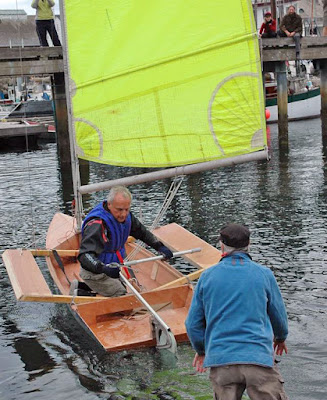
Winner of the competition, designer Richard Woods on board at the initial push-off of his Zest dinghy. This is definitely a racing singlehander with hiking wings. (The hull is a relatively narrow, flat bottom shape.) The hull was completed by the team over the weekend and Richard was able to scavenge sailing parts from some of his other projects to get this design sailing in short order. I think the pushee in the photo is Michael Scott who owns several sailing dinghies including a couple of Classic International 14s and who is constantly feeding news tidbits to the blogmeister.


Instead of painting over the freshly applied epoxy, the Richard Woods team decided to apply a silver vinyl decal material over the hull (purchased at an auto supply store). Very distinctive, hence the boats name Silver Bullet.


Designer of the other sailing dinghy at the competition, Stephen Ditmore sailing his Classic Moth design. Unfortunately we have only seen his Moth show up once at Brigantine, New Jersey.


The wrap up video from the Edensaw competition.


Third Annual Edensaw Wooden Boat Building Challenge! from Al Bergstein on Vimeo.


Read More..

Sutton Manor New Rochelle Americas Sailing Community

My hometown, Annapolis, has the slogan "Americas Sailing Capital" whereas Newport, Rhode Island, long-time home of the Americas Cup, about 640 km (400 miles) north of Annapolis, goes one better with their slogan "The Sailing Capital of the World". Notwithstanding the competing Chamber of Commerce hype of these two East Coast sailing towns, there is one community that, between the war years of WWI and WWII, could rightly maintain they were Americas Sailing Community.

Sutton Manor, of New Rochelle, New York was a 50 house bedroom community of New York City that began development in 1914. The community butted up to Long Island Sound and the harbor of Echo Bay that included Tank Island, Harrison Island and Echo Island. There were three active yacht clubs, all predating 1900, within several miles of the community; the Huguenot Yacht Club, The New Rochelle Yacht Club (now defunct, located in Echo Bay on Harrison Island) and the Larchmont Yacht Club. The names of some of Americas most distinguished yachtsmen made Sutton Manor home:

  • Stan Ogilvy
  • Cornelius Shields
  • Bob Bavier
  • Howard McMichael, winner of championships in the 210 Class, the International One-Design and Hipkins Trophy.
  • Walter Coursen, a Commodore of the Larchmont Yacht Club and the New Rochelle Yacht Club.

Also, two prominent sailors featured in the Earwigoagin historical archives; Larry Huntington and Harry Hall, owned houses in Sutton Manor.

To take a stroll through Sutton Manor during the 1920s and 1930s, one could, every couple of hundred steps or so, have a very interesting conversation about boats and sailing.


Read More..

July 2 to 13 Six Days of Sailing and First Two Nights Aboard

Yes, twelve fun filled active boating days (and two nights) for Lene and me. Six were sailing days which averaged only about 3.35 hours per day, plus a work day and two overnights. Before that, a fireworks party on the 37th floor of Devs apartment, which was great, including the fact that due to the distance from the event, the fireworks were like children should be: seen but not heard.
The first sail in this period was with two of the men from my Book group, Arthur
and Gary, Arthurs wife, Marie Genevieve (the photographer) and Rafael, their son, on his dads lap. This pic, like many others are taken on the launch because your correspondent is too busy sailing the boat to perform his photographic responsibilities, and because the bimini and dodger do too good a job of providing shade, which makes it hard to get good pictures.
So we had the Chief Librarian of a prestigious New York university, an Emmy Award winning Film Editor and a practicing Psychiatrist. They were my friends who have became Lenes friends as well. Marie is the sailor in the bunch, with lots of experience with her father in Europe, and took the helm most of the time, but her husband and son took stints. Rafa steered like a Navy Helmsman, taking orders such as "a little to the right" -- because at eight, he can not yet see over the binnacle.

Next up were four of Lenes friends who have become mine as well. Sheila, MJ, Christine and Heather, all repeat sailors whose pictures are in other posts. We put up less sail than normal and went at a slow stately pace that the guests appreciated. We started with reefed main and small jib but finished without the jib.

Then came Ilenes first sail on Bennett and Harrietts new Beneteau. Lene, as I had been, was quite impressed with the boat. I was able to whip the ends of all of her lines that terminate in the cockpit. Another day, not underway, will be needed to get the other ends of these lines. She has a lot less lines than On Eagles Wings.

A work day to get the top of the Genoa working and mostly sanding the cafe doors for another coat of varnish, which could not be applied because the varnish I had had jelled to a solid. I also got two spare fuel filters - expensive little buggers, which, in their boxes are now aboard in zip lock bags to prevent rust.

For the final three days and two nights of sailing, in addition to the human guests, Whitty and Alpha Girl got reacclimated to the boat. That process was hardly an event; they walked about like they owned the place and tried to get into the cabinet where their food is stored. Cats are smart, especially when their dinner is concerned. Alfie is quite at home inside the aft end of the stack pack, atop the boom, when ILENE is on a mooring. The red and black lines are the first and second reefing lines, respectively.
It is warm and quiet in there. But we have to remember always to make sure we see the little devils before we hoist the sails to avoid crushing them. Our human guests during the first of these three days were Jill and Ken, her boyfriend. She is the kitties Vet and he is a family therapist and soon to be published memoirist. Neither of their expert services were required for this voyage, just the pleasure of their company.
The most remarkable thing about this daysail was the tidal effect of the so called "Super Moon" -- which was full and at the point in its orbit closest to the earth, increasing its magnetic effect on the water. Coming north back toward the mooring we passed what is usually safely east of  Stepping Stones Light. The depth sounders beeping alerted us to the fact that the rocky seabed was only seven feet deep -- 16 inches below the bottom of our keel. I veered sharply to starboard to get further away -- toward deeper water. At high hide that day, the water would have been another eight feet deep. The same low tide problem almost prevented us from getting back to our mooring. Other members of our Club, who had intended to race that Friday evening, had to wait for the tide to rise a bit, being stuck in the mud.  We made a groove in the soft mud bottom for about ten yards of our approach to the mooring; inertia carried us through. Our keel is 5.66 feet deep and the water was only 5.6 feet deep. After dinner at the Club, I took our guests to the subway so they could get home and listened to our Clubs mostly amateur but great sounding six piece rock band playing. But it was already 9:30 and my bed time. A calm cool night.
Next day, after breakfast, our guest was Christine, a frequent sailor with us, here with Whitty.
We had the best sailing of the summer so far. We beat deeply into the south end of Little Neck Bay on eight tacks using Main and small jib, then ran out and through the passage behind Stepping Stones off Kings Point, which required three gybes, and finally turned south into Manhassett Bay to the M.B.Y.C. on a single starboard close reach. Lene had the helm most of the way and has mastered the art of taking advantage of puffs that round us up slightly. Our speed rarely dipped under six knots and on the broad reach we were making eight.
MBYC charges $60 for a mooring and has a lovely big pool. We got there late in the afternoon and lounged on the pools deck. It was not at all crowded and we just read. Later the pool attendant told us that our guest mooring fee did not include use of the pool. Apparently this rule resulted from an experience a few years ago when a boater with twelve souls aboard took a mooring and his guests clogged the swimming lanes. But MBCY has a great guest shower which we did use before an excellent dinner in their restaurant. From the restaurant deck, you see the pool in the foreground, their mooring field in mid ground and a wee bit of the east side of City Island under the setting sun.
Another good nights sleep and a good breakfast aboard before sailing back to the Harlem.


Before casting off, however, I finished the improvements that I had been working on. I hung the wool (or maybe cotton) wall hanging of a stylized sailboat that we got in Finland (dare I call it a tapestry?).  (Sorry about the color and underlined nature of this next paragraph; I didnt intend it and cant get out of it!)  I installed a new block at the base of the mast and a new fifth clutch on the starboard side of the coach roof, next to the other four of them there, so the winch there can handle the outhaul. From now on I can change the tension of the foot of the main sail and thereby trim it better without having to go forward to the mast, laying on my back there, having Lene steer up into the wind and hauling on the outhaul line manually. My only mistake was caused by Lewmar, which provided absolutely zero instructions on how to install their clutch. To release the four existing ones, I lift a lever that swivels up and forward on a pin at the forward end of the clutch. So I installed the new one with the lever moving the same way -- which was backward!!
All the others open one way; this new different one, the other!
In other words, when closed, the clutch did not hold the line when you want to lock it, but it did prevent you from tightening the line. But having done all the drilling and bolt and washer selection and grinding and snakeing of the line needed for the first installation, it took only ten more minutes to detach and reattach the clutch the right way. The clutch is fastened to the coach roof reinforced by strong washers, above this removable panel in the cabin ceiling.
This little job used an enormous number of specialized tools and I confess that I was pleased with myself. Thanks go to my rigger, Jeff Lazar, proprietor of Performance Yacht Management, who encouraged me to do it myself and gave me some helpful hints. He had also told me the size of the Allen stud which I installed myself (And I sorely regret that I did not bring my camera to the top of the mast to gain pictures of our clubhouse and mooring field from an altitude of 63.5 feet above sea level. Lene cranked me up and let me down gently. Another time for that photo.) While working from the top of the mast of a nearby boat Jeff also advised me to possibly shorten the strap at the clew of the Genoa to lower it a bit. The last step on the clutch job will be using a punch that Jeff recommended, and a hammer, to drive out a horizontal athwartship pin embedded in the forward end of the boom on which three thumb cleats rotate. They were used to hold the out haul line and the two reefing lines (red and black, remember) in place. Now, that the third and last of them is led to the cockpit, the thumb cleats are worse than superfluous --  they tend to chew up the lines.
Our sail home on Sunday in the late morning was via the shortest logical route on a variety of port reaches, from broad to close. It rained a bit en-route and with more and heavier  rain forecast for the afternoon,  and my shoulder getting sore from too much sailing, we made a short day of it.
Read More..

August 10 to 24 Not Much Sailing

We began by going to a lovely wedding of friends daughter, out on Long Island.

Lene, Lianne, Ellen and Rudy
Then came Lenes successful surgery: laperoscopic removal of the malignancy in her left lung and her return after two nights in the hospital. We were very lucky to have such a good outcome due to an accidental early detection.
There was also a membership meeting at the Harlem YC to discuss our need for an assessment to pay for mistakes of the past such as forgetting to pay the taxes we collected and the need to come up with not just the taxes, but  penalty and interest as well. Self inflicted wounds caused by volunteers who are human and hence fallible. Been one; done that. The more important issue was how to create a mechanism to try to insure against repetitions of such debacles. Creation of a new position: A designated Pain In The Butt Officer who will have a calendar of dates when payments and license renewals, etc. are due and whose sole function will be to bug the other members of the Board and demand to see that the checks (taxes, payroll and insurance) and applications (occupancy, fire safety, etc.) are written.

And a visit to Fran, in Western Connecticut where a smaller boat was involved.
Mendy in the bow; can you see his muscles?
Also, I worked about thirteen hours during three days on many small projects involving electrical, carpentry, plumbing, sanding and varnishing. Ill spare you the details.

And there were three days of sailing though short ones, totaling only about eight hours.

1)  With Bennett, bringing his boat, fresh from the repair of damage caused by a close encounter with a rocky bottom, from Barrons Yard, on the other side of City Island, back to the Club, but with a sail through the channel off Kings Point and to Throggs Neck, about two hours, in light winds and smooth seas. A pleasant day.

2) With the Wednesday afternoon sailing club (formerly and sometimes currently called The Old Farts). This group assembled automatically and organically in prior years but has had a rocky start this season so I organized this outing, the second one this year. While still not a success, we did get nine folks out on two boats for a couple of hours. With me on ILENE were Richie, who no longer owns a boat, Rhoda, and Alfred and Leona. The latter two are older, averaging in their higher 80s,  and while Alfreds ability to steer, learned in German waters before WWII, is unimpaired, his ability to see is not as good and I had to stand close while he was at the wheel to get us back on course. Leona had great difficulty in the transfers between the launch and the boat -- knee problems -- and actually hurt her arm on the way off. Sorry Leona. Both great sports and Alfred will be back. The other vessel was Brian and Angelas "Debut," a Bristol. With them were Morty and Clara. The G&Ts were supplied by Alfred and Leona after two hours of sailing in light winds to the east coast of Mamaroneck Bay and back.

3)  We sailed in the Clubs 60th (or so) running of the Sidney J. Treat Regatta. Lene steered, our nephew, Mendy, did most of the winching and Rhoda and Lloyd helped out as well.  But we are the scratch boat and have to finish far in front of the other boats so our time after PHRF handicap correction, will still have us as the winner. Specifically we were assigned a handicap of 87 compared to the others in our division, which ranged from 123 to 234.  And the upshot is that of the five boats that finished (out of six that entered), we were next to last in actual time and dead last after corrected time.  So I guess I better explain why we lost. These are the reasons, not excuses. The biggest problem is that due entirely to my fault, we were way out of place and did not get to the starting line until about two minutes after the race started. In a race that lasted less than 43 minutes, this is a deadly sin. Another thing was lack of crew training and practice. Mendy is very strong and very willing, but I had not trained him so I had to tell him what to do which slowed things down.  The last reason other than my mistakes was the nature of the wind on race day. In very strong wind I can use ILENEs small jib, which is self tacking, making the tacks and jibes very fast, i.e., we do not lose much speed. But in lighter wind, as on race day, the power of the big Genoa is needed and to tack or jibe with it, one has to furl it, do the maneuver and then let it out on the other side, which in such a short race takes ages. For long distance ocean racing, where a tack of gybe might be needed every few hours or even every few days, the loss of a few minutes per maneuver is no big deal and ILENE can do well. Every boats handicap is computed based on the performance of other boats of the same model in all kinds of races. These results are averaged out. In strong winds ILENE will do well against her handicap but not today.
After the race we took a long loop into Littleneck Bay before returning to the Club to congratulate the winners. ILENE has won Club races but this was not our day. Nevertheless, a good time was had by all.

For a more interesting post than this one, Google: "Sail Pandora" for an account by our friend, Bob, of his sail on a 180 foot luxury yacht out of Newport RI.

Read More..

May 26 to June 21 Its Been A Long Time with Little Sailing But

Normally the summer time is the busiest blogging time, but after 146 days afloat this calendar year before May 27, this is a decompression time. I do not feel the urgent need to get out on the water every day, not that nothing water related has taken place.

I have gone on two of the Wednesday afternoon sails with the Old Salts, the new name for the revived Old Farts. First on PC Marks "Deuce of Hearts", a catamaran, and then on ILENE.  Mark has been instrumental in reviving this group this year. Four people came the first time and seven the second (me, Mark, Mike, Richie, Dave, Morty and Clara). And the G and Ts are just as good as ever. Both days we were graced with moderate light wind after lunch at the Club. The food at the Club is a bit pricier than last year, and the portions a bit smaller (which is good for our health). The food is simply much better quality and better prepared. On ILENE we cut through the channel behind Stepping Stones Light where there was very light wind and we were near a run, before heading to the Throggs Neck Bridge and back to Hart Island before heading for home. The wind changed direction with the result that we only did one jibe and one tack.

I also had a pleasant afternoon with Ilene, and Bennett and Harriet aboard their Beneteau, "Ohana". She moved nicely in very moderate air. Come to think of it, we have had a lot of very moderate air for June. The four of us had a good dinner at the Club after, trying out our new chef, Ann, who does good things to food.

And I crewed for PC Mark on Deuce of Hearts
with PC Erwin, visiting from Florida, and PC and Ms. Bob and Laura in the Clubs annual Rear Commodores Regatta, which was set up as a pursuit race of slightly less than five miles.
Lene and I had won this race on ILENE back in about 2008, on a pursuit-destination race to New Rochelle with, miraculously, only one jibe. In a pursuit race, the handicaps are computed for the given course in advance and each boat starts at a different time, reducing the collision-inducing madness when several boats want to be at the favored end of the starting line at precisely the same time. So, if everyone sails as projected, all of the boats should arrive at the finish line at the same time. ILENE had the biggest handicap back then and hence started last and passed every other boat in the fleet on the way to the win.
Alas, this year we came in tenth of twelve boats because we made two mistakes. The first was not getting to the starting line until almost a minute after our time. Stuff happens and this has happened to me. The second mistake was using the small jib until the third leg of the triangular course. Deuce of Hearts is set up like ILENE, with a larger headsail set forward of the jib; it has to be furled between tacks. With the smaller headsail we were just too slow. Another great feature of Deuce of Hearts is that the tack of the big headsail is mounted on a track and can be moved to port or starboard  from the cockpit to catch wind without messing up the wind in the main. We were untrained crew and the PCs figured out how to use this neat trick, but too late. I think Deuce of Hearts has a lot of potential to be a fast boat on the race track.

Part of the reason for relatively little sailing was the visit by Lenes niece, Barbie, her son Trevor (who we hung with in Amsterdam last June) and Anna, a 16 year old exchange student from Denmark who lived in Barbies home for the school year. So we had five folks in our apartment and they made it very clear that their jam packed week in NYC did not include sailing. But we did see sailboats  -- at the MOMA -- Seurats pointillist masterpiece.

And there were several days of planning for the Club cruise plus a Club weekend excursion to Sheepshead Bay in August, and Club participation in the July 4th parade up the Hudson with a full wooden replica of "Le Hermione", which brought LaFayette to these shores and participated in winning the battle against the British fleet that was intending to re supply and reinforce General Cornwallis at Yorktown. When deprived of such aid, Cornwallis surrendered to General Washington, thereby ending the military operations of our war of independence.

And four workdays, pickling the water maker, which we will not need this year, cleaning out the refrigerators and the bilge, putting up the new plastic enclosure to the cockpit for measurement for straps to tie it up out of the way in the rolled up position when needed and snaps to mate it with the sides of the dodger. Finally I did work on the solid cherry batten that holds up the ceiling in the salon, to accommodate the new hatch screen enclosure.

And arranging some sail dates, sending back the new stainless steel snubber line hook which was replaced with a smaller one that fits and holds onto the anchor line, reducing the cruising area of our insurance policy to save money and other boating related chores.
Read More..

August 10 to 19 Cleaning Dining Paddling Planning and Oh Yes Sailing Too

Not all sailing in this period.
One day was devoted to cleanup after the cruise, replacement of the last cherrywood batten to hold up the cabin liner after installation of the new screens in the salon (Thanks, Tony!) and topping up coolant in the engine.
One day we had a lovely dinner with Craig and Katherine of Sangaris at the Club. I accepted their invitation to crew for them on their passage back to Boca Raton, Florida this fall. I expect this will be about three to five days, to the Chesapeake. The start date is not yet set, but probably sometime in October. So the departure may be while Lene is vacationing with our niece, Yael, in Israel, which will require some cat sitting coordination.
Another day we visited Fran, an old friend, in Kent, CT.  I paddled her canoe around her lake; not sailing, but.....
Lene was somewhat reluctant to come with me and Bennett and Harriet for a week on "On Eagles Wings" in the Virgins at the end of next March, but consented. I always tell her the same thing and it usually turns out true: "For a good time, come with me!" And Bennett advised that he would drop off the guests he will have during the first of his two weeks aboard, in Charlotte Amalie Harbor on St. Thomas, rather than on Tortola, sparing us the ferry ride from our flights arrival on St. Thomas, USVI to Tortola, BVI. And more important to me, he has agreed to look into going back by boat from St, Thomas, USVI to Tortola, BVI via St. Croix, USVI. This simplifies our Customs process because we will already be in the USVIs. But the major benefits of the proposed route are first, that it provides for two somewhat longer than usual passages (40 to 50 miles) to and from St. Croix  and second, it will add a "new" island to my travels. The beauty of this route is that the passages have a lot of south and north in them, providing for beamy reaches in the prevailing trade winds from the east. I immediately got out my Puerto Rico and VI chart kit and plotted the courses and their lengths and did some preliminary scouting about the entrances to the harbors, anchorages, restaurants, and shore attractions on St. Croix. I enjoyed this very much and sent off an email to my companions with the fruits of my labor of love.
Also, I have blocked out a date in May 2016 for a lunch with Eve, who with her late husband, Selwyn, have mentored me in sailing. [The word "mentor" derives from a sea story; Mentor was a character in Homers Ulysses, who mentored Ulysses son during his long sea travels.] Eve now lives in Austin TX but is visiting New York and we will pick her up and drive her to lunch with Jim, who has sold his beloved "Aria." So, some bits of advance planning. "Failure to plan is planning to fail."
And I did enjoy three day sails, for a total of 10.25 hours. The first was with Lene and our artsy, facially hirsute friend Jeff, who took this self portrait: his reflection on one of ILENEs shiny dorades.

Wind varied from 5 to 15 knots. We headed up through Hart Island Sound, circumnavigated Execution Rocks counterclockwise, getting around green can 1 off New Rochelle, thence a rather straight shot back through the small passage off Kings Point to Throggs Neck and back to the mooring. A rain cloud to the west looked threatening but passed south of us.
Dinner at the Club was again excellent.

Next came a sail with Lene and our nephew, Mendy, visiting from Israel. Mendy has sailed with us several times including Maine and on Club cruises over the years, and he is stronger than an ox due to excessive workouts in the gym. He did all the pulling and winching. All I need do is train him a little better on which strings to pull, how far to trim them  and why to do so, and he will be an excellent sailor. But for the first two hours the wind was so light that we only made about two knots, though the wind came up at last and we got to 6.5 knots for the return. In hindsight, if we had left two hours later we would have had more fun.
The third sail was an Old Salts Wednesday and provided the best wind of the three. ILENE had a bye day. I sailed with Bennett, Brian, Mike, Morty and Clara on Ohana. Wind was at about 12 knots from the NE and we darted back and forth several times between Throggs Neck and the entrance to Manhassett Bay on near beam reaches, achieving a speed of up to 7.5 knots.
Here is Ohana taken from Deuce of Hearts, sailed by Mark, Richie, Mark and Marsha and Art and Carolyn, who sailed on Deuce of Hearts, we had twelve sailors in the cats roomy cockpit for the after-sail libation. Sunny warm and windy; what more can one ask for!

Read More..

Ideas Sailing catamaran free plans

Catamaran Boat Plans Sailboat Sail Rigging Catamaran Boat Design Plans Free-model-boat-plans-catamaran.jpg Aluminium Catamaran Boat Plans
Read More..

Ideas Sailing boat plans for sale

Small Yacht Boat for Sale People in Row Boat Aluminum Sailboats Boat Catamaran Sailboats for Sale Motor Yacht Plan B Above is a
Read More..

This is Sailing dinghy boat plans

Sailing dinghy boat plans currently i stumbled upon this Sailing dinghy boat plans what is meaning Sailing dinghy boat plans you have found it on my blog In the survey I get that not a few people who need a pdf version for Sailing dinghy boat plans check this article illustration Sailing dinghy boat plans Is this a sailing dinghy or a sailboard ?-uspatent5170734.jpg
Read More..

Fast sailing boat plans

Fast sailing boat plans one photo Fast sailing boat plans Old Sailing Ships Sailboat Sail Parts Sail Boat Line Drawing Wooden Boat Plans Sailing Dinghy Small Boat Plans Free
Read More..

Learn Traditional wooden sailing boat plans

Clinker Built Boat Plans Small Sailing Dinghy Jon Boat Plans Come Sail with us this year Wooden Model Boat Plans Above is a
Read More..

Popular Sailing boat model plans

Free Model Boat Plans Free Model Ship Building Plans Model Ship Plans Blueprints Golden Hind Ship Model Plans Free Model Ship Plans Blueprints
Read More..