Tampilkan postingan dengan label beach. Tampilkan semua postingan

Trawler Fest Rivera Beach FL

Once again I am happy to announce I will be part of the boat buyers program at Trawler Fest in Rivera Beach, FL. http://www.passagemaker.com/events/trawlerfest-riviera-beach-2016/


I am looking forward to teaming up with yacht designer Stephen Seaton  on a seminar about buying and building custom yachts. We will cover what you will need to know about having a custom boat designed and built. We will also cover the purchasing of a used custom boat, most of which are one off built boats. We will mostly cover metal which is the most common in custom built trawler materials, but will also touch on wood and fiberglass.
Read More..

April 21 22 Charleston SC to Wrightsville Beach NC 155 7 Miles

We left at 10 as planned, but I screwed up reading the tide table so the tide was against us on the way out of Charleston, though weakly. We put up the main in the inner harbor and jibed it several times on the way out, past Fort Sumter where our Civil War began. Actually it began in SC, earlier, with the thinking of Calhoun, on the theory of states rights to "nullify" federal authority, a doctrine now becoming popular again among the lunatic right in this country.
We turned left as soon as we reached the first buoy after the end of the seawall and put up the genoa as well. This was before noon but the wind was too weak and too far behind us, to move the boat with  any speed, so we motor sailed, mostly motored, until about 1:30. I even had taken down the mainsail. I had not realized how much of the first 109 mile long part of this passage, was more easterly than northerly and so the projected five to ten knots of west wind was behind us. Then came wind, much stronger than projected and a gift to us. I was able to get up half the mainsail, with double reef in it, and continued with the genoa. The wind built behind us and we were screaming along at seven to eight knots with peaks at 8.9. And with the wind about 120 to 150 degrees from our bow, we rolled a lot from side to side, most unpleasant. Lene felt a bit nauseous though she did not lose her food. We had a delicious cold dinner -- no cooking with the rolling. It was warm and sunny by day and reasonably warm at night, with no rain. But during the night we got some slow speeds, less than four knots and even though I did not put up the genoa again until near daybreak, it was this night part, as well as the first few hours, where we lost time
After dinner, at 7:30, we replaced the genoa with the small jib, a safety measure for nightime sailing in big waves, and were still making over seven knots with just the small headsail and double reefed main. We had put on the preventer to prevent accidental jibe of the mainsail, and with the small jib sliding back and forth we took it in and sailed under just double reefed main. The preventer was a good thing because the wind had shifted from off our starboard quarter, to off the port quarter during Lenes watch. We were sailing "by the lee" -- the way you get that accidental jibe. When I got up at one (Lene let me sleep late) we jibed the main and continued on toward the turning point - off the tip of Frying Pan Shoals, which extend many miles out into the Atlantic from the Cape Fear River. We saw very little traffic: Two big freighters passed us at quite respectable distances -- closest point of approach being miles away -- and one sailboat overtook us, headed for Beaufort. I saw his lights and estimate he was 200 yards off our starboard side, moving a fraction of a knot faster than ILENE. Prior to the close passage I had a radio conversation with him to confirm what each of us was going to do.
Once around Frying Pan, at about 4 to 5 am, we turned north to Wrightsville (The Masonboro Inlet) and the wind came up from our port quarter to its beam and even forward of that. This second leg was only 32 miles and wind speed varied considerably during the leg, as, consequently, did boat speed.
It is hard to get good pictures of a night passage so at least I have the long awaited dawn.

Masonboro Inlet is easy, wide, well marked and flanked with seawalls. Once in, it is easy to get to the anchorage area and we dropped at 1:30, only 90 minutes "late" compared to our projected schedule that would have averaged 6.5 knots. Nice homes line the bay side of the barrier island.
We put out a lot of chain because there is lots of room and 20 knots were predicted for this evening. But by 4 pm it was howling at up to 40. We visited Wrightsville and made the reciprocal of this same ocean passage, to Charleston on our way south last fall and hence felt no need to lower and raise the dink to stretch our legs in Wrightsville. Tomorrow: Beaufort NC, about 80 miles and if the forecast comes true, a beam reach  or close reach from the port side, with five to fifteen knots.
I  tried to take a photo of the pod of dolphins playing under and around our bow, taking the Ipad up there, but they are way faster than ILENE at eight knots. I took maybe 50 shots and only one, a video of less than one second, caught a dolphin. These were not the slow graceful swimmers in the ICW but racers amidst the big ocean waves. I couldnt get the video into this post but it is on Facebook. I did manage to neither fall off the boat nor drop the camera.
Ilene is a true member of this crew and a solid citizen on overnight passages. She grumbles a bit and still relies on me, and I have to admit I like the  second part of that. She is even taking an interest in the charts, tides and weather. I couldnt make this trip without her, physically, mentally or emotionally. We have some chores that each of us do most of, but both of us do many of the chores. She said she liked our 25.5 hours together.
On our honeymoon on the old ILENE, in August 2002, we spent a pretty terrible 36 hours in a noreaster off the coast of Maine  The boat got beat up (torn sail, water inside through the dorades, compass light out) and we got beat up too. After a good nights sleep Lene asked, "Where do we go next?"  I replied "God, I married the right woman!"  And that has become truer with each passing year.
Read More..

November 9 and 10 Overnight from Wrightsville Beach to Charleston 162 Miles

To plan arrival times from overnights so as to coordinate with tides, marinas being open and daylight, one has to assume a speed. Divide the distance in nautical miles by speed in knots and you get hours. Several questions in the Coast Guard Captains licence exam involve this fact and an assumed constant speed, which power boaters can more or less maintain. For overnight passages, we assume ILENE will make an average speed of 6.5 knots. We left at 9:30 am with a plan to arrive in mid morning the next day.

But sailboats have only moderate control over their speed, which is largely wind dependent. And it takes a minute or two of going the wrong way while putting up and lowering the mainsail, and relatively slower motoring speeds for the miles of the going out at the beginning and coming in at the end. And our course was lengthened when, due to the wind being directly behind us too slow, we took a wider turn around Frying Pan Shoals to avoid a dead run. That shoal extends quite a few miles out from the north side of the mouth of the Cape Fear River. Conversely, our course was shortened slightly when we cut the last buoy, R2, and passed near Rattlesnake Shoals off the entrance to Charleston. (That shoal is 16 feet below the surface so we could go directly over it, but why take even theoretical chances.) But the greatest variable is the wind. We had a few hours where the wind gave us less than four knots, and two hours in which we made a thrilling 8.5.

We had about three hours of very light rain in the late afternoon. One cant get rainbows without rain.


Some dolphins played with us at dusk.
Our dinner was a delicious and filling hot bowl of peppers, onions, sausages, pasta, red sauce and cheese that Lene had partially cooked before we left; we ate in the cockpit in the dark. Lene maintained the watch from 7 to midnight and I came on for the rest of the trip. It got cold during the wee hours but full foulies and gloves kept the chill out -- no pain. When Lene took over we were going only 3.5 knots on a very broad reach so I authorized the engine at 5 knots and we hauled the mainsail to midships to be a stabilizer. This was a mistake, in the sense that we wasted fuel and engine hours: sometime during Lenes watch the wind came back, and just aft of the starboard beam. So at midnight I eased the mainsheet out and we jumped to six knots. I shut down the engine and let out the genoa to play as well and our speed built to seven and eventually to variations over nine for several consecutive minutes. Eventually, we furled the genoa for the last three hours to delay our arrival. We had a beautiful sunset,

but the sunrise took place "off camera"  because heavy dark clouds blocked the eastern horizon during that event. The night time watches were quite boring due to the absence of even a single other boat out there to be seen, much less to worry about; we really had the ocean to ourselves.

The high speed portion was thrilling. ILENE seemed to be saying "I was born to go fast and Im having fun out here!" Comparatively little heeling, and not big waves, just an exuberant dash through the open seas, out of sight of land with enough light, after the moon came up, to be able to see a bit. "Thanks, Dad", she seemed to be telling me.

In my last post I worried about the auto pilot but it performed very well during this passage. We expect minor variations in our heading among strong forces out there and auto steered admirably, though noisily, with a soft squeaking/beeping sound that I need to investigate.
This bridge is just a bit upstream from us.

Im getting the spring lines in place for our arrival; end of the bridge, right.
Bottom line: we arrived in the Charleston Maritime Center at 10:30 am, 25.5 hours after we left, with an "average" speed of 6.35 knots over the assumed 162 nm.
Read More..

April 23 24 Wrightsville Beach to Beaufort NC and Lay Day There 80 5 Miles

Underway from 6:45 until 4:00, outside in the Atlantic. Raised main in the harbor, because we were motoring directly into the wind. Then a brief two minute torrential downpour, a right into the inlet and another right outside put us on course for Beaufort. A straight shot at about 60 degrees for 69.1 miles across a good part of Onslow Bay, which is an 80 mile crescent from Southport to Cape Lookout. Out came the genoa and we were doing fine, on a port beat. But the wind was veering very slowly to the right, forcing us a bit more and more off course, not that this was dangerous: thousands of miles of the Atlantic were to the right. But then the winds came up strongly. The clinometer measures us while heeling 39 degrees.


The effect is more dramatic than shown of the clinometer.


We "buried the rail", i.e., water was rushing over the side deck on the leeward side.
So we furled the genoa, put a reef in the main and put out the small jib. Normalcy and safety restored. When the wind diminished a bit we were at a slower speed. Our objective was to be on our dock before night fall, so we turned on the engine and motorsailed. At one point we were pushed so far off course that it was time to tack. Then, instead of being pushed to the right of where we wanted to go, we were being pushed toward the left. As the wind continued to veer or "clock around" to the right, we were able to change course to the right, two degrees at a time, until our course over the ground matched the bearing to the Beaufort inlet.
We met two interesting boats in the inlet, a tug going in and a shrimper coming out.

Beaufort Docks is the municipal marina of Beaufort, with a large,friendly and knowledgeable staff. They gave each of us a wooden nickle, good (with a dollar for a tip) for a free glass of wine at the restaurant/bar of the marina. I had the house red both nights because Lene does not drink. Their showers are not fancy or spacious but clean, with lots of hooks, seats and plenty hot water. They provide a quality wifi at the docks. We used their courtesy car to get a propane refill at a fish store. And also, a delicious fresh flounder that the store fileted for us and Lene cooked that night. We also got groceries. and fresh engine oil for the next change. We each got haircuts from Rachel of Enchanted on the Lane. A mechanic came over to try again with the engines intermittent rattle and did less but charged more than Leo of Jekyll Island -- nothing, except he gave his opinions.
Our other diner was at a restaurant called Queen Annes Revenge, its food adequate. It was named after Blackbeards pirate ship, that sank just outside the inlet through which we had entered.
The North Carolina Maritime Museum had a good exhibit on the recovery of the remnants of that ship along with pirate life generally -- free admission.
There is also a lot there about commercial fishing and outboard engines, but the best part of this museum was about what they called "indigenous boats." These are boats built of locally available wood and designed to do the work needed by the local population and the water conditions they are likely to face. It started with dugout canoes with the best explanation I have heard on how they are created and ended with the sharpies, a type of flat bottomed fishing boat first built in New England but modified and popular in NC waters. They had several full size boats and models in the display. Worth a lot more time than the two hours I had for it.
I also had taken a stroll through the historic town, three blocks by ten blocks in size along the waterfront. Strip shopping malls and other attractions and probably some lovely suburbs are outside of this historic area. Front street is at the waterfront, its business side full of restaurants and shops and, across the small park area to the right, the marinas docks. The kitties did not enjoy it here as much as they had hoped to because a man on our neighboring boat is allergic to cats and was not pleased when he discovered Alfie exploring his cabin. They had to remain aboard.


Old placarded homes, are on the other streets.


The Allen Davis house of 1774, picture above was used by General Burnside in the Civil War but it did not say which side he fought for.


A historic triumph for this rural town was when the Railroad was built here, allowing inland produce to be shipped to market. The Depot remains beside where the tracks used to run
and is now a civic meeting place with a museum including this recreation of the RR office. Both the Railroad office and our barber reminded me of my maternal grandfather who was a barber when young and retired from the railroad office when he got older.
As sections of the Atlantic coast of Florida have been nicknamed the gold, treasure and space coasts, Beaufort and several surrounding towns now call themselves the Crystal Coast. Someone told me this was because the Atlantic water is so crystal clear.
In 2012 we anchored out off the docks here and did not go ashore. We made up for that oversight this time. From here on until Norfolk we will be inside.
Read More..

May 14 Capital Yacht Club DC to Anchorage North of Bluff Point Colonial Beach VA 56 6 Miles

Two observations: 1. From the last bridge in the ICW in South Norfolk, to Maine -- no bridges that we have to worry about!  2. The Washington Channel is the flying lane for helicopters in the DC area, which has lots of them, apparently to keep them out of the way of the runways of Dulles Intl Airport that are parallel to the Chanel. If you stay at the Capital YC -- get used to their noise!

It was cold the past two nights and yesterday and today. So I was warmly bundled for todays 7:00 to 3:45 passage  -- a retracing of our path, back down the Potomac. The early start was dictated by the desire to capture a few hours of good tide.  We went further than Fairview Beach because we had the time and want to go further tomorrow too. Here is Fairview from the channel, above the gate in the lifelines. It shows that this river is w i d e!
Tide was favorable at the start, giving us, with engine, small jib and wind at our back, about 7.5 knots, gradually diminishing to 4.9 and then building back up to 5.9. Going downstream is faster than going upstream.
With the wind behind us the small jib self-jibes at will while the other two sails, though they would have given us more speed, would have been a bear to handle through all the jibes of the twisty river. In fact the Potomac is a pretty easy river to navigate, especially once you have been there. Our electronic chart plotter displays the water more than 20 feet deep, the channel, in light blue, with dark blue for the shallower water at the sides. Red and green buoys are shown and we generally respect them, but if you stay in the light blue, you cant go wrong.
Tonight the wind is predicted from the south at 5 to 10 knots so while we elected to stop in the Potomac, rather than in a harbor, we are on the north side of a bluff which should make the 5 to 10 knots of wind from the south easy to take tonight. We have 60 feet of snubbed chain in 11 feet of water and no other boats in sight. For those with Google Earth who want to know, we are at 38 degrees, 16.6 minutes North; 076 degrees, 59.4 minutes West. Here:

I have tried to show pictures of things you have not seen before, or new views of the old.  Like this style of buoy. Ive never seen such before. They are common on this river. This one has a guest, or squatter, who is hawking "Danger" as we got too close for his comfort. Check the current running past it-- the "bow wave"
Floridian gargantuan houses on the upper Potomac.
A better view, on a non-foggy day, of the huge power transmission towers with strobe lights.
The rivers banks are lined with such cliffs, as if the Potomac is trying to become the Grand Canyon. It still has a way to go.

Maryland Point Light, with rapids flowing past and many birds watching from the man made islands on both sides.


Tomorrows destination: St. Marys, Maryland.


Read More..

December 25 and 26 Vero Beach to Lake Worth Then to Ft Lauderdale 48 1 and 54 Miles

These two rather longer passages were quite different because the first was inside, cold and dry while the second was out in the ocean, warm and rainy.
On both days we got underway a few minutes after seven but we dropped the anchor at 4:15 the first day and 3:00 the second. More miles in less time.
The ICW requires attention to detail and while we flew the small jib for speed, we could have profited from the larger genoa except that the wind was generally directly behind us so that the self tacking smaller head-sail gybed back and forth as minor wind changes and course variations took place. With the genoa such gybes would have been a major problem. One of the myriad beautiful homes we passed.
There was very little other traffic on Christmas morning and we wished a merry Christmas to the bridge tenders of the low bridges when requesting openings. Bridges were the major frustration, causing delay and providing the days "moment of terror". When we called to alert the tenders that we were coming from the north and request openings, most of the tenders, who these days are mostly ladies, told us to maintain speed -- they would open for us when we got there. One failed to live up to this promise and at the last minute, moving at almost seven knots, three of them provided by a favorable current, I had to slam into reverse gear, hard, to avoid breaking our mast against the not yet opened bridge. A moment of terror. We normally thank the tenders for the openings.

We also had to wait for three of the bridges to open because they open only on request but only on the hour and half, or at 15 and 45 minutes after the hour. I have written in large print on our paper charts whether each bridge is "High" or "Low" and if low, its name, (needed to hail it to request an opening) and what its schedule of openings is, or "on demand".  But what I have yet to do is calculate the nautical miles between each pair of bridges with schedules so that we can regulate our speed to arrive "on time."

One cant get there late and early is bad too, because the current is sometimes trying to push you under the closed bridge. And I learned through experience yesterday that a 1:30 pm opening does not mean that the bridge will actually be open at 1:30. Rather, the whistle sounds then that the gates will be coming down and only after all the traffic has passed and the gates lowered does the bridge begin to slowly swing upwards. So our ability to pass will not occur until 1:35 and an additional five minutes of fighting the current has to be built in together with a five minute delay in starting toward the next bridge. I hope it does not sound like Im whining about the bridges; actually I write to give you a sense of the challenges we embrace.

I tried to rendezvous with Dave of the Harlem YC, who was visiting in the Deerfield Beach area but our plans were thwarted by a failure of communications. Lake Worth, Florida, is a city that appears on land maps. But the lake in question is quite long and our anchorage was in a cove at the extreme north end, in Palm Beach actually. This extra drive, the difficulty in finding a restaurant open on Christmas night and the problem of directing Dave to a parking spot near the dinghy dock of a place I had never been before all conspired to prevent the rendezvous. I changed the oil instead. And after a long day, we had a quiet evening aboard and did not lower the dinghy. I won at rummy and Lene won at casino, as usual.
The anchorage is quite large with many boats and room for many more. And it is surrounded by private residences including many high rises and a marina where mega yachts stay, like those in Antigua, St. Maartens and St. Barts, and, well, Fort Lauderdale. We are in the crowded wealthy part of Atlantic South Florida. Many of the people up the coast told us they felt that they had escaped from here.
(The only time I was ever in the Lake Worth anchorage before was briefly, aboard m/v Sea Leaf, in the spring of 2012. heading north, I had continued straight into the anchorage instead of making a left turn to continue up the ICW. All of the thousands of reds and greens that mark the ICW have a distinctive yellow square to distinguish them from non-ICW buoys, like those marking the channel into the anchorage. But I did not know that then. I sensed that something was wrong, however, and the captain confirmed it and we turned around.)
The next day we avoided about twenty bridges by going outside in the Atlantic from the Lake Worth Inlet to the Port Everglades (Fort Lauderdale) Inlet. One high bridge before transit through a busy commercial port on the way out and one low bridge with half hour openings on request at the other end, which we made without a significant wait. And once out, our course was essentially a straight line, an average of about .7 miles off the coast. Actually the coast here curves slightly to the west so we added a few degrees to the west as we got further south. At first the wind was from the west, not the north-northeast, as had been predicted. And then it was confused and near absent. But by nine a.m. the wind came in from the predicted direction and the apparent wind was  a bit more east, about ten to twenty degrees aft of ILENEs port beam. We used full main and genoa; how long has it been since last we used them -- before Thanksgiving on the overnight passage to the St. Marys River. With apparent wind in the teens we were making better than seven knots, with autopilot steering.
We overtook one sailboat. It first appeared as a speck before us on the horizon. Soon it became apparent that it was a sailboat. Her mast kept getting taller as measured against the slot between the upper and lower rails of ILENEs  bow pulpit. She was not even visible behind us when we turned in. We passed another sailboat being towed north by Sea Tow and I felt so sorry for him. We passed the condo where my parents lived in Pompano Beach. We passed four huge freighters anchored out at sea. The rain was mostly light but decreased visibility to the beach, though you can see it in the photo below.
A brief heavy downpour occurred just as we were furling the headsail to turn right into the inlet.


But it was warm so the rain was not unpleasant, though it chased Lene and the paper charts below. If I do not look like a happy camper to you, your impression is mistaken.


Lots of big traffic in and out of Port Everglades. We saw this guy miles away, heading west toward the inlet as we came south.


Two of these funny looking rectangularish tugs came out to greet her and push her in just behind us, honking us further to the red side of the channel.
We hugged the eastern shore tightly going in and at mid tide saw no less than 7.8 feet of water during the entry. As soon as we were secured, on 50 feet of chain in eleven feet of water, the rain stopped and the drying process could begin. The cats began their mutual bathing ritual. We were the 17th boat in the lake, with room for more. (Sorry about this font.)
We spent a week in Lake Sylvia in the Spring of 2012 but this time we are planning to stay most of our time in Fort Lauderdale at Cooleys Landing, a municipal marina in the New River, next to Riverwalk and two blocks from Las Olas Boulevard. I guess we are just city people at heart, though we do enjoy nature too, like this Lake Sylvia sunset.


Read More..

Virginia Beach Project Update

After letting the last coat of epoxy on the hull dry for several days I did minimal touch up sanding of high spots. As I look back I should have done a lot more from an appearance standpoint but it certainly has a passable appearance. I again wiped the hull down well after having vacuumed the garage so that I was in as dust free as possible. I then used masking tape around the gunwale line feeling that the glue would probably adhere better to the epoxy directly than to a coat of paint. I used Rustoleum Marine primer, one coat applying it with a foam roller. It was difficult paint to stir and get well mixed but it went on very well and the roller gave it a good smooth even appearance. I again let it dry well for a couple of days and then used Rusteolem Marine Topsides paint for a finish coat. It too was rolled on and was easy to use. It will take a second coat to achieve a really nice look. It should be noted that this is Topsides paint not designed as “bottom” paint so if you plan on leaving a boat in the water for any long periods of time this is not the paint to use.


One final comment on the paint. Compared to the usual marine paints Rustoleum is much cheaper but also offers a more limited choice of colors and it would appear that it is not designed to be used as a mixing base to make your own color.


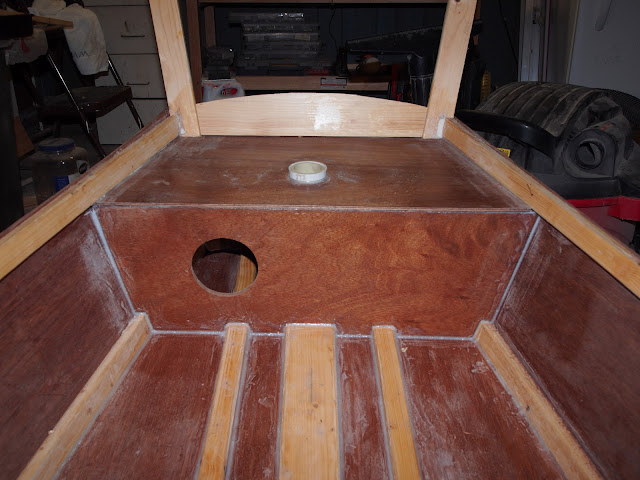
I let her get good and dry and then flipped her over onto a nice soft cloth pad to protect the paint. The frames were still attached and were the way I supported the boat while painting. Now for the first time I got a good look at the inside of the boat. WOW! I had a lot of finishing to do. This included filling screw holes but mainly if was filling in and making filets were the chines, keelson etc. did not seal as tightly as I would have liked. From a functional standpoint the boat was sealed. From and esthetic one I had a lot of work ahead of me. Since the epoxy is pricey I mixed up just enough so I knew that there would be no waste. This was your peanut butter consistency and applied with a tongue depressor went on easily and gave a nice effect. I would give a piece of advice when doing this. Wipe off the excess with a vinegar soaked cloth as soon as you are finished with an area. It is a heck of a lot easier than sanding this rock hard stuff once it dries. 


I still had the frame “legs” uncut. The center ones in particular were a real nuisance to work around so I cut them off almost to where they will be finally but since I still have work to do on the sheer as far as trimming off the plywood I left a few inches that will come off later. Now I at least wasn’t catching myself on this stick that was serving no purpose. The bow and stern legs weren’t nearly the problem and I still haven’t touched them. I went off the CABBS plans for the mast step and thwart. I saw in someone’s plans that they had enclosed this part and made a buoyancy box out of it. I used ¼” maranti for the top which I fitted up tight to the underside of the inwales. Put a few cleats along the sides and fore piece to hold it tight. I then scribed a pattern on cheap plywood for the vertical piece. For this I used ½” maranti figuring that this would be extra cross bracing since I am using ½” plywood instead of the ¾” per plans. I will cut a 2 3/8” hole at the point 11” back from the bow and into this will go a piece of 2” PVC. When finished it will be sealed with epoxy.

What I haven’t got straight (so to speak) yet is the rake of the mast and exactly how the step will be angled. The mast will be reinforced 1 ½” PVC. From what I can tell, and Kyle Leonard has said, the mast should be perpendicular to the sheer line That is what I finally did. I took a piece of 1x4 sprude, used a 2 3/8’ hole saw an cut completely though it and attached it to the keelson in just the right position so that the 2” pPVC would be perpendicular to the sheer line. Not as difficult as it may sound. Used epoxy to fasten it. I put in a 4” water tight inspection port in the vertical piece a little off center so that the area may be used to store a towel etc. I will have pictures of all this. The port cover is frm West Marine and cost less than $10. Really happy with it. As looked at the inside of the bow transom it just looked unfinished so I took a piece of 1x4 spruce, as clear as I could find, and scribed a piece to fit on the inside of the bow on top of the mast thwart. I think it looks pretty good. I am doing the same on the stern with the exception that there will be a perpendicular piece running down to the keelson. Since the gugeons will attach here the added strength makes sense. BUT all this trim work adds weight to the boat so for those wanting the lightest craft possible all this is not for you.
Read More..

December 19 20 Dragon Point to Vero Beach and First Two Lay Days Here 32 4 Miles

Another day of motoring in the ditch with no wind. Passing Johns Island, near Vero, to port, we were impressed by the wealth invested in real estate there recently, lets say within the last decade, in large single family homes. The John Island stretch of the ICW was nice and deep, about 16 - 18 feet, compared with 10 - 14 feet most of the rest of the days passage. possibly the influence of money.
Dragon and Vero are very similar geographically. Both are on the eastern, barrier island side of the ICW, just north of a high, 65 foot bridge linking that island to the mainland. In both cases you continue south until you are almost at the bridge and then hook a sharp left around a green buoy into a small sheltered space.
Vero has a nice municipal marina with docks (at left in photo above) for those who want them and moorings that rent for less than $15 per night, including taxes, cheaper on a weekly, monthly or annual basis.
ILENE is third from right. Sailors on a budget joke that the place is called "Velcro Beach" -- people come here and seem to stick here -- living aboard for about $300 per month. The marina reserves the right to raft you up, as many as three boats on a mooring, but so far we (and all the other moored boats) have been alone. We told the marina to raft up only people who are not allergic or phobic about felines. They have no launch service but a very short dink ride in sheltered water to an ample and secure dinghy dock in a canal just off the harbor.
Good showers and laundry but the wifi is terribly weak: we retreated to ILENE where Lene finished Breaking Bad using most of our remaining monthly allotment of fifteen gigabytes on the last day of the subscription month.
Our neighbors:
The town has a free public transit system of fifteen mapped and scheduled routes. The marina is a stop on Bus Route 1 which runs both to and along the Atlantic coast, about a mile east, leaving at 10 minutes after the hour and west to the airport on the mainland side at 45 minutes after the hour. At the airport, or before, you can connect to most of the other routes but some destinations require three buses. So it is free and extensive but service is limited to once an hour, ending on weekdays at six, Saturdays at three and there is no service on Sundays.
We walked to the beach and back on our first evening (about two miles round trip) and had a mediocre Italian dinner. We took the bus to the mainland market and to the beach for a long walk on it the next day. We had some nice talks with some of the local people. Many jellyfish, about a foot in diameter when flattened, lay dead or dying on the beach, to be cleaned up by the authorities. The Beach is steeper than those at Daytona and Cumberland Island. This beachside town is the opposite of Daytona Beach. No honky tonk.  No cars on the sand. Banks and brokerage houses(insurance, real estate and securities) instead of head shops and tattoo parlors. And no or very few high rises. Moderately large suburban ranch style homes that I guess were built in the 60s.Modest compared to the Johns island megamansions. More older people. Development has been managed here. There are poor people in Vero but not in the beachfront side of this town.
We saw a sign advertising a diver, Peter, who lives on his boat here. He came to do our bottom, said it was rather clean, and replaced our zincs. I was surprised that he charged only $40.00. I topped up the water levels in the seven batteries, which were down very little, except for the group 27 starting battery where the level was too high, above the "fill to this line" mark, so I used an eye dropper (used to test the battery) to draw out the excess fluid from it. I wonder how that happened and what harm the excess acid-water may have done to the battery. Its charge seems better now.
We had planned to stay two days but some forecast  rain and strong winds from the south  may extend our stay until Christmas. It is a pleasant place to be detained and we plan to visit the Art Museum, which is an easy walk, on Sunday, and the Botanical Gardens and a movie at the mall using bus connections after that.
We have also been contacting present and former members of the Harlem YC who live in south Florida at least part of the year, and though some are going north to be with family for the holidays, we expect to rendezvous with at least some of them during the next few weeks.
Read More..

November 8 Swansboro to Wrightsville Beach 49 miles

Yes, a long day -- underway at 6:15 and put anchor down at 3:45 -- 9.5 hours of motoring in the ICW. Today and yesterday we traveled on sections of the ICW that Ive never traversed before, having been outside at these latitudes on past trips. And I noticed how almost exclusively, and less so than in the spring of 2012, the ICW is in fact a one way street - southbound only - and seems devoid of commercial traffic. It is a road dedicated to snowbirds migrating south.

Our depth sounder is perhaps our most valuable piece of navigation equipment in the ditch and we watch it like hawks. When it starts to go from lets say 14 feet of water to 13.9. 13.8, etc, it means one of two things: either we have moved to a section of the ICW with shallower water, or we have started coming closer to one of the sides. We assume it is the later, try to guess which side we are too close to and go gently toward the other side, watching to see it the water deepens under us.

We noticed two potential mechanical problems that have to be thought through. One, the autopilot seems less responsive and more likely to roam a few degrees to either side instead of staying on the straight and narrow,Perhaps it is only a perceptual problem in that we notice the situation more when we are in a narrow path as compared to when there is nothing but horizon in front of us. Two, the voltage on the starting battery is getting low. Both batteries are charged together in the normal course of events, by the solar panel and by running the engine. The third method is by turning on the battery charger when we are attached to shore power. My current theory on this problem is that the battery charger is somehow decreasing rather than increasing the voltage of the starting battery. It seems to have done this last winter when I replaced the battery, and now again in Deatons, where again we had shore power. Yesterday I replaced the broken off lifting stem of the galley sink trap with a bolt and nut from ILENEs collection of them and cleaned out the filter leading to the fresh water pump, thereby restoring a healthy flow of hot and cold water.

Well today: The first thing occurred as we were getting underway in less than full light. About 30 small fishing boats, each with two warmly clad people were milling about. Lene had to pick our way through them while I secure the anchor.Then a siren sounded and they all took off at breakneck speed overtaking
us on both sides, motors roaring and wakes a making.Wild! Some sort of race or fishing contest perhaps.

We saw dolphins again, the third day in a row; they seem to love to play in the inlets and finally Lene got a shot of one, albeit not the greatest.

Why did our passage take so much time? Blame part of it on the bridges. There were four low ones on todays route, for which one has to hurry to be there on time and then to wait with other boats for their appointed opening times. Waiting, keeping a boat stationary in close proximity to others, can be quite a challenging task if there is strong wind and or tidal current. But today there was no wind. Actually we did get a knot from the Genoa for about an hour but after that the wind Gods took a break. By dumb luck we made the first bridge on time. The second required us to push ILENEs Yanmar diesel harder than I have ever pushed her --3000 rpms. In addition, we made it because the kindly bridge tender asked the waiting motor boats whether they would mind a five minute delay in the opening so the three sailboats could catch up. They graciously agreed. But the third and fourth bridges could not be made by speeding up so we had to make the appointed times by slowing down.

Wrightsboro is a college town for nearby UNC Wilmington, which city is far by boat but near by car. The anchorage is easily reached by small boats who take a left turn almost immediately after passing under the last bridge. But this route is not recommended for boats with deeper drafts like ILENE. We had to continue down the ICW for another 1.5 miles, then take the left, leading to Masonboro Inlet with its protective seawalls extending arms out to sea (through which we plan to depart tomorrow for an overnight jaunt to Charleston SC),
and another left along the inside of the barrier island and another mile and a half
to the sheltered anchorage area.

We lowered (and later raised and secured) the dink for a ride in to town, checked out the beach

and brought a few groceries. It is not supposed to be as cold tonight, or tomorrow, as it was last night and today. No, it is not shorts and tee shirts weather yet. And have I mentioned how much I have enjoyed and depended on Lene; without her company and help this trip would be no fun and very difficult.

After anchoring we learned that our friends, Dean and Susan on "Autumn Borne" pulled in here after us, at the end of an ocean sail from Beaufort. They have been chasing us since they left Catskill New York, We had a headstart. But while we are going outside tomorrow for 162 miles, overnight to Charlestown SC, they are going inside and visiting friends for a few days. So for now, we are still just two boats whose wakes have crossed.

Read More..

December 11 13 Daytona Beach to New Smyrna and Two Lay Days There Only 16 Miles

It took only three hours with a fifteen minute delay at a bridge near our destination that opens only every twenty minutes. Cold but clear with more wind than yesterday so we used only the small jib. We passed the Ponce de Leon Inlet with its distinctive lighthouse by the sea.
There were alternate buoyed routes at two points in this short passage and we took the one officially marked as the "ICW route" which was inland from the light. The last time I was here was crewing on a northbound 74 foot motor yacht, m/v "Sea Leaf," in 2012. Then we stopped at a marina by the light before jumping out into the Atlantic for a romp up to Beaufort NC.
Today we could have gone another 32 miles to Titusville, but we broke the trip there from Daytona into two parts by stopping here because Lene heard or read that New Smyrna is a nice town.  This has emerged as our plan for the winter: We are going south in Florida slowly. We are already in Florida but have several hundred miles to get to the Dry Tortugas, which is as far as one can go in the U.S.  This involves a lot of the ICW because many of the ports are not easily accessible from the sea. The two hops from Lake Worth to Fort Lauderdale and from there to Miami Beach, will be out in the Atlantic, during good weather, because of bridges. There are so many bridges that you have to wait for in the first such hop and a fixed 56 foot bridge in the second that we just can not ever get under. And the trip in the Keys is planned as a mix of inside and outside jumps. Having stopped almost everywhere in Florida on our way south, we plan to skip a lot of these same stops on the way north by going outside. A plan that has sort of come to us and like all plans is waiting to be changed.
Anyway New Smyrna is a very nice cozy well run, friendly municipal marina with good showers but mediocre wifi.

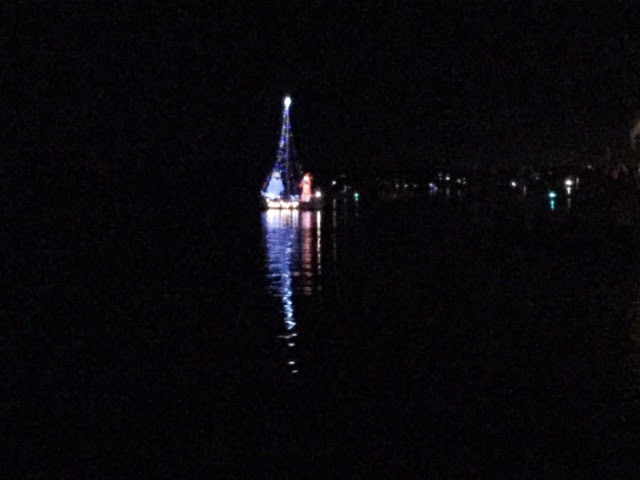
We are at the furthest out slip, which, given how small this place is, was not a disadvantage. In fact it was an advantage because we had a clear unobstructed view of the Christmas Parade of lighted boats on Saturday night from our cockpit. About 20 boats, both power and sail, decked out in vastly colorful lights came up the ICW right past our cockpit. The photos do not do the spectacle justice.
They have a decent history museum here run by the historical society with interesting local artifacts such as the equipment used to cut "cats faces" (shallow "V" shaped slashes) on pine trees to collect the sap to make turpentine. The town got its name from the home town of the founders wife in Greece. The Marina is in the background, two blocks from the museum and between them is a 20 foot high plateau
on which is the ruins of the foundation of either the home that was shelled and burned in a naval bombardment from two US gunboats during the Civil War or a fort. The signage was more directed against vandalism than providing information. The museum has a copy (or original of an affidavit signed by a survivor, after the war, in support of a claim for reparations, asserting that no member of the family lifted arms in support of the Confederacy. I was interested in how the legal form of the affidavit has been relatively unchanged from then to today.
One thing I forgot to report from the museums in St. Augustine is that during the civil war, excluding the native Americans, the total population of Florida was less than 10,000, more than half of them slaves. But you cant believe all you learn in museums: In Fernandina I was told that the original native Americans here were a peaceable and matriarchal society; in St Augustine the story was about the chiefs and the wars between them. Because we can not talk to them directly anymore, each historian draws his or her own conclusions.
The main drag on this half of town, west of the ICW, is called Canal Street,


about six blocks long. We had dinner one night at Yellow Dog Eats on that street, which specializes in variations on pulled pawk. Saturday the street was closed for an antique and classic car show. My friend Jim would have loved the car show. Meticulously maintained and highly shined cars from the 30s through the 70s simply parked on the street, with their owners in lawn chairs nearby to answer questions. Some pride themselves on all original components while others have replaced the interior mechanicals with more powerful and efficient engines.
We took the shuttle bus that picked us up at the far end of Canal Street at Dixie Highway and took us to the beach.
The fare is $0.75 one way for a senior. After a stroll on the beach, we walked the two plus miles back through the main drag of the beach side of town, Flagler Street, and across the bridge that detained us on our passage into town.


Read More..