Tampilkan postingan dengan label days. Tampilkan semua postingan

January 11 15 Five More Lay Days in Coconut Grove 1 5 Miles

We spent four nights at a dock of the Coral Reef YC, after one more rough night on anchor in the John Brennan Channel way off from the Dinner Key Marina. We did not even go ashore the day after the botanical garden trip, because it was so rough. This Google Earth picture shows both locations and the route between them, which is not charted, in the northern half of its brief 1.5 miles. (The dinghy dock is clearly visible in the extreme lower left and the well marked Dinner Key Channel -- through which we entered and will leave -- runs in from below the yellow humanoid figure in the upper right, slightly downward to the left, between two islands. The chart does not indicate and I am not sure which of the islands shown is actually Dinner Key.)
 The white dots, right side lower central are moored boats. They are rather orderly, like grave stones, because mooring fields are generally laid out in an orderly manner. We were anchored to the right of them, off the picture, in the anchorage area, where such orderliness does not exist. Our first anchoring attempt (not enough water) was among the white dots at the extreme lower right corner. The dark blue between these two fields of dots is the John Brennan Channel. To got to the Coral Reef YC we motored (1) to the  left through that well marked channel, (2) south of the lower end of the berm that runs sort of vertically past the end of the seven docks of the Dinner Key YC, (3) turned left to pass between the ends of those docks and the island running to the upper right, and (4) hugging the ends of the smaller docks, toward the upper left where we (5)entered and tied on, facing the shore, between the two shoreward docks extending downward from the "E" shaped dock in the extreme upper left.
 After bringing ILENE to the dock we went to the movies seeing Big Eyes (about an female artist who painted children with emotive big eyes and her emotionally abusive husband) and Inherent Vice (which provided a vehicle for actors to act as trashy people doing trashy things which signified nothing and was a waste of time). And we stopped at Fresh Market for take out food to eat at home, i.e., aboard.
We learned the local mass transit system and used it to visit local cultural attractions. This included the rather new, large and very elegant Perez Art Museum of Miami (PAMM).
The 249 bus took us from two blocks from the YC, about a mile, to the Coconut Grove light rail elevated system station which in turn took us to the People Mover, a free elevated loop in the central downtown area, which left us a block from the museum, of which the Miamians are quite proud, having spent $200 million on its construction in prime real estate next to the new concert hall and the new science museum under construction.
Lene hooked up with the same Rhonda who we had dined with on our first night in Miami Beach and three other women. She viewed the art and had lunch with them. I explored the art myself. It rained a lot early in the day but we had our foulies and did not get very wet. Most of the artists were not known to me and most had some Miami or south Florida connection by birth, education, work, residence or death.They had a large collection of pop art, by name brand artists: Warhol, Lichtenstein, etc. which Lene liked. This seemed old to me. These two works, one inside and one out, are based on geodesic domes.


My favorite was this painting, approximately 5 by 8 feet by my guess, by an African artist. Three zig zag lines, two starting in the upper right and one from the top toward the left define the spaces that are painted in. And the bottom represents more, little triangles that I saw as water in this landscape, though the plackard said it could be a TV static pattern. I spent quite a few minutes intrigued by this one.
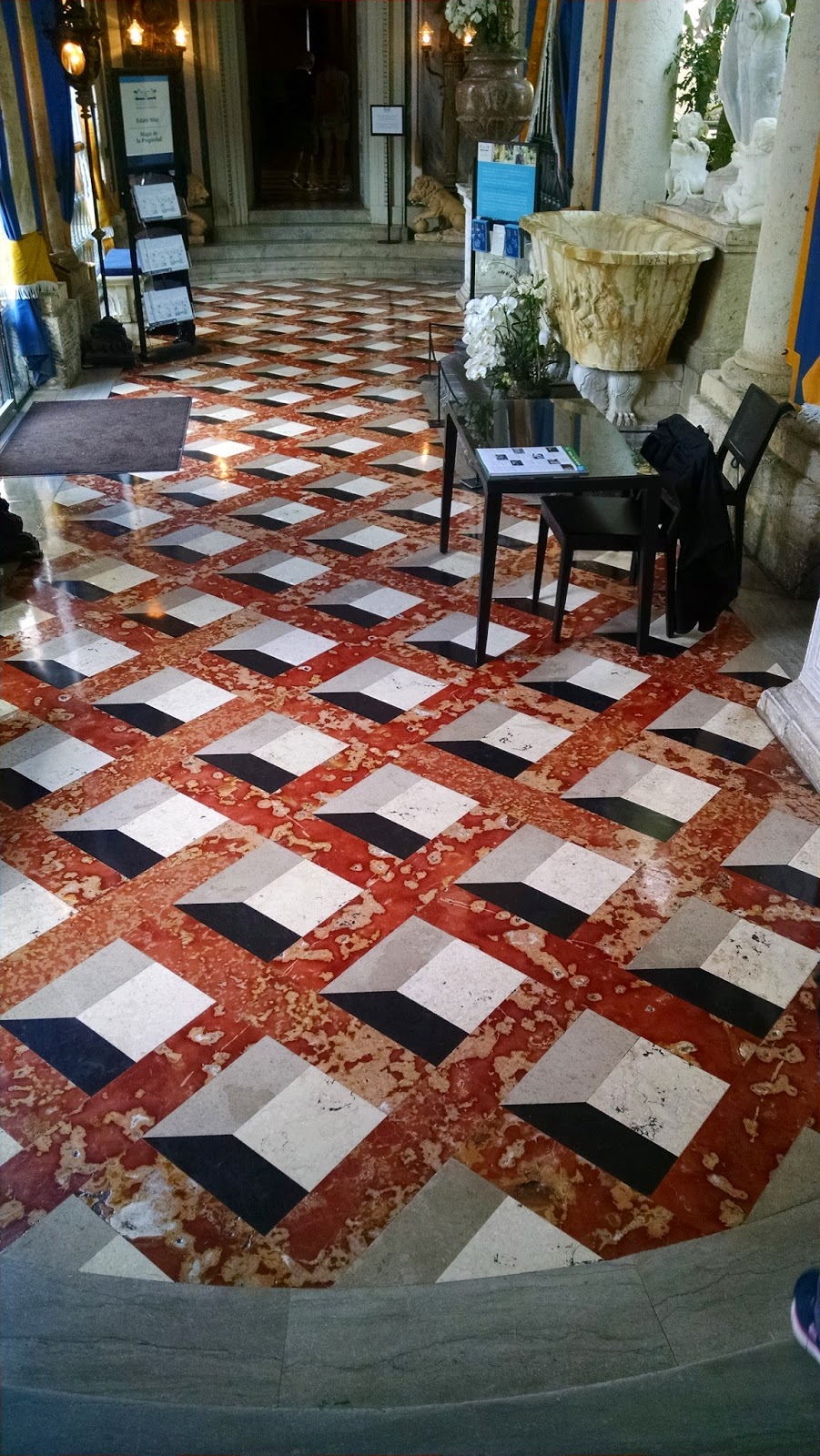
Another day we visited Viscaya, the seaside mansion of John Deering of John Deere fame, another Breakers-like home of the rich. This one was built during the portion of WWI before the US went "over there" to end it. Deering was a bachelor and imported fountains and whole rooms of walls and furniture from Europe. Quite lovely actually. The big change here in the last century was the erection of a glass roof to cover and hence seal off the central courtyard onto which all rooms of all three floors open -- to keep out the salt air and rain. This, of course, also necessitated air conditioning. And the gardens are not what they once were. I love these marble floors of theseaside and land entryways:


The gardens are nothing to sneeze at either, and here is one of the fountains with "merboys"  --mermaids with boys instead of girls.


A large stone Venetian barge (a place for guests to recline at ease) was built on a sandbank to protect Vizcayas sea entrance, with me at the extreme left and the towers over Government Cut barely visible on the horizon in the between. A bird walked by unconcerned with his proximity to humans.
One evening some young men strolled past our boat and started up a conversation because they recognized ILENE. Russ and Tom had sailed with my late son-in-law, Julien, and sung his praises and those of my daughter who they asked me to convey their good wishes. Small world.
We spent a pleasant afternoon lounging at the YCs underutilized swimming pool and, after some wine aboard, had a nice dinner at the Yacht Club with Jerry and Louise, who came over from Miami Beach and took us to Publix afterwards so Lene could get some products that the very nearby Fresh Foods does not stock, e.g. frozen blueberries and sugarless peanut butter. We lucked out that this was an all you can eat pasta plus night for only $17.00.  I have yet to learn how to avoid over stuffing myself at such affairs, though. The eighteen percent service charge is added to the bill automatically. This club has lots of helpful friendly staff to serve its 800 members, most of who do not keep boats here. It has fixed concrete piers against which we put up the fender board. The docks are busy by day with contractors and many people in suits apparently use the club day and night as a venue to do business. The only drawback is that on sunny days numerous black birds sit in the rigging and emit the remains of their fruit based diet, staining the deck. I washed it off over and over and will use bleach on the remaining stubborn though by now faint stains.
Another evening we were visited by Janet (who had taken us to the Chihuly exhibit) and another member of Lenes grade school posse, also named Rhonda. Rhonda was in town from New York to visit her Mom. After wine and cheese and a tour of the boat, I had, among other things, a single stone crab leg, my first, a delicacy here, and not as good as other seafood to my taste. This was at the well known but not excessively expensive (except for stone crab legs) Montes, on the water, less than a quarter mile away. Photo to be added. Janet and ?Ed may drive down to Marathon to visit us there, and perhaps to fish, though access to the boat on anchor or mooring will be more difficult for Janet than dockside. Also, yesterdays news about Cuba has started us thinking about getting the charts and cruising guides we will need for such a visit, though our insurer, Pantaenius, has not yet come around on this issue. They have several weeks to do so. Life is very very good.

Read More..

Rhode River to Cambridge and Three Lay Days in Cambridge October 13 17 38 7 Miles

First the passage: The wind was predicted at 5 knots, building to 15, in our face. Not pleasant, but manageable. It came from the predicted direction, a bit east of south, but at  20 to 25 knots and one has to add five to that to account for our boats speed into it!  And with Chesapeake Bay running generally north-south, the wind had time to work up large stiff waves of up to five feet. ILENE was pitching in these waves, some of them breaking over her bow, throwing spray back onto us. And with both these waves and the wind pushing us backwards, we were making only about four knots over the ground -- making for a long day to cover the 34 miles involved.

What to do. We changed course by 35 degrees, with the engine still working at its high speed for continuous use, 2500 rpms, and put out the small jib. Now less pitching, speed up to over six knots and a whole lot of heeling. The Saga owners network is having a discussion of the merits of adding  a ton of extra lead at the bottom of the keel (a sole under the keels foot as it were) and with Lene reporting this was on her "ten worst passages" list, I think the time has finally come to bite the financial bullet and do this -- next winter, when the boat is hauled. I thought of taking photos for you, or video, which could have shown the excitement, but decided to keep the salt water off the iPad, which was in a ziplock bag.

Turning a bit east, into the Choptank River, the wind was 60 to 80 degrees off the starboard bow and our speed was over seven knots with the throttle turned way down.  But this wide but shallow river twists and turns and when we came to a point where tacking in the channel would have been required we elected to furl the small sail and motor the rest of the way.  The trip took seven hours, from 11 to 6.

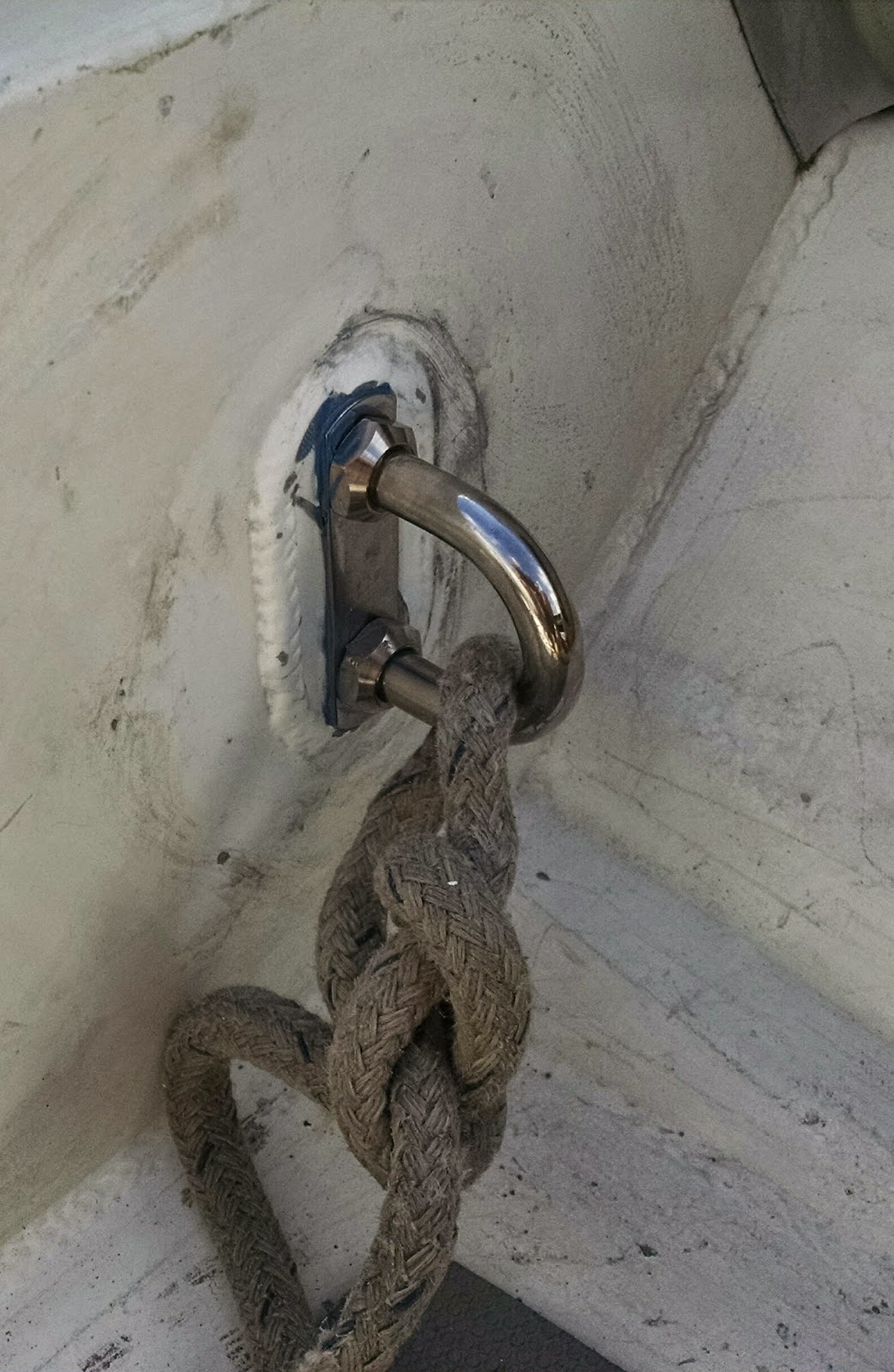
The landing at a dock in the Cambridge YC was very poor due to Captain Roger forgetting an important rule: always check the wind direction when attempting a landing at a dock. Maybe I was tired -- a reason but not an excuse. Anyway, the wind blew us onto the dock. We should have aimed further away from the dock, stopped and let the wind blow us to the Tee dock. Instead, with some way still on, we crashed our starboard quarter with the dinghy, hanging from its davits athwart the stern and protruding a few inches out past the side of the boat on each side, catching the dinks bow on one of the pilings that support the fixed height dock.  The painter, which is one of three lines used to snug the dinghy to the boat, parted (here reattached and a foot shorter),
and one of the welded aluminum


 padeyes holding up the bow ripped open.
But we landed and enjoyed three days at the YC, though the first of them was rainy.


On the sunny days that followed we enjoyed this view from ILENE of a replica of a screwpile lighthouse at the adjacent marina. I visited our friend, Johns meticulously maintained 28 foot S2, "Hearts Content" there.
 John, a former New Yorker and Harlemite was the best host one could find and our reason for staying in Cambridge. He has many talents in boating and as a mechanic, and he has a whole lot of power tools and the knowledge of how to use them. He rebuilt the interiors of the Plaza hotel and Columbia Universitys Butler Library as well as working for 15 years in NY theater, both on the stage and behind it. A gentleman and a pleasure to be with who put himself at our service. 
He drove us all around the town (population 12,250) showing us where everything was, took us to the post office to mail time sensitive mail, to the hardware store where we got a stainless steel padeye, bolts split washers, to the supermarket, several times, for provisions, to his home where we hacked off the extra length of the 1/2" bolts of the padeye and chamfered the edges, did our laundry and printed out a letter that was on our computer. He lent us one of his cars. He came to the boat and "helped" (lets just say he did the jobs with me as helper/learner/doer of the easy parts). He ground off the remnants of the old aluminum padeye, drilled the 1/2 inch holes for the new bolts
and we attached the new stainless padeye -- stronger than before!
We also replaced the old carburetor with the new one which had been fedexed to his house and he showed me how to adjust the idle and it works again!


We spent our days here with John and actually stayed the fourth night, when it was much calmer, at the wall of the town basin, rent free.
For our stay in the basin, he suggested the creation of the fender board, shown here, which uses two fenders and a hanging board to keep the pilings from harming the boat.
We watched Johns TV. He took us to his favorite restaurants and bar, Leaky Petes, where we had Natty Bos (National Bohemian beer). We tried scrapple, and crab, oyster and fish.


Cambridge is a very sleepy town, which has seen better times, especially its downtown district, which was devastated by suburban stores, fires, the recession and greed. We toured its Arts Center, and visited its Maritime Museum
and the Harriet Tubman Museum, but  the last two were closed.


Here are the kitties exploring a neighboring boat at the YC; maybe they smelled fish.
And I just loved this one, which I call "Still Life with Boat".

On our last day John took us on a long car ride to the southernmost of the three Hoopers Islands, connected by road and only a few feet above sea level, and populated mostly by watermen (crab and oyster harvesters) and their families. These islands were reached after driving through the Blackwater Wildlife Preserve, a huge swampy expanse.  We had lunch at Old Saltys

which has this wonderful view of mainland Maryland, the thin line at the horizon, across the Bay,
where we will be going next. John and I are planning the next leg of the cruise, I wish we could have persuaded him to come along for a few days.
Read More..

January 22 26 Five Lay Days in Marathon Zero Miles

Mike and Bev are in the Marathon Community Theater -- operating since 1944!  Well, they have only been in it for seven years; he is an actor and she is lighting crew. We went to their production of "Harvey". Actually, they drove us there. They had to be there early which gave us time for pre-theater dinner at the nearby Cracked Conch Cafe. I pigged out on conch chowder, conch fingers and key lime pie -- and a local beer! If you are going to eat native, go all the way. (ful disclosure: the conch comes in from Turks and Caicos and most key limes are not grown in the Keys.)
Other friends drove us to the local Publix, a little over a mile away, at which we stocked up on everything except Boars Head cold cuts; they sell -- for $3 less per pound than anywhere else -- at the nearby liquor store/deli, where we stocked up. Cab ride back: $4.00
We volunteered to help kids make "projects" out of materials donated by Home Depot, as part of a Family Fun Day at the adjacent municipal park, but the event was cancelled due to adverse weather. It didnt actually rain but threatened and there was a strong wind. We had a mango pancake breakfast on ILENE with Marsha and John, of the Saga 43, "Remora".
Nice folks and we compared our boats; theirs is six years younger and some improvements were made but other good features had been discontinued. They are from Houston and had sailed across the Gulf.
Around noon, the wind came up very strong and our anchor dragged -- a very bad thing in this crowd. We would have gone aground or crashed into other boats (even floating at one knot, ten tons can do a lot of damage to both boats). Luckily we saw it, got the engine and windlass on and Lene steered, I picked up the anchor and we moved to a slightly better location where we dropped again, let out more scope and held while the boat hunted back and forth, getting close, fifty feet, from "Selkie",
an aluminum hull from Cork, Ireland. Selkies captain came over in his dink and we invited his son and daughter, age six and ten (and their parents) over later, to play with our felines.
We were more lucky than a nearby boat, behind us -- facing the wrong way and heeled over -- that dragged into the sandy mud.
 Fortunately, they were afloat again the next morning. We would like to be on a mooring which is more secure against dragging, but no one is leaving until a weather window opens up for the Bahamas.
The daily radio net on VHF channel 68 creates a community among the boaters. It has a section called "Activities": movies,  theater, daily specials at restaurants, archery lessons, bible study, astronomy, meetings on human trafficking, passages to the Bahamas, etc. get announced. I asked whether anyone else sailing with cats wanted to  get together to share stories. But we had to leave our radio and did not get the replies, if any, which were to be shared on Channel 69 after the net. But next day s/v "Mardi Gras", from St. Louis, MO, with Barry and Linda aboard, hailed us while leaving Marathon by yelling, and gave us their phone number, so we could later exchange cat stories. Their stories were about Pearls swim one night when she got distracted while chasing a moth, and the crazy obscure hidden places in Mardi Gras  in which Pearl was able to trap herself. Similar to our cats adventures with variations. Their blog is sailmardigras.blogspot.com. We may see them in Key West or the Tortugas.
Our new pencil holder arrived and is installed. Lene hadnt liked the idea until now. I had thought this would be useful for several
years, to avoid having to open the hinged top of the desk and look under it for a pencil but didnt get one until now.
The movie "Red Dot On The Ocean" a documentary about Matt Rutherford, was shown on a sheet hung at the outdoor Tiki Lounge, next to the main marina building one evening. Matt, who had a troubled past with school, family, substances and the law, sailed an old Vega 27 -- a 27 foot boat -- around the Americas, departing from Little Creek Virginia and returning back there 309 days later, including west through the northwest passage above Canada to the Pacific and around Cape Horn -- (1) alone, (2) without stopping or going ashore and (3) on a short budget. He was met twice by other boats who brought him food and a replacement hand powered water maker. He had essentially no spare parts, sails, etc, and when he got back the boat was filthy and almost everything was broken, except his spirits. The film was highlighted by the presence of its director and producer,
Amy, from "Mary T", on a mooring. Needless to say this movie was appreciated by the audience, including us. Free admission! A real treat.
Technically, we are in Boot Key Harbor, formed by Marathon to the north (on which Route 1, the black line, runs), Boot Key to the South and Vaca Key to the east. We entered between the two red dots in the upper left (The upper one is a green buoy) and motored 1.2 miles east to between R"16" and R"18", shown just below the word "MARATHON."  From here it is a .6 mile dinghy ride, first continuing west and then north to the the land jutting south from Marathon by the buoy "5B". The greenish spot extending just below 5B called PA is a shoaly sea grass area, too shallow for even the dink. Thus, the harbor has room for expansion if people have the money to spend and the Corps of Engineers would permit this large squarish area, perhaps 200 yards on each side, to be dredged.
One morning we dinked through Sisters Creek which is the other entrance to the harbor, for dinghys and boats of up to four feet draft, to visit Sombrero Beach. The Creek is shown on the southern part of the chart and separates Boot key from Vaca Key. The water at the beach was warm enough for barefoot wading but  the air was cool enough for the sweatshirt. When I was in Key West for antisubmarine training in the fall of 1965, the type of seaweed that lines the shore here was made wet by daily rain and rotted in the intense heat, giving off a sulfurous gas that peeled the paint from peoples houses! No such problem here.
The municipal marina is next to the city park where they have tennis courts and shuffleboard courts and equipment and probably lots of other things, available for rent, if you can call it that, because they are free.

Readers may recall my friend Hugh, from my navy days, who sailed with me with his grandson, Levi, in Boston Harbor in early August 2013 and who visited us with Levi in NY in 2014. Learning that we were to be in Marathon through this blog, he put me in touch with his Machetonim (Yiddish word to describe ones childs in-laws), Beverly, who lives here. We contacted her but our first proposed meeting had to be cancelled by us due to excessive wind making the dink ride uncomfortable, and to be here in case of dragging.
We have spent two, non-consecutive days aboard here due to high winds. In the later, our extra scope and the shifting direction of the wind put us in the channel and we were directed to move and did so, to a new spot about .2 miles further from the marina. Our plan calls for us to stay here a few more days.
When I drove to and from Key West in 1965, the keys were largely unpopulated, just a few bars and low budget motels is all I recall. The place has filled in with the rest of Florida.
Read More..

February 3 6 3 5 Lay Days in Key West Zero Miles

Im calling it 3.5 lay days because we got in so early on Feb. 3, shortly after 1 pm. We strolled Mallory Square and Duval Street -- the heart of the islands tourism. The cruise ships tie up at Mallory Square. The buskers perform there. The town is jammed with tourism. Countless bars (someone said 400), restaurants, shops (chi chi and otherwise), B and Bs, and boats selling trips to fish, sail, look through glass bottoms, dive, snorkel, or jet-ski etc. Most of the  B and Bs and restaurants are in former homes in residential neighborhoods. There are also many larger hotels, new and old.  This town is SO changed from my navy days here, the two months of August and September of 1965.  Possibly this had something to do with the season. Then it was hot -- the seaweed that washed ashore rotted on the beaches giving off  sulfurous fumes that peeled the paint off houses!

When a hurricane came through, my ex and I were ordered to evacuate the little cinder block house we inhabited and stay in the navy school, perhaps the sturdiest structure on the island. We parked our little red Triumph Spitfire on the navy bases baseball field, which was on high(er) ground. I went looking for the squat hot cinder block apartment where we lived but sometime in the last 50 years it had been replaced, with a larger more upscale structure.  It was right down the street from a large parcel of land that was all boarded up in 1965.

When next I visited this island, in the mid 80s the Bar Association Section meeting was held behind those boards -- in the newly renovated Marriott Casa Marina Hotel. The original Casa Marina had been built by Henry Flagler, at the end of Flagler Avenue. The road, Highway 1, which ends (or begins) here, was not a road 100 years ago, but a railroad. The Casa Marina is now a Waldorf Astoria Hotel after an additional renovation.
It was from the beach of the Casa Marina that I had my first sailing lesson, only five minutes long and not long enough: we capsized the Hobie cat several times, righted her, beached her on off-limits property of the Navy base and told the hotel to come and get it and us -- a better solution than going the other way -- to Cuba. And I learned through that experience that I needed lessons to become a sailor.

We were on a budget back in the mid 60s. Movies on the navy base and reading of the NY Times Sunday edition were our primary leisure activities plus swimming in the base pool and shopping at the PX.  The Jewish high holy days took place during our time here. In my Ensigns white uniform my ex and I attended the local synagogue, which has long since been replaced by a larger modern structure. The congregation raised funds by offering ritual honors to those who could afford to buy them. One man gave his honor "to the Navy boy".  Later, my ex said: "Hes taken!" when the gentleman, a local merchant, tried to introduce me to his daughter. Another merchant invited us to the post-prayer feast at his home following services. There I ate my first gefilte fish, home made by his black maid. My father was right! I didnt know what I had been missing.

The island was at a nadir in the 60s which I imagined got worse when the navy shut its base and pulled up stakes here. Duval Street was undergoing a repaving job which lasted most of our two months. Sloppy Joes, on Duval, Hemingways favorite bar, was a stop for us then, no trouble finding a place at the bar.

But I have been told that it was the departure of the navy which created the start of the tourist boom here. One thing remains the same: the roar of navy jets taking off from the naval air base on adjacent Boca Chica Key, due east of here. LOUD! Another thing is new -- I dont recall it in the past: as in the Caribbean nations, chickens roam the streets, their crowing ringing out in the night. you might call them free range chickens.

OK, Roger; enough nostalgia!

We visited "The Little White House",  Harry Trumans favorite retreat during and following his term of office. We enjoyed an excellent informative tour by docent Rene. The navy came to Key West early in the 19th century, long before Florida was a state, and created a base to fight our enemy -- pirates!
The place had become a submarine base and when President Truman was ordered by his doctors to take his first vacation after many months in office
-- in a warm place -- Key West was chosen. The position of base commander being vacant, that officers residence was used. The President loved it here and the navy improved, expanded and redecorated it for his future use. Other executives have used it too, most recently, Collin Powell, as Secretary of State, to work out the settlement of the Balkan War. The place was sold to a developer who wanted to develop Tank Island, across the harbor. He needed easements and the State said: "Sure, IF you fix up the Little White House and give it to the state as a tourist site."

We had a pretty good dinner on Lenes birthday at "Flaming Buoy".  The original proposed name was "Flaming Buoy and Hot Grill." Key West, like Provincetown, has a lively gay segment of its population.

We had breakfast at "Blue Heaven", highly rated and decent and a lunch in a very nice retro Chinese restaurant (when have you last seen Chow Mein or Chop Suey on a menu?) because we were cold walking home during the rare all-day rain. We do not eat deserts so we were not able to patronize a desert restaurant named "Better Than Sex."Its menu has suggestive double entendred names.

The rain came after the day I scrubbed ILENEs topsides. I used FRS to get the rust stains out near where the anchor rode has been shedding pieces of rust. It worked well.

We visited the two iconic sites of Key West:


We had a nice dinner aboard with Alice and Danny. Well, left over sausage, pepper and onion with pasta, red sauce and cheese, plus salad, wine and fresh fruit. No one went to bed hungry. Alice is a friend of Lenes from NY, now living in North Carolina and married to Danny. I had never met either of them before. They are here on a land vacation, found we were here via Facebook and we got connected. Lovely people and a nice evening.


Ernest Hemingways house was a repeat tour for both Lene and me, though we had each visited it in the past with others. The crowd there reminded me of  the Sistine Chapel in July. Another excellent informative and entertaining docent with what might be called Key West attitude.
One of the 45 six toed cats that have
 the run on the place, on the marital bed.

His study in loft above the caraige house where he worked
from 6 a.m. each day and wrote most of his books


Papa Hemingway surrounded by his
 four wives, one of who bought this house for him.


And while the light house has been here since the mid 19th century, it was not on the tourist list until recently.  Unlike the lights of Scotland described in a book review in a recent post, this one was set way back from the sea, on high ground, and made of brick. It was decommissioned in the 1960s. The  picture of it is from the Hemingway House balcony. We climbed the 88 steps and saw the museum in the keepers house.


We will be here in the Bight for a few more days.


Read More..

May 12 13 Last Two Lay Days in Washington No miles

No, not a Maritime Museum. This is one of the fishing boats used by the Danes in WWII to smuggle most of their 7000 Jews into neutral Sweden. It is one of the many artifacts in the United States Holocaust Memorial Museum.
I spent a whole day (10 to 5:15) here and did not see it all. Designed of the same beautiful pale yellow stone that is used in most other government buildings in this city, the interior has a long atrium around which the horrible history unfolds, as one starts on the fourth floor and works ones way down. This atrium is glass covered and reminded me of a railroad station  -- such an integral part of the Germans "Final Solution". I have been to such museums in NY, Jerusalem and smaller ones in many other cities but none that were as comprehensive, with a significant slant on US responses before, during and after the war. It showed how gradually Hitler came to power, consolidated his power and set to work first trying to drive the Jews out by making life unbearable and dangerous, then deporting them and finally, exterminating them. One huge wall of etched glass, has the names of the numerous European towns where Jews lived before Hitler, including my fathers birthplace, Untergrombach, middle row, right, with my imagined "RR Station" below.
The place was very crowded with lots of high school kids who were very respectful. I was quite moved by the experience. The museum repeatedly discussed the plight of the Roma (gypsies) and other victims. It also had exhibits on the three post-Holocaust genocides: Cambodias killing fields, the Serbo-Croation conflict and Rwanda. It seems humanity has not learned yet, despite the saying "Never Again! We had lunch in the museums cafe, located in a small building outside the Memorial.
Our final day was for Congress and the Library of Congress. We had planned to visit the adjacent Supreme Court as well. I had to be admitted to its Bar to oppose a Petition for Certiorari  in the late 70s. (Since about 95 to 99 percent of such petitions are denied, winning that one was rather easy.) But our tourism stamina gave out before we got there, which was a shame because Lene has never been there. On our way we passed the Frances Perkins Department of Labor Building.
Ms. Perkins was one of FDRs "brain trust" and the first female Secretary of Labor. She co-taught a seminar in labor history I took at Cornell in about 1964.
In 2008 Congress opened a huge underground entrance, visitors center, "Emancipation Hall," with Museum, gift shops, a large cafeteria and many restrooms to handle the throngs of tourists. We were shown an inspirational movie about how well Congress works, which is somewhat of a joke given todays hyperpartisanship. Leah, our assigned
tour guide was energetic and bright with the kids but the tour did not include either house of the Congress. We easily secured a pass to visit the House, which was in session, but just barely. The person acting as speaker recognized a stream of Representatives who rose to give speeches of up to four minutes. It was mostly women in red suits on the Democratic side and men in blue suits on the other side. Several democrats spoke in favor of refinancing the Highway Trust Fund and opposing yet-another bill to restrict abortion, which the Republicans are addicted to and will undoubtedly pass. The Republicans spoke in favor of the anti-abortion bill and in memory of slain police officers. They all spoke to an almost empty room. The speeches go into the Congressional Record and are fodder for the folks back home. "See how I represented your interests!"
After lunch we visited the Library of Congress through an underground tunnel which avoids having to go through security again. Our first time here.


The entrance hall reminded me of The Hermitage in St. Petersberg, with its staircase, marble, red, statuary and grandeur.


The main reading room is much smaller than the one in NY but more elegant.
A highlight of my stay here was a visit to the Geography and Map division, where I was given access to their collection of nautical charts published by the United States Navys  Hydrographic Office from about 1850 to 1950. The charts are numbered, to about 6500, with some omissions. I have been studying them and cataloging them, as a volunteer in the Map Room of the NY Public Library for about seven years now. They describe the coastlines of the world (excluding the U.S. and the Philippines which are the subject of a similar series of charts published by the Coast Guard. Each branch of the armed forces had its champions in Congress and back in the 19th century they worked out this geographic compromise.)  I had a good conversation with the director of the map room who invited me back. Maybe, by land, some day.
I also saw a German antiquarian map of the world, in Latin, published a few decades after 1492, purchased for $11,000,000 (less than half of it taxpayer dollars), an exhibition of Herblock political cartoons, and a recreation of Thomas Jeffersons circular library of Monticello (he sold it to the government) with mostly his original books. He was a well read man.
Read More..