Tampilkan postingan dengan label 7. Tampilkan semua postingan

Rhode River to Cambridge and Three Lay Days in Cambridge October 13 17 38 7 Miles

First the passage: The wind was predicted at 5 knots, building to 15, in our face. Not pleasant, but manageable. It came from the predicted direction, a bit east of south, but at  20 to 25 knots and one has to add five to that to account for our boats speed into it!  And with Chesapeake Bay running generally north-south, the wind had time to work up large stiff waves of up to five feet. ILENE was pitching in these waves, some of them breaking over her bow, throwing spray back onto us. And with both these waves and the wind pushing us backwards, we were making only about four knots over the ground -- making for a long day to cover the 34 miles involved.

What to do. We changed course by 35 degrees, with the engine still working at its high speed for continuous use, 2500 rpms, and put out the small jib. Now less pitching, speed up to over six knots and a whole lot of heeling. The Saga owners network is having a discussion of the merits of adding  a ton of extra lead at the bottom of the keel (a sole under the keels foot as it were) and with Lene reporting this was on her "ten worst passages" list, I think the time has finally come to bite the financial bullet and do this -- next winter, when the boat is hauled. I thought of taking photos for you, or video, which could have shown the excitement, but decided to keep the salt water off the iPad, which was in a ziplock bag.

Turning a bit east, into the Choptank River, the wind was 60 to 80 degrees off the starboard bow and our speed was over seven knots with the throttle turned way down.  But this wide but shallow river twists and turns and when we came to a point where tacking in the channel would have been required we elected to furl the small sail and motor the rest of the way.  The trip took seven hours, from 11 to 6.

The landing at a dock in the Cambridge YC was very poor due to Captain Roger forgetting an important rule: always check the wind direction when attempting a landing at a dock. Maybe I was tired -- a reason but not an excuse. Anyway, the wind blew us onto the dock. We should have aimed further away from the dock, stopped and let the wind blow us to the Tee dock. Instead, with some way still on, we crashed our starboard quarter with the dinghy, hanging from its davits athwart the stern and protruding a few inches out past the side of the boat on each side, catching the dinks bow on one of the pilings that support the fixed height dock.  The painter, which is one of three lines used to snug the dinghy to the boat, parted (here reattached and a foot shorter),
and one of the welded aluminum


 padeyes holding up the bow ripped open.
But we landed and enjoyed three days at the YC, though the first of them was rainy.


On the sunny days that followed we enjoyed this view from ILENE of a replica of a screwpile lighthouse at the adjacent marina. I visited our friend, Johns meticulously maintained 28 foot S2, "Hearts Content" there.
 John, a former New Yorker and Harlemite was the best host one could find and our reason for staying in Cambridge. He has many talents in boating and as a mechanic, and he has a whole lot of power tools and the knowledge of how to use them. He rebuilt the interiors of the Plaza hotel and Columbia Universitys Butler Library as well as working for 15 years in NY theater, both on the stage and behind it. A gentleman and a pleasure to be with who put himself at our service. 
He drove us all around the town (population 12,250) showing us where everything was, took us to the post office to mail time sensitive mail, to the hardware store where we got a stainless steel padeye, bolts split washers, to the supermarket, several times, for provisions, to his home where we hacked off the extra length of the 1/2" bolts of the padeye and chamfered the edges, did our laundry and printed out a letter that was on our computer. He lent us one of his cars. He came to the boat and "helped" (lets just say he did the jobs with me as helper/learner/doer of the easy parts). He ground off the remnants of the old aluminum padeye, drilled the 1/2 inch holes for the new bolts
and we attached the new stainless padeye -- stronger than before!
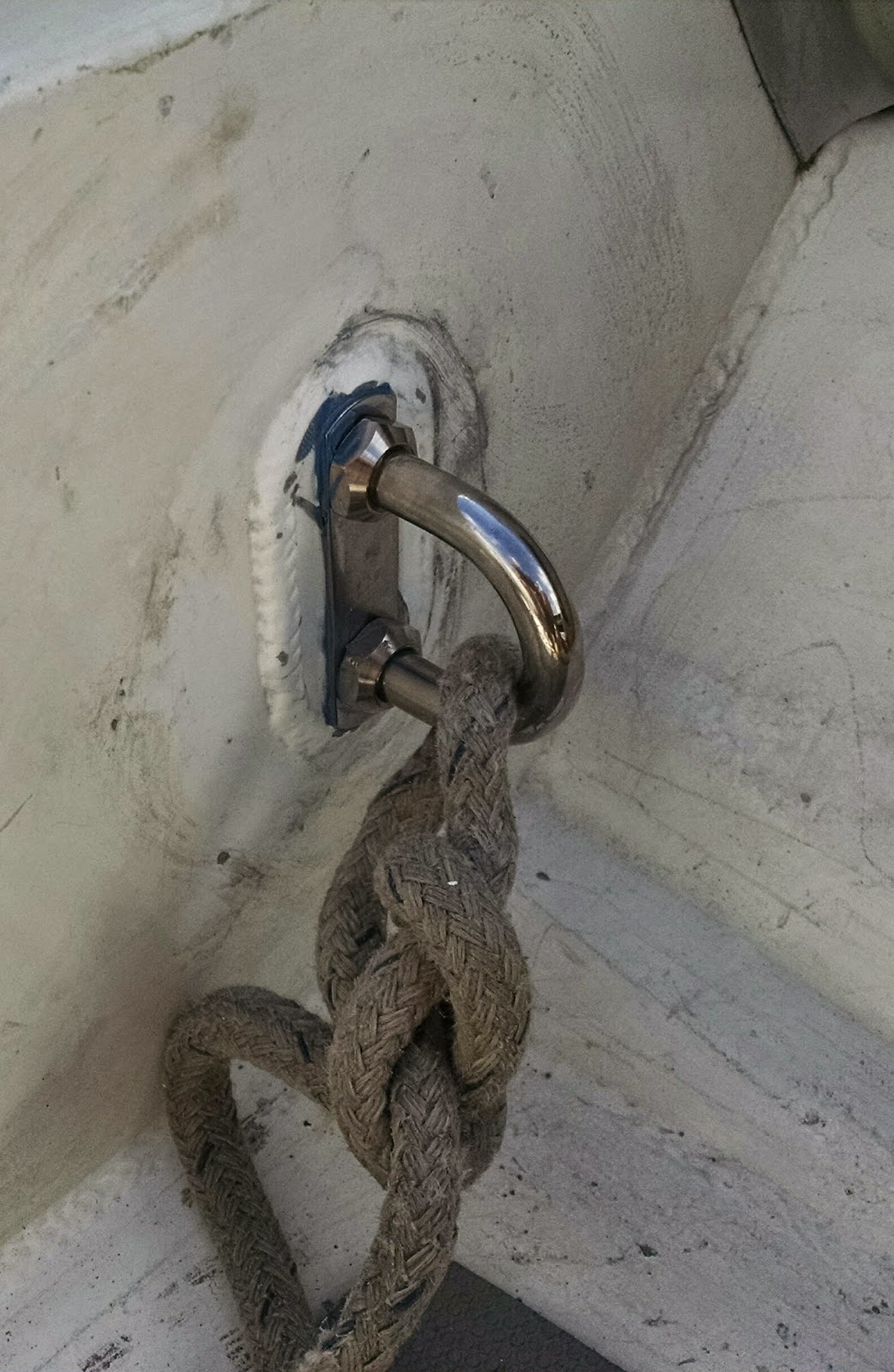
We also replaced the old carburetor with the new one which had been fedexed to his house and he showed me how to adjust the idle and it works again!


We spent our days here with John and actually stayed the fourth night, when it was much calmer, at the wall of the town basin, rent free.
For our stay in the basin, he suggested the creation of the fender board, shown here, which uses two fenders and a hanging board to keep the pilings from harming the boat.
We watched Johns TV. He took us to his favorite restaurants and bar, Leaky Petes, where we had Natty Bos (National Bohemian beer). We tried scrapple, and crab, oyster and fish.


Cambridge is a very sleepy town, which has seen better times, especially its downtown district, which was devastated by suburban stores, fires, the recession and greed. We toured its Arts Center, and visited its Maritime Museum
and the Harriet Tubman Museum, but  the last two were closed.


Here are the kitties exploring a neighboring boat at the YC; maybe they smelled fish.
And I just loved this one, which I call "Still Life with Boat".

On our last day John took us on a long car ride to the southernmost of the three Hoopers Islands, connected by road and only a few feet above sea level, and populated mostly by watermen (crab and oyster harvesters) and their families. These islands were reached after driving through the Blackwater Wildlife Preserve, a huge swampy expanse.  We had lunch at Old Saltys

which has this wonderful view of mainland Maryland, the thin line at the horizon, across the Bay,
where we will be going next. John and I are planning the next leg of the cruise, I wish we could have persuaded him to come along for a few days.
Read More..

April 25 26 Beaufort to River Dunes Marina Oriental NC and Lay Day There 28 7 Miles

At 8:10, we had help from the Beaufort Docks staff  "springing" us off the docks so our stern was swung out and we could back out safely. (They hold a line from our stern on the end of the dock while we go in reverse while trying to steer out. It works!)  This was the time of my choosing, but about 10 minutes too soon, resulting in a wait of that duration for the 8:30 opening of the Beaufort Bascule Bridge.
Once clear of the bridge we went perhaps a hundred fifty yards and then aground in mud. There is a fork in the watery path, of which we have to take the right because the left fork was silted in years ago. Mindful of that, I was so vigilant to to not take the right that I took a left, but at  earlier fork, and into a channel that was too shallow for ILENE at low tide. It was low tide so I knew we would float off eventually. But after half an hour I tried another trick. I swung the boom far out to starboard and hung my weight way over the side of the boat to heel her, just a few degrees, to break the contact of the keel with the mud, while Lene gunned the diesel. We were off again, delayed by half an hour, but no worse for wear. It seems I make more mistakes first thing in the morning. This is something to watch out for.
From then on, the only problem was the tide which slowed our progress up the Beaufort River, and through Adams Creek. With low tide at Beaufort at about 9, I thought we would have the help of a flooding tide pushing us on our way up. No such luck. About ten miles up is a high bridge and there the low was at 10:30. I put up the small jib but furled it soon, when it was obvious that there was NO apparent wind to breathe life into it. Even in the broad Neuse River, which we beat down in 2012, there was no wind. Our depth sounder stopped working for about ten minutes but then came back to life while entering River Dunes off Broad Creek. This place was dredged out of the pine forests since our chart was published and has about 160 docks constructed, less than half the number when it is fully built out. They try to make it feel like a Yacht Club, with its own Burgee and Clubhouse with library.


ILENE is at extreme right

We took on a load of fuel at their fuel dock at 3:30, having motored a lot since Jekyll Island, and got on our dock at 4:00.  The rain which had looked threatening all day, held off until the evening and night and during our lay day.
I washed the topsides, cleaned off the rust stains leading from the anchor chain down the outer edge of the starboard side of the deck, where the salt water washdown pump washes the rust particles it takes off the anchor chain, and then waxed this strip to try to keep the rust out in the near future. One shouldnt wax the nonskid deck; it is made rough on purpose. But this narrow strip is now waxed and I have to be careful to tell Lene not to place her feet at the outer edge.
We met some interesting people on our neighboring boats, including a Canadian man on a Catalina 42 with a 185 pound Pyrenese. We dined at the River Dunes Clubhouses dining room, only serving ten dinners that night, in addition to those for a wedding party above. Good food here.
On our day day we were picked up by Bill and Sandy, and served a delicious brunch of baked french toast with ALL the trimmings in their home, with its commanding view of the Neuse. They picked us up at 9 and brought us back at 2:30, so we had a good long time for discussing boats, destinations, books, politics, families, etc.
River Dunes is a relatively new marina, with good wifi and showers. They have an exercise room, pool and sauna. It is very well maintained, only $1.50 per foot and we cashed in the one-time-only Annapolis Boat Show special offer of two nights for the price of one. We liked it here when we visited at about this time of year in 2012 and just as much this time. We hope Bill and Sandy will visit us in NY, perhaps on their way on the loop around eastern Canada aboard m/v Lucille. From NY they would go north on the Hudson, through the Erie Canal, into the Great Lakes, east through the Thousand Islands, down the St. Lawrence River and, after Nova Scotia and Maine, back to North Carolina.
Read More..

November 7 Morehead City to Swansboro 20 4 miles

We headed off in the ICW through Bogue Sound and this is hard work because the sound is so wide and the deep channel so narrow. I ran us into the sand at one point but we dropped the sail and backed off. Yes, I tried to sail, using the small jib only, which gave us an extra knot or two, but the strong gusty wind blew us off the course auto pilot was trying to steer; and with trimming the sail came the inattention that led to the grounding.  So no more sailing today. 
We were underway from 9:30 to 1:30. Most of the way was a few degrees north or south of due west. Ilene called the Coast Guard who told us that the live shelling at Camp Lejeune would end at noon, hours before our arrival, so we could anchor at Mile Hammock Bay. But just a half mile after we passed Swansboro, “Pipe Dream,” which has overtaken us, was coming back the other way and told us that the live firing would continue until 5, too late for us to arrive there. So we too did a “U” turn and anchored in Swansboro.
The pencil is pointing to the white spot to the right of the town, where we are anchored. In the lower left, just below the line "X---X", is a magenta line labelled "St M 230" (Statute Mile 230 since Norfolk), running perpendicular to the double dash bordered magenta line indicating the route of the ICW, which shows how crooked it is. And below the knife blade in the lower right corner it says Bogue Inlet, through which, in the photo below, we saw out to the Atlantic for the first time since Cape May, NJ.
We also saw the dramatic effect of the swift running tide. It was ebbing  and as we came to the Inlet our speed picked up to 6.6 knots, only to drop to 4.2 knots as soon as we passed the inlet when the same outgoing tide was running against us.

Here in Swansboro we  are one of eight boats and are on 80 feet of chain in 17 feet of water. The big factor here is the tide which caused us to face the other way when it changed. We happened to anchor next to “Island Time” and used our dink for the first time on this cruise – I’ve been out a month today! The town is quant but we failed to find a postcard though we did find this Gekko,
made from the steel top of a 55 gallon drum, at a gallery.


This house was built in 1778.

   Here were ashore, our heads framing ILENE.
Tomorrow is a long day to Wrightsville Beach, almost 47 miles. So its early to bed.
Read More..

April 21 22 Charleston SC to Wrightsville Beach NC 155 7 Miles

We left at 10 as planned, but I screwed up reading the tide table so the tide was against us on the way out of Charleston, though weakly. We put up the main in the inner harbor and jibed it several times on the way out, past Fort Sumter where our Civil War began. Actually it began in SC, earlier, with the thinking of Calhoun, on the theory of states rights to "nullify" federal authority, a doctrine now becoming popular again among the lunatic right in this country.
We turned left as soon as we reached the first buoy after the end of the seawall and put up the genoa as well. This was before noon but the wind was too weak and too far behind us, to move the boat with  any speed, so we motor sailed, mostly motored, until about 1:30. I even had taken down the mainsail. I had not realized how much of the first 109 mile long part of this passage, was more easterly than northerly and so the projected five to ten knots of west wind was behind us. Then came wind, much stronger than projected and a gift to us. I was able to get up half the mainsail, with double reef in it, and continued with the genoa. The wind built behind us and we were screaming along at seven to eight knots with peaks at 8.9. And with the wind about 120 to 150 degrees from our bow, we rolled a lot from side to side, most unpleasant. Lene felt a bit nauseous though she did not lose her food. We had a delicious cold dinner -- no cooking with the rolling. It was warm and sunny by day and reasonably warm at night, with no rain. But during the night we got some slow speeds, less than four knots and even though I did not put up the genoa again until near daybreak, it was this night part, as well as the first few hours, where we lost time
After dinner, at 7:30, we replaced the genoa with the small jib, a safety measure for nightime sailing in big waves, and were still making over seven knots with just the small headsail and double reefed main. We had put on the preventer to prevent accidental jibe of the mainsail, and with the small jib sliding back and forth we took it in and sailed under just double reefed main. The preventer was a good thing because the wind had shifted from off our starboard quarter, to off the port quarter during Lenes watch. We were sailing "by the lee" -- the way you get that accidental jibe. When I got up at one (Lene let me sleep late) we jibed the main and continued on toward the turning point - off the tip of Frying Pan Shoals, which extend many miles out into the Atlantic from the Cape Fear River. We saw very little traffic: Two big freighters passed us at quite respectable distances -- closest point of approach being miles away -- and one sailboat overtook us, headed for Beaufort. I saw his lights and estimate he was 200 yards off our starboard side, moving a fraction of a knot faster than ILENE. Prior to the close passage I had a radio conversation with him to confirm what each of us was going to do.
Once around Frying Pan, at about 4 to 5 am, we turned north to Wrightsville (The Masonboro Inlet) and the wind came up from our port quarter to its beam and even forward of that. This second leg was only 32 miles and wind speed varied considerably during the leg, as, consequently, did boat speed.
It is hard to get good pictures of a night passage so at least I have the long awaited dawn.

Masonboro Inlet is easy, wide, well marked and flanked with seawalls. Once in, it is easy to get to the anchorage area and we dropped at 1:30, only 90 minutes "late" compared to our projected schedule that would have averaged 6.5 knots. Nice homes line the bay side of the barrier island.
We put out a lot of chain because there is lots of room and 20 knots were predicted for this evening. But by 4 pm it was howling at up to 40. We visited Wrightsville and made the reciprocal of this same ocean passage, to Charleston on our way south last fall and hence felt no need to lower and raise the dink to stretch our legs in Wrightsville. Tomorrow: Beaufort NC, about 80 miles and if the forecast comes true, a beam reach  or close reach from the port side, with five to fifteen knots.
I  tried to take a photo of the pod of dolphins playing under and around our bow, taking the Ipad up there, but they are way faster than ILENE at eight knots. I took maybe 50 shots and only one, a video of less than one second, caught a dolphin. These were not the slow graceful swimmers in the ICW but racers amidst the big ocean waves. I couldnt get the video into this post but it is on Facebook. I did manage to neither fall off the boat nor drop the camera.
Ilene is a true member of this crew and a solid citizen on overnight passages. She grumbles a bit and still relies on me, and I have to admit I like the  second part of that. She is even taking an interest in the charts, tides and weather. I couldnt make this trip without her, physically, mentally or emotionally. We have some chores that each of us do most of, but both of us do many of the chores. She said she liked our 25.5 hours together.
On our honeymoon on the old ILENE, in August 2002, we spent a pretty terrible 36 hours in a noreaster off the coast of Maine  The boat got beat up (torn sail, water inside through the dorades, compass light out) and we got beat up too. After a good nights sleep Lene asked, "Where do we go next?"  I replied "God, I married the right woman!"  And that has become truer with each passing year.
Read More..

HYC Cruise Day 7 July 31 Second Lay Day in Block Island


Shanghai departed after the fog lifted and CJ reported that they made it to a mooring in South Cove at old Saybrook in the Connecticut River.
True North rested up after Bruce felt ill from the dinner the night before. The folks on Blast continued exploring this island via automobile and planned dinner at Deadeye Dicks.

We detached and stowed Ohanas dink engine and then hauled the dink aboard and discovered the cause of the leak when water that had entered the inflatables starboard tube flowed out through a separation between that tube and the blue conical cap at its aft end. Drained of air and water it is rolled and stowed with the outboard.

Ohana and ILENE then took advantage of our rafted condition to take a 4.5 hour day sail past the southern coast of the island aboard Ohana, leaving ILENE on the mooring. We experienced moderate winds under clear sunny skies accompanied by big ocean rollers from yesterdays winds. We saw Mohegan Bluff and the SE lighthouse from the sea, from a distance.
Our fastest speed was sailing back into the Great Salt Pond.

After our return, Rolo, Laura and Christain headed off to swim and dinner while Lene, Bennett and Roger dined at Elis, a small gem of a restaurant one block back from the main road through the Old Town. Elis is a fine dining experience that Ken and Camille, who plan incidentally to meet up with us in Stonington CT, tomorrow,  introduced us to a few years ago. This was my third time there and we have never been disappointed. It opens at six, takes no reservations, does not advertise and is always full. I got there early and  waited on line while Lene and Bennett shopped for souvenirs. Im not going to describe the menu but it is imaginative and if we paid a lot more for this food in Manhattan we would not be dissatisfied. And the walk back to the Boat Basin helped the food settle.
Read More..

April 5 Rockhouse Creek New Smyrna to St Augustine 54 7 Miles

9:45 to 7:45 -- a long day, longer than planned. Our plan had been to go to the anchorage by Fort Matanzas on the Matanzas River, only 42.3 miles to break todays trip into two legs. The various sources we use: Skipper Bob, Doyle and Active Captain, have different ideas about how best to enter this anchorage. They all involve turning east into the Matanzas from the ICW but some are crowd sourced and some say to make the turn just south of green buoy 81A while others said to make the turn north of that buoy, and there is a discussion that the sands shift. We turned in just south and went from 12 feet of water to hitting the sandy bottom within 20 feet. Whump! Naturally, in such chancy circumstances we were going slow, as slow as the current in the ICW would allow. But if we had not been making some speed the current would have pushed us backward when we turned. We were able to back off in perhaps 15 seconds. But now we knew that we did not know how to get in there, though we saw another boat anchored within. So this episode took the bloom off the Matanzas anchorage rose and we motored the remaining miles 12.4 miles that we had planned to do the next day, to the Municipal Marinas mooring field in St. Augustine.

The waters were as vacant during this Easter Sunday passage as they had been crowded with people and boats the day before. This may have had something to do with the weather. It did not rain, but all day the meteorologists predicted rain and the skies looked like they were planning to let loose. It was reasonably warm until late afternoon. In the morning the winds were quite strong, gusting to 20 knots, so we flew the small jib while motoring and made more than seven knots. Later we made such speed when favored by the tide but only 4.8 knots when it flowed against us. Someones idea of an unusual waterside home:

It was a bit foggy, misty lets say,  toward the end, diminishing visibility of "the next buoy" which is our holy grail. This reminded me of how dependent I am on the most primitive navigation device we have: the human eye. But the mild fog in the mooring field is what permitted me to capture the loom of the Saint Augustine Lighthouse (one white flash every 30 seconds) at dusk.

We were visited buy a pack of four Porpoises, which swam against our boat on its mooring, probably seeking to eat seaweed growing on our hull, which reminds me she needs a cleaning.  Ilene believes they sensed our cats and wanted to make friends.

We plan to use our dink to run errands and for sightseeing tomorrow, and the launch, which only runs only once per two hours from 10 a.m to 6 p.m., on Tuesday and Wednesday, when the dink will be repaired. Weather permitting, we will sail, outside, to Cumberland Island by the St. Marys River on Thursday. less than 60 miles and ILENEs first sail since Miami to Fort Lauderdale.
Read More..

April 9 11 St Augustine to Cumberland Island Lay Day There and then to Fernandina 58 7 Miles and 5 3 Miles

We dropped the mooring at 7:15 to make the 7:30 opening of the Bridge of Lions. We made our way to the inlet using the charted buoys. But from there out to deep water, the buoys are not marked on the chart because they are frequently moved as the waves push the sand around. The marina provided us with a very helpful aerial photograph with the buoys shown. It would have been more helpful for readers had I been able to get this rotated. You can see the white beaches through which we exited and then its simple: Just stay between the reds on your left and greens on your right until "STA" for St.Augustine, the red and white buoy at the open end. Except the buoys are a lot smaller than the dots in the photo and appeared as black dots in the rising sun. We never saw less than 17 feet of water.
And the seas were flat calm, making it easier. Even though when we got in the ocean we put up full sails, we had to motor. Flat seas made a turtle near us visible, however, as well as numerous dolphins.

We lost half an hour when the engine stopped. After tinkering with the filters and switching to the other fuel tank and hand pumping fuel with the hidden lever, she started right up again. During this time the sails were doing little good, 1.8 knots over the ground. A few miles later I noticed that the interlocking Allen head bolts that hold the eye splice at the bitter end of the main sheet in place in a block were missing. Luckily I found the two parts on the deck and locking the boom in place with a different line, I reinserted them onto each other through the splice and used blue Locktite so they will hopefully not fall apart by themselves again.
Around noon the wind came up on our starboard quarter, strongly enough to move the boat at a bit more than five knots. It was such a pleasure to sail, without the noise, that we shut down the engine even though we were making only five knots, a lot less than the 6.5 we had planned for.  These big guys were anchored in our path, about three miles off the mouth of the St. Johns River leading to Jacksonville.
At about 4:30 we gybed for the left turn into the St. Marys River and felt the effect of three knots of adverse current, making only 2.8 over the bottom until we augmented with the engine again. Another gybe and we were headed north up Cumberland Sound where we anchored in 15 feet of water with 60 feet of snubbed chain at 6:30; a long day. We were near s/v Seeker
and Earl and Kathy invited us over for a delicious fun dinner as soon as I got the snubber on and the dink lowered. He is a psychologist who taught groups of corporate executives. They are newly retired and planned to haul Seeker until the fall at nearby St. Marys, where s/v Pandora was earlier this year, They have interesting summer plans including a motorcycle ride from NC to Alaska and back.
Next day I put cat proof screening in the four starboard side opening ports using proper fitting spline that we had obtained in Cocoa. The tops of ILENEs interior cabinetry give our felines access to these screens which they had clawed.
In the afternoon we went ashore and toured the ice house museum and the ruins of Dungeness, the largest (37,000 square feet) of the Carnegie family mansions on Cumberland island. Lene at front; Roger at rear entrance.


We also visited the beach.

The island is 13 miles long and its very clean wide lovely beach is almost unused by humans. Behind Lene is the view to the south and behind me, the north.


In November we saw a few of the horses, but at a distance. Today we saw many and they came close.
Three in the meadow
Three on the trail from the beach, walking past us.
One of the three passing us.
Three more on the beach, one of whom is interested in making more horses.
There is a no-touching rule honored by the humans and the equines. I
keep thinking how much my youngest daughter would love this place though she would not like the law prohibiting the Park Service from feeding, sheltering, grooming or providing veterinary services to the horses. They fend for themselves and are rather small compared to the hunters and jumpers she works with..
Back on ILENE, we prepared for the predicted thunderstorm by letting out twenty more feet of scope. There was no one within several hundred yards of us. We saw the thunderstorm both on radar pictures and in reality, and heard it, moving north, just west of us. No rain and no wind for us.
Our next stop was supposed to be -- and will be -- Jekyll Island, but they had no room for us the first night so we backtracked, south, back into Florida, and took a mooring off Fernandina. Lene wanted to go to the farmers market, where this impromptu group was jamming.
I took this photo just after the two fiddling ladies had left. I walked about a mile further and got two oil filters, one to install at Jekyll and a spare. I also picked up To Kill A Mockingbird, my book groups selection for the May meeting, and a delicious Pecan roll to enjoy with the dinner at the end of Passover.
Read More..

May 6 7 Herring Creek MD to Fairview Beach VA to Washington DC 41 7 and 38 8 Miles

We got underway from herring at 6:40 to avoid low tide a few hours later. There was no wind to speak of. Rivers often provide poor wind though last nights interval of 35 knot gusts cant be denied. So while we had our sails up both days, they gave us only a few tenths and only briefly; it was a motoring day.

We heard what sounded like explosions. I thought it might be coming from our boat but Lene reassured me it was far away, like last nights thunder. Then came a voice: "Sailboat heading north on the Potomac off Cobb Island, this is Range Boat 4." I acknowledged and he asked me to switch to channel 12 which I did. He asked if we had paper or electronic charts and I said "Both". He said they were conducting naval gunnery exercises and the deep wide channel in the center of the river is where the shells would be landing. He asked me to check my charts and pointed out five navigation aids that hug the Maryland shore.  I should thread our way to and through them. We complied cheerfully and while the water was a lot shallower than center channel, it was never less than 12 feet. We heard many explosions, seeming to come in pairs, about two seconds apart: the guns report and the shells explosion upon hitting or its fuse setting it off. This is the orange topped Range Boat One, at the other end of the range, who stopped a crab boat that did not have its radio on.


We passed this nuclear power plant, the smoke or steam rising from it telling the tale of the days wind.


We crossed under the Nice Memorial Bridge on which Route 138 runs.
Once again, with our early start,  we went further than originally planned. The guide books describe anchoring in the Port Tobacco River, which flows into the Potomac from Maryland. It is about four miles wide at its mouth and perhaps four miles deep to the village at its narrow end (approximately the dimensions and triangular shape of Hempstead Harbor in Long Island Sound), but most of it is considerably less than six feet deep though there are large areas on both sides near the mouth that are 7 to 9 feet deep, where we could anchor. With winds (though light) predicted from the South, there would be little protection in those areas. Lene discovered a broad underwater plain on the chart, about ten to eleven feet deep, on the Virginia side of the river, near what the chart described as Fairview Beach, about ten miles further upstream and far outside the channel. This likewise provided no protection from wind or waves -- except from the south.
This place was not listed as an anchorage by the cruising guides, but it was very advantageous in dividing the 80 miles to the District of Columbia into two nearly equal passages. The chart described the bottom as "s sh" meaning sand and shells, which is good for anchoring. I asked friendly Range Boat Four about it. He said he had used it so we did too, and the anchor held so well that we had to use ILENEs engine to break the anchors hold on the bottom once we got its chain tightly straight up; the windlass was not strong enough. We were the only boat anchored and had lots of swing room and potential drag room but the scattered thunderstorms missed us and we had a quiet night. The next day we left at 6:30 to catch favorable tide most of the way, making seven knots instead of four. Again, motoring, except when the engine stopped for a few minutes and I had to switch fuel tanks. We passed this strange and unmarked buoy farm on the Maryland side.


The Potomac is huge - long, broad and deep -
and much of its shorelines are  undeveloped though some nice houses are built on the bluffs overlooking both sides, including this old one -- Mt. Vernon -- George and Martha Washingtons house, to the left of the big white tent, about ten miles from DC.
Except for the crab boat and one other trawler heading south that we passed near the end of our two days, we saw no other boats except for small runabouts and an anchored derelict boat during our almost 80 miles combined, until we got within ten miles of the Nations Capital, where the waterway had ferry traffic.
The Woodrow Wilson Memorial Bridge, which our charts said was a "bascule bridge under construction", caused us some consternation when we first saw it from five miles downstream. Bascule bridges, after the French word for see-saw, are designed to be opened and from the distance it looked low, so we tried to call on channels 16, 9, and 13 to get an opening, but with no response. Lene then read that it requires a twelve hour advance notice for opening. Oh no! She got a telephone number and called. "Yes, but you are in luck, we are opening for maintenance at 11:30 tonight" was the response. Im saying to myself that this cannot be. We will be having a ten hour wait and then have to enter a new harbor in the dark!!  We were told that this new bridge has so much vehicular traffic that it opens only at night. Finally we learned that its vertical clearance, at the white part to the left, which does open, is 70 feet; it is a high bridge that ILENE can pass under without its opening. I had assumed, that all new bridges over major waterways would be at least 65 feet high and many low bascule bridges are being replaced with new high ones so it made no sense to build a low bridge in the 21st century. But it sure looked low from a distance.
We refueled and then docked at the Capital YC, which is under reconstruction, with a series of temporary walkways between the docks leading to its temporary clubhouse in a former motel. We are at the furthest end of the furthest dock, making for a long walk to get out or to the showers, but the most remote dock is a good place for the kitties to roam. We immediately found both the staff and the other boaters here to be quite friendly and helpful. Free coffee, a map with the directions to the supermarket, etc.
Our first afternoon I spent faxing and Fedexing a document to my daughters attorney in Vermont who is helping her sell the riding academy where she has lived and worked for over ten years We also provisioned at a nearby supermarket, washed the topsides and, after dinner aboard, watched a couple of hours of "Wolf Hall" via the Clubs wifi in the clubhouse.
I also contacted my friends, Bob and Maria, who invited us for dinner at their house on Saturday night. I have known them since I worked with Bob in 1970. We last saw at about this time of year in 2006 when they drove to Annapolis to meet up with us there. We are looking forward to spending several sightseeing days in this beautiful city.
Read More..