Tampilkan postingan dengan label 15. Tampilkan semua postingan

Seen at the 2014 Sailboat Show Part 3 the Zim 15

One of the hidden casualties in the ongoing clash between Laser Performance Europes business strategy and the rest of the small boat sailing world has been the virtual stoppage of production of the Vanguard 15, a two-hander racing and recreational dinghy that, since the late 1990s, has sold well in the United States and still has a national presence. As with any vacuum in the market someone will step in and in this case Steve Clark, one of the original team that developed the Vanguard 15, has linked up with Zim boatbuilders to produce his higher-end version of a hiking doublehander, the Zim 15.

Zim Sailing freely admits they are targeting the post-collegiate market with the Zim 15 and it comes with a bunch of modern performance features, albeit at a higher selling price compared to the Vanguard 15. What modern features do you get?
  • A hull designed for higher speeds.
  • Carbon spars.
  • High aspect ratio blades.
  • Roachy Mylar sails.
  • Gnav vang to clear up the forward end of the cockpit.
  • A multi-purchase rig-tensioning system run through the forestay.
  • A bow stem made of high-impact plastic.
  • A dangly whisker pole.
  • A flow-through double bottom cockpit with open transom.
  • Enough cleats in the right positions to make adjustments easier.
Some photos.

Here is the bow bumper which is cleverly molded in during construction so as to be an integral part of the hull.


The Zim 15 has a centerboard for easier launching but the centerboard trunk has grooves in each side so the board can be pulled up and "reefed" in a breeze, just as you would with a daggerboard.


The dangly whisker pole is not seen in the U.S much but is very popular in the U.K. non-spinnaker classes. It resides on the front of the mast when going upwind. To deploy, pull the dangly pole down with its control line. To retract. uncleat the control line and a shock cord returns it to the front of the mast. There is also the multi-purchase forestay tensioner sitting on the foredeck in front of the mast.


The flow-thru double-bottom cockpit with the nifty tilt-up rudder. The hull sports soft-chines as it was also designed for team racing.


The business end of the cockpit. We can see the Gnav vang on top of the boom, the dangly pole, recessed cleats in the wide thwart and plenty of adjustments at the base of the mast.


A computer-rendered sideview of the Zim 15 (lifted from Zim Sailings website).


Read More..

January 11 15 Five More Lay Days in Coconut Grove 1 5 Miles

We spent four nights at a dock of the Coral Reef YC, after one more rough night on anchor in the John Brennan Channel way off from the Dinner Key Marina. We did not even go ashore the day after the botanical garden trip, because it was so rough. This Google Earth picture shows both locations and the route between them, which is not charted, in the northern half of its brief 1.5 miles. (The dinghy dock is clearly visible in the extreme lower left and the well marked Dinner Key Channel -- through which we entered and will leave -- runs in from below the yellow humanoid figure in the upper right, slightly downward to the left, between two islands. The chart does not indicate and I am not sure which of the islands shown is actually Dinner Key.)
 The white dots, right side lower central are moored boats. They are rather orderly, like grave stones, because mooring fields are generally laid out in an orderly manner. We were anchored to the right of them, off the picture, in the anchorage area, where such orderliness does not exist. Our first anchoring attempt (not enough water) was among the white dots at the extreme lower right corner. The dark blue between these two fields of dots is the John Brennan Channel. To got to the Coral Reef YC we motored (1) to the  left through that well marked channel, (2) south of the lower end of the berm that runs sort of vertically past the end of the seven docks of the Dinner Key YC, (3) turned left to pass between the ends of those docks and the island running to the upper right, and (4) hugging the ends of the smaller docks, toward the upper left where we (5)entered and tied on, facing the shore, between the two shoreward docks extending downward from the "E" shaped dock in the extreme upper left.
 After bringing ILENE to the dock we went to the movies seeing Big Eyes (about an female artist who painted children with emotive big eyes and her emotionally abusive husband) and Inherent Vice (which provided a vehicle for actors to act as trashy people doing trashy things which signified nothing and was a waste of time). And we stopped at Fresh Market for take out food to eat at home, i.e., aboard.
We learned the local mass transit system and used it to visit local cultural attractions. This included the rather new, large and very elegant Perez Art Museum of Miami (PAMM).
The 249 bus took us from two blocks from the YC, about a mile, to the Coconut Grove light rail elevated system station which in turn took us to the People Mover, a free elevated loop in the central downtown area, which left us a block from the museum, of which the Miamians are quite proud, having spent $200 million on its construction in prime real estate next to the new concert hall and the new science museum under construction.
Lene hooked up with the same Rhonda who we had dined with on our first night in Miami Beach and three other women. She viewed the art and had lunch with them. I explored the art myself. It rained a lot early in the day but we had our foulies and did not get very wet. Most of the artists were not known to me and most had some Miami or south Florida connection by birth, education, work, residence or death.They had a large collection of pop art, by name brand artists: Warhol, Lichtenstein, etc. which Lene liked. This seemed old to me. These two works, one inside and one out, are based on geodesic domes.


My favorite was this painting, approximately 5 by 8 feet by my guess, by an African artist. Three zig zag lines, two starting in the upper right and one from the top toward the left define the spaces that are painted in. And the bottom represents more, little triangles that I saw as water in this landscape, though the plackard said it could be a TV static pattern. I spent quite a few minutes intrigued by this one.
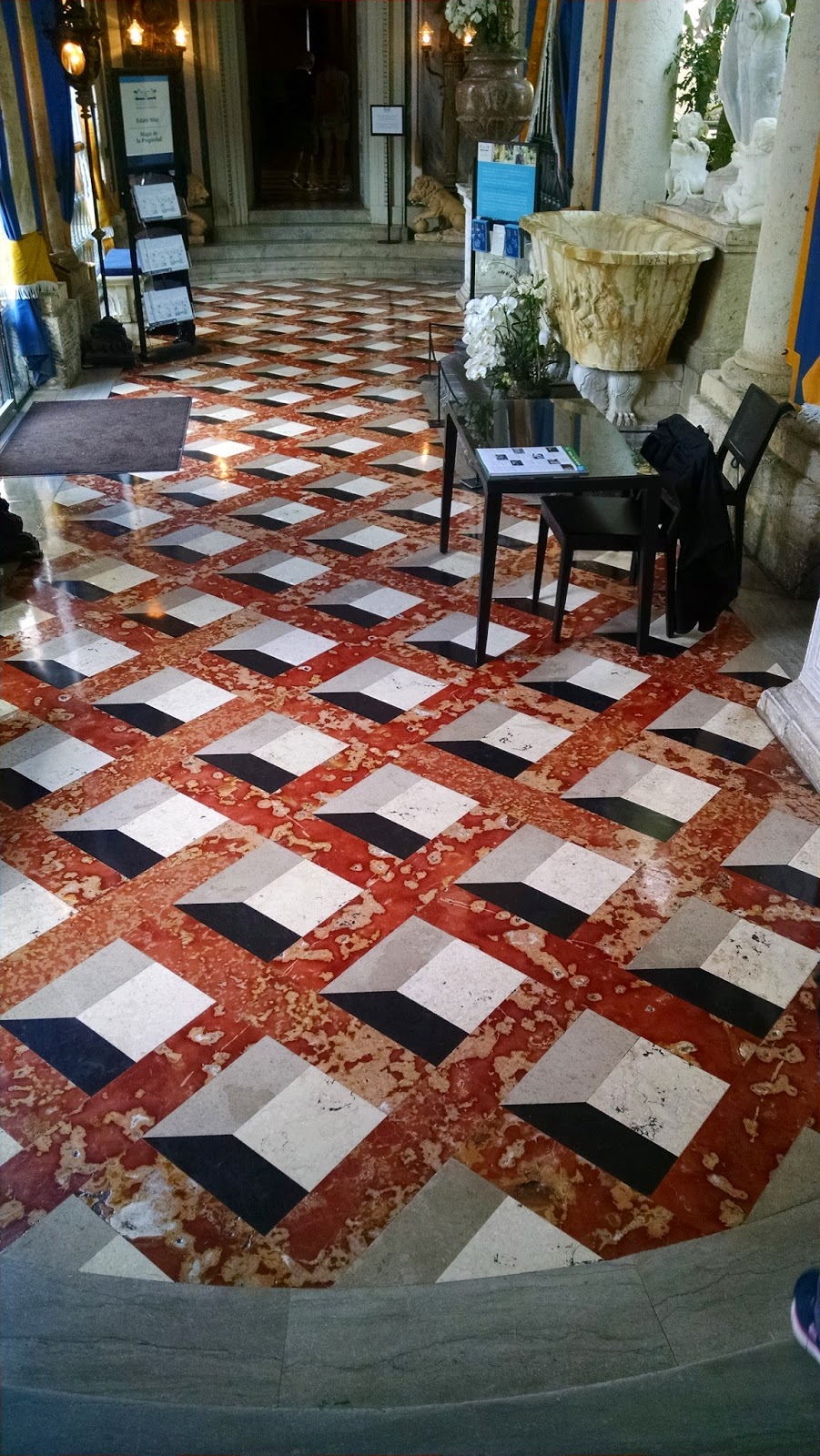
Another day we visited Viscaya, the seaside mansion of John Deering of John Deere fame, another Breakers-like home of the rich. This one was built during the portion of WWI before the US went "over there" to end it. Deering was a bachelor and imported fountains and whole rooms of walls and furniture from Europe. Quite lovely actually. The big change here in the last century was the erection of a glass roof to cover and hence seal off the central courtyard onto which all rooms of all three floors open -- to keep out the salt air and rain. This, of course, also necessitated air conditioning. And the gardens are not what they once were. I love these marble floors of theseaside and land entryways:


The gardens are nothing to sneeze at either, and here is one of the fountains with "merboys"  --mermaids with boys instead of girls.


A large stone Venetian barge (a place for guests to recline at ease) was built on a sandbank to protect Vizcayas sea entrance, with me at the extreme left and the towers over Government Cut barely visible on the horizon in the between. A bird walked by unconcerned with his proximity to humans.
One evening some young men strolled past our boat and started up a conversation because they recognized ILENE. Russ and Tom had sailed with my late son-in-law, Julien, and sung his praises and those of my daughter who they asked me to convey their good wishes. Small world.
We spent a pleasant afternoon lounging at the YCs underutilized swimming pool and, after some wine aboard, had a nice dinner at the Yacht Club with Jerry and Louise, who came over from Miami Beach and took us to Publix afterwards so Lene could get some products that the very nearby Fresh Foods does not stock, e.g. frozen blueberries and sugarless peanut butter. We lucked out that this was an all you can eat pasta plus night for only $17.00.  I have yet to learn how to avoid over stuffing myself at such affairs, though. The eighteen percent service charge is added to the bill automatically. This club has lots of helpful friendly staff to serve its 800 members, most of who do not keep boats here. It has fixed concrete piers against which we put up the fender board. The docks are busy by day with contractors and many people in suits apparently use the club day and night as a venue to do business. The only drawback is that on sunny days numerous black birds sit in the rigging and emit the remains of their fruit based diet, staining the deck. I washed it off over and over and will use bleach on the remaining stubborn though by now faint stains.
Another evening we were visited by Janet (who had taken us to the Chihuly exhibit) and another member of Lenes grade school posse, also named Rhonda. Rhonda was in town from New York to visit her Mom. After wine and cheese and a tour of the boat, I had, among other things, a single stone crab leg, my first, a delicacy here, and not as good as other seafood to my taste. This was at the well known but not excessively expensive (except for stone crab legs) Montes, on the water, less than a quarter mile away. Photo to be added. Janet and ?Ed may drive down to Marathon to visit us there, and perhaps to fish, though access to the boat on anchor or mooring will be more difficult for Janet than dockside. Also, yesterdays news about Cuba has started us thinking about getting the charts and cruising guides we will need for such a visit, though our insurer, Pantaenius, has not yet come around on this issue. They have several weeks to do so. Life is very very good.

Read More..

February 15 17 Marathon to Rodriquez Key to Hurricane Harbor on Key Biscayne and Lay DayThere 46 4 and 47 4 Miles

Well the good news is that I did not screw up the screw -- i.e., the transmission still turns the propeller. But the bad news is that the rattle is still there. I guess its time to have a professional take a look. And with all the contortionism required to muscle bolts with wrenches in a terribly cramped space, I got a back pain though it was a little better the second day and gone the third. Its just that so many tasks require throwing your weight into it or reaching or bending -- everything except typing a blog -- that one notices such pains. But ibuprofen helps.

And I started the first day with a mistake, though not a harmful one. I recalled that some of the three passage days from Biscayne Bay to Key West were 20-25 mile days and others were 40-50 mile days, but I guessed wrong on the trip to Rodriguez and we lallygaged about and made a late start at 8:45 for what was a longer day, arriving after five. Some of the trip was good sailing, some motor sailing and during the last hour and a half the wind was directly in our faces and rather than tack back and forth we furled all sails and just motored slowly. We were passed by a boat. I could not read the boat name because it is in a fancy script- more later.

We anchored on the west side of Rodriguez Key; we stayed on the other side when going south;  it appeared to provide some shelter from the wind, which was quite strong.
But the oblong island is aligned from north to south and so neither side gives much protection from a wind that was mostly from the south. But we put out 110 feet of snubbed chain in ten feet of water, with plenty of room behind us. Our nearest neighbor, 100 yards away, was the unnamed boat that had passed us. I awoke from the wind at 2 a.m. and sat up worried the rest of the night in fear of dragging. The anchor alarm suggested that we had slowly dragged but in the morning light
it appears that we did not. Not a good nights sleep.

Next day after a great french toast breakfast, thanks Lene, we set off at 8 am. We gradually caught up with that boat that had passed us the day before, who had left before us. They passed us the day before because I did not want to push the engine with its rattle. But now, I saw, via the binoculars, that she was a Catalina 34 with hailing port Oriental NC. I called them on low power on channel 16, and we switched to 17 to not impede the Coast Guard: "Catalina 34 hailing from Oriental; this is the sailboat ILENE on your port quarter." I learned that their boats name was "RagTop" and they were making the same two passages as we were and planned to stay in No Name Harbor on Key Biscayne as we were. ILENE is longer and hence faster under sail. When we passed them we wished each other a good passage and said we would try to meet up in No Name. I still did not know the peoples names.

The wind was in the low 20s and on our starboard bow. It was on shore yet the waves were not large. The Keys, heading for Key Biscaye through Hawk Channel are arrayed in a curve and as we got closer we were able to gradually steer a bit more north and a bit less east so the wind came from near close hauled to near our beam. We had full main and small jib and were heeled quite a bit,
though Witty wasnt upset by it.  We were doing near seven knots on average the whole way up Hawk passage and hit eight for a few minutes. We could probably have gone faster with less heeling if we had reefed the main but the forecast called for 10 to 20, not 20 to 25.
 We accomplished  in one day the mileage that  took us two days on the way south, going directly between Rodriquez Key and Biscayne Bay without the stop at Pumpkin Key. This was in part due to the free open speedy passage in Hawk Channel and was necessitated by the fact that we passed the entrance to Angelfish Creek way before high tide and waves were pushing on shore there. We entered through Biscayne Channel which is wide, deep and well marked.
Still with the wind and waves and tide all pushing us in, and never having been there before, and with the course involving some jibes, and channels always looking narrower on the charts than in real life, we dropped the main before entering and used the small jib, the tide and the engine at low rpms to make 5 to six knots on the way in. The channel is marked by 20 day marks and several fishing camps, houses built on stilts, on its sides. You can occasionally see shoals that line the sides, but mostly they are under water so you cant see them; it was like Boca Grande. Once through the channel into Biscayne Bay, we turned to starboard for No Name Harbor, which the book says is horribly overcrowded on weekends. This was Presidents Day and it was quite overcrowded, so we went to Hurricane Harbor, where the entrance was shallow, 62" at mid tide, but it quite deep enough at fifteen feet once inside.
And there was plenty of room for ten boats with only three present. I called RagTop and told them we were in Hurricane and they were anchoring outside of No Name due to the crowd so I suggested that they come over. There are NO waves in Huricane Harbor and precious little wind. The advantage of No Name is that though they charge you $20, they have a dinghy dock, restaurants and access to beaches etc. This harbor is completely surrounded by private homes.

and there is no shore access at their private docks, but we do not need shore access every day. In the second photo, on the right, through the harbor entrance, you can see the skyline of Coconut Grove, about four miles across Biscayne Bay.

Our neighbors here have left us alone, which is better than some of Floridas wealthy waterfront land owners have behaved. We exercise our legal right to anchor, for free, in the navigable waters of the USA and do no harm. And ILENE is a pretty boat, at least in our opinion and enhances their view. But some have tried to use legal means and sheer harassment to exclude boats from the waters near them. They dont own the water but they like to think they do. One guy moored a fleet of his own small faux miniboats in front of his house to "use up" all the available space. The idiot spoiled his own view with those ugly things.

When they had anchored we invited  Rag Top for wine and thereby finally learned their names: Don and Trish. They live four hours inland by car from Oriental, and this is their first extended cruise. They were part of a rally of new cruisers who went from Hampton VA to Florida, sort of like the Caribbean 1500, but via the ICW, so they partied most nights.  They are pretty good sailors in that they only gave a few tenths of a knot to ILENE. We enjoyed talking with them about cruising and boats in general.

The lay day was devoted to cleaning, -- the spots that we dont get to very often. Benny of s/v ""Rhianna", who we met in Beaufort SC, alerted to our nearness by Dean, of s/v Autumn Born, called and we might meet up with them soon. Three of four boats came into this harbor during the day but left within hours. We were also very close to Bob and Brenda of s/v "Pandora", which I helped sail from Essex CT to Annapolis in September. Our last night in Hurricane they were in No Name, only a mile away. Now back to Miami Beach where we have guests coming from NYC.
Read More..

November 15 to 17 Three Lay Days in Beaufort SC Zero Naut Miles

Here is that Ladies Island Bridge, first from land, closed, and then from ILENE at the dock, open, with just a few of the waiting cars at the extreme left.

It was cold but the third day has been warm but first windy and then rainy. The wind pushed us hard on the dock, separated by our somewhat flattened fenders. Several boats that were anchored out dragged into the marshes.
Lene used the Downtown Marinas courtesy car for groceries and to obtain this Mr. Heater Buddy,
which burns propane, producing carbon monoxide and hence is not as safe as using the electricity driven heat exchanger, but used when we are not at a dock and carefully, for small periods of time while we are awake, it can take the chill off in the evening and early morning.

I washed the boat, cleaned the starboard rub rail with acetone and waxed it; not much for three days, I confess. I also plotted a whole bunch of alternative courses between here and St. Marys, where we want to arrive a few days before Thanksgiving for the festival there. All the way from a single 125 mile overnight passage to as many as four intermediate stops, each such shorter hop or combinations of them by the inside and outside routes. It all depends on the winds, as always. Each such potential course except the inside ones, consist of three segments: to get out to the sea, in the sea and coming in from the sea.
Beaufort is a very historical town and the county seat and site of a US District Courthouse (federal court), as well as a tourist town with many shops, galleries and restaurants. I checked out the mostly used bookstore with a huge selection of books by Pat Conroy, and an antique shop with a nice selection of antique nautical charts. The restaurant we found and patronized this time is Low Country Produce, located in the tile walled former post office and town hall. It has good reasonably priced innovative cuisine and sells groceries as well. We bought a jar of their pickled Jerusalem artichokes after having been given a few with our dinner.
I visited the John Mark Verdier House,
right on the main street, Bay Street, which survived the war and several fires since 1804. It is the site of the historical society but they offer only guided tours of the house, which they do not conduct for only one person, so I saved $10 and contented myself with viewing the public rooms.
I had never thought that the Union army "occupied" the South during the war, but they did occupy Beaufort, because it was a harbor from which, through port Royal Sound (where a multi-ship naval battle was fought) they could operate the blockade of the Confederacy to choke off revenues from the sale of Sea Isle cotton, the finest grade, to England. The white confederate residents fled leaving their property (slaves) behind, so missionaries came in to help them, as well as merchants, newspaper publishers, photographers and carpetbaggers of all types. Many of the buildings on Bay Street survived to this day and a diorama was created of them and,from photographs, of the others.

Robert Smalls was a slave who had been stationed on a cargo ship, the "Planter". He put his wife and family aboard and brought the ship to the Union forces and surrendered. For this daring heroic act he was given command of a Union warship, later granted prize money with which he built a house here in town and was elected several times to the US House of Representatives.

But perhaps the best part of this town was just walking among the old homes and the magnificent live oak trees with Spanish moss that grace them.


This last one is Bythewood (two sylables not three), built in the 18th Century by the sea captain of that name and perhaps our favorite. The owner, Heather Perl, came along, took this picture and invited us for dinner. Maybe on the way back we can take her up on that.

We finally met up again with Dean and Susan of "Autumn Borne", who have appeared in this blog several times since we met them, coincidentally here in Beaufort, in the spring of 2012.


We also met their friends (our new friends), Benny and Lisa of "Rhiannon," a 42 foot Catalina. We six shared a pot luck dinner and played  and a game of cards.

Read More..

April 15 16 Jekyll to Walburg Creek to Redbird Creek 60 6 and 14 Miles Respectively

We got underway from Jekyll late relative to the tide, at 8:30, due to the need to fuel up. But the first  time we went aground it was solely my fault: Green on the right northbound in the ICW,... I just wasnt thinking. But no biggie; we backed off easily and quickly. The second time it was the fault of the lack of dredging in the ICW: we were in the center of the channel and while we were not stopped, the alarm was ringing and the fathometer said we had only five feet of water so we were dragging the bottom six inches of our keel through eight inches of very soft sediment. But after the first two miles of the days passage, depth was no longer a problem.
St. Simons Sound, gateway to the commercial city of Brunswick, is quite deep. And the tide flowing out, southeast, was favorable, very favorable, so we were motoring at over nine knots. Once clear of the channel we motor sailed during the morning but once the wind came up (a broad starboard reach) we sailed without motor in the afternoon toward St. Catherines Sound. A very pleasant sail under warm and sunny skies. Other than two shrimpers who were working St. Simons Inlet, and a sailboat we were catching up to off St. Catherines Sound, we saw no other boats. We even enjoyed good tide after the jibe, going west into St. Catherines Sound, making eight knots with just the main.
We had started with the plan to go to Wahoo Creek in the Sapelo Inlet. (Most inlets around here are named after the rivers that flow out of them and most are named for Saints: John, Mary, Catherine, Simon -- maybe it was from the period when Spain was influential here?) But while out there, we found that St. Catherines was only ten miles further and we had lots of time to get there before dark, so plan B went into effect.  Nearing arrival, we saw rain clouds gathering to the west, ahead. When we set our anchor in Walburg Creek a light rain had begun and while I was attaching the snubber and securing things it got torrential. Nothing to do when the boat was finally secure but take off all clothing -- everything was saturated -- towel off and put on fresh clothing before dinner.
Walburg Creek is bound by marshes on both sides and sparsely inhabited on land or by boat. We had a scare in the middle of the night when the tide had gone out and we showed only eight feet of water, rather than fourteen, and were dangerously close to the south shore. The wind had come up and the tide was flowing. I got Lene up and she started the engine. I pulled up the anchor, Lene moved us maybe 50 yards to a better spot (there was lots of room) we dropped and set it and, after watching, we went back to sleep. Lene, who edits these posts, criticized me for failing to express our sense of terror while picking up and re-anchoring in inky blackness with current flowing fast and wind howling. She is correct.
In the morning the plan had been to sail to Bull Creek, up in Tybee Roads, which is the entrance to the Savannah River, near Hilton Head. The outside route would have been 43.2 miles as compared to 48.9 via the hairpin turns of the ICW. But the wind was from the north at up to 20 knots and especially for the 20 mile plus outside part of the passage Lene was not enamored of beating into that stuff on a cold grey day with rain forecast. And I was not looking forward to it either. There is a saying to the effect that "Gentlemen do not beat." Beating into strong wind in the ocean beats up the boat and the boaters. So Plan B: inside. But blocking the way was Hell Gate. It is a portion of the ICW, a canal, only .6 miles long, connecting the Ogeechee and Vernon Rivers. But with our draft, we cannot get through except at very near high tide. And the tide was already flowing out and we had a couple more hours to go, so: Plan C: Redbird Creek is a totally uninhabited creek through the marshes and only 4 miles from Hell Gate. It was tricky in Redbird when the strong wind was blowing from the north while the tidal current ran the other way. ILENE did not know how to lie on her anchor. The good news is that the anchor held. No one came through by day or night; it was just us and the kitties. And very dark at night, being for from civilization. We arrived in the late morning with plans to leave in mid afternoon, but stayed the night. The views: N, S, E and W; are impressive for their blandness. At low tide one is six feet lower and sees less other than the banks which are closer.


Read More..

May 15 16 Colonial Beach VA to St Marys MD and Lay Day There 35 5 Miles

Cool last night. Lene likes fresh air but we kept the hatches and ports closed. We got a late start this morning, 9 am, and it cost us adverse tide until the last eight miles up the beautiful St. Marys River, which was a delicious engineless broad port reach to Horseshoe Bend, with diminishing wind that gradually slowed us from eight to four knots as the headlands on either side cut off the wind. Before this, out in the Potomac, the propeller rattle reappeared and we motorsailed with main and small jib. It was slow at first with light wind and then there were 25 knots, but on our nose, requiring us to beat our way down the Potomac. It was Friday and we saw our first substantial river traffic. A tug was pushing a heavily laden barge in Kettle Bottom Shoals Channel. I called and he asked me to stay outside the channel, which I had planned to do anyway. Also about four cruising sailboats and about ten fishing boats dragging vanes to spread out their lines; they take up a lot of room but we had no close calls. Your photographer was inattentive; sorry.
Horseshoe Bend is roughly circular and about two thirds of a mile in diameter, with water in the teens almost to its edges. On its SE side, near where we anchored in 16 feet of water with 100 feet of snubbed chain, is the waterside sailing center of St Marys College. We are center right. Lots of kids out on skiffs, SUPs, and kayaks. Free use of the schools dinghy dock. A most welcoming place. The school is celebrating its 175th anniversary and has only 2000 students; Lene and I attended much larger schools. St. Marys is
an "honor" college of the University of Maryland. It has the only eating facility in the area, its cafeteria, where you can get all you can eat for $13 for dinner. But with graduation on our lay day, we had their last supper, burgers and dogs. We actually attended the graduation ceremony, why not.  Rashad Robinson, director of The Color of Change, a million member strong on line civil rights group,  gave an address and received an honorary doctorate degree. We stayed until the roll call of the names of the 430 scholars who were awarded their BAs was begun and then toured the campus, which was mostly locked up. We could hear but not see the speakers and a lot more people were seated to the left. The Bend is in the background left. A lovely setting.
 Across the road from the college is "Historic St. Marys City", which was the capital of the Maryland colony from 1636 to 1695, when they moved the colonys capital to Annapolis. Dont get this place confused with the St. Mary on the St. Marys River at the southern edge of Georgia, where we celebrated Thanksgiving.
This is the frame of "a lawyers house" in the former, and possibly future, historic city. It is there to mark where the house was. If they get money they plan to rebuild it as they have some of the houses, stores, a barn a church and the meeting house.


One of the best features is the Dove, built to resemble  a supply ship that accompanied the settlers in 1635. This one has a diesel, hidden away in its bowels, and GPS as backup to its octant. It actually sails, once a month, in the St. Marys River, and once a year it goes further, such as across the Bay.


Here is the Doves Bosn, Jeremy, a retired navy corpsman. We enjoyed talking with each other.
The colony was founded by Catholics who created the first experiment in what our Constitution now calls "the free exercise of religion". But colonial rule was influenced by the religious war in England between Protestants and Catholics, and the experiment was short lived, when the tides of the war turned.


Here is my land docent, (Is it Gretchen, Im so sorry I forgot your name and Lene discarded the paper on which I wrote it!),
soon to graduate from St. Marys with a Masters in Education and return to teaching HS history. The Historic City might become another colonial Williamsburg or Jamestown  but is suffers from a somewhat remote location. They are conflicted between two methods of restoration. The expensive way requires mega doses of expert historians to get it right and craftspeople with knowledge of  and access to period materials and tools. Much cheaper is to erect a structure that looks kinda like what they think the old building looked like. A complicating factor for them is that the land was put to other uses in the intervening centuries, such as a tobacco plantation with its own greathouse in the 19th Century.
I had never heard of the St. Marys settlement and it is a very interesting place to visit and easy for sailors, near the mouth of the Potomac.

Our last night, we experienced a 35 knot thunderstorm. I put on instruments and sat in the cockpit to check against dragging, but we were not, and once having sustained winds of that strength, we relied on the fact that the anchor had dug itself in deep, and called off the watch for the duration. Just a bit lumpy out there.

Read More..

December 14 15 New Smyrna Beach to Titusville and First of Three Lay Days There With Car 35 Miles

Motoring in the ICW is not a peak experience. During this trip and while at Titusville, there was almost no wind. It was sunny and not as cold. I put up a head sail for about an hour but then the wind was gone again. Companions make it more interesting. These guys, from New England, said that they were in training for the spring racing season and wanted to be on our "wake". They kept up with us, motoring at 5.7 knots, for about half an hour before turning back. They said "Were your dolphins!"
We also saw more dolphins than ever before, in small and large pods, close to a hundred total, during the five hours we were underway.
In Titusville one simply takes an available mooring and then calls the Marina to tell them the number. The Indian River is as much as three miles wide but with a depth of only one to six feet, except for the ICW channel with twelve feet depth that is perhaps 50 yards wide. Near Titusville the river has a piece that is seven or eight feet deep and several hundred yards wide. This is the anchorage and mooring field. We took a mooring near the ICW and near the outer end of the private marked channel leading from the ICW to a large marina with many slips that was dredged in the western (mainland) side of the River. The chart showed three low bridges, one shortly before we arrived and two further south. The first is for a railroad and is apparently open unless a train comes. The second was replaced by a beautiful new high expensive bridge, shown here from ILENE at sunrise,
and so only the third requires us to request an opening. I think they made a mistake in deciding which of the two car bridges to replace: the high one leads to the Merritt Island National Wildlife Refuge and is little trafficked. The remaining low automobile bridge also leads to the Kennedy National Space Center at Cape Canaveral and has a lot of cars and buses to be detained. Id be interested in what local politics caused the decision to replace the wrong bridge.
We took both our dinghy lights (so others can see us) and our flashlight (so we could see the unlighted channel markers and find our way home after dark). We had some wine on Autumn Borne with Dean and Susan. They are planning to haul, do their bottom and visit relatives back in Buffalo and will catch up with us later on. Also aboard were the crew of Seeker, Earl and Kathy, and friends who sail but live in Florida and did not have their boat here: Eric, an engineering colleague of Dean, and Joyce, a biker and tennis player, from Holland. When Erik and Joyce had to leave, the rest of us had dinner at Crackerjack, by the foot of that new bridge.
Next day was the first of our three with a rental car. After breakfast out we went to the Kennedy Space Center. We took the bus ride out along the path that the mammoth mover travels carrying the rockets (at one mph), and saw about four videos, each in its own theater, walked through a lot of objects, large and small and heard a great talk by former astronaut Don Thomas, who made four shuttle flights, the highlight of the day, actually.
Each stripe in the flag is eight feet wide!
Lift off!
End of Stage Two, with me, below, to give a sense of scale
Lene by capsule, looking lovely, as usual
.
The Rocket Garden
We were there from 10 to 4 and were quite tired by the end of it. We have access to a movie house here and Interstellar was playing but no, a quiet evening aboard.
The Space Center is operated entirely without government support, it brags: But taxpayers pay for it. Driving there for two seniors includes a $10 parking fee and $97.00 admission. it was not as expensive 25 years ago when I was here last.
Read More..