October 25 Portsmouth VA to Elizabeth City NC 43 8 Nautical Miles

Today we traversed the Great Dismal Swamp, one of three inland routes between Norfolk and North Carolina. This is the westernmost route and most of it is a very straight and narrow (about 50 feetwide) canal
that is not very deep (about eight to ten feet).A new route to a new port.
One thing about it is easier. Normally I piece together many legs of a days journey, measure the length of each lag and add them together. But in the ditch, the charts show the mileposts from mile zero in Norfolk to over a thousand miles later in Florida. But these are in statute (land) miles and so one must take only 85 percent of them to get the nautical miles. Today we started half mile north of mile zero and Elizabeth City is at mile 51, leading to 43.8 nautical miles. And describing "legs" would have been difficult after we exited the canal proper into the Pasquatank River, which is nothing if not sinuous. Oops, upside down. Eliz. City is the black boxes (streets) toward the upper right, the old down town.

But this path is more challenging because there is no sailing allowed, and the road is so narrow, requiring constant attention as when driving a car. Also there are hazards above and below. Below are "deadheads" -- water soaked tree stumps that lay on the bottom and give us a thump when we hit them. We know they are there and that we will take a few hits (four today) but unlike coral heads in the Bahamas, they do not sink your boat. The peril above is tree branches that overhang the canal and get whacked by our mast (about three times today).


Here is some of the flora we harvested with our mast and shrouds, showing also the straightness of the canal, the diagonal to the lower left corner.


It was a long day, but warm at last and sunny, and windless. Normally we dont like windless days but no sailing is possible in the canals so no big loss. We got underway at seven in morning mist, and headed up the Elizabeth River to make it to the first lock, at the northern end of the swamp, at its 8:30 scheduled opening.


Here we are, all five boats, locked up together.
The lock business and the associated bridge took an hour and we timed the next 22 miles at five knots to arrive at the second and last lock for its 1:30 opening, and arrived in Elizabeth City at about 5 pm. A long, slow, ten hour day.
Yesterday we crossed paths with a mammoth container ship; today a more modest craft.
Eliz. City calls itself "The Harbor of Hospitality" and this billboard
is 50 feet from our slip. It proves this true by providing seventeen free guest docks, and we took one. In the morning, a man and his daughter offered us a ride, three miles, to the supermarket and Judy and Rich, who work for the Coast Guard, gave us a lift back. Yep, a friendly town. We are bow in. On the way in we looped our starboard stern line over a piling and  then ran forward to hand a bow line to one of the friendly volunteers who secured it to a piling near land on the port side. Easy, in the absence of wind. The other two lines loop around pilings off the other two corners and I added a spring line to keep us from crashing into the street ahead of us if there was a surge (but no surge tonight) and we were totally secure. Black line is starboard aft line and white is spring line.
The last step was loosening the starboard forward tether and tightening the port one to bring our bow above the short stubby dock so that we could climb down from the bowsprit onto it.


On arrival we took free shoreside showers
and had dinner ashore before returning for the evening. There was a very easy camraderie among the crews of the boats here, all enthusiastic about their similar but individual adventures. Next to us, separated only by our biggest fender, is a beautiful Shannon, "Whisper", whose three very young, very blond children came aboard to play with our crew. Witty was not really a happy camper in this, but he played along well enough. I missed the photo op.
Read More..

May 14 Capital Yacht Club DC to Anchorage North of Bluff Point Colonial Beach VA 56 6 Miles

Two observations: 1. From the last bridge in the ICW in South Norfolk, to Maine -- no bridges that we have to worry about!  2. The Washington Channel is the flying lane for helicopters in the DC area, which has lots of them, apparently to keep them out of the way of the runways of Dulles Intl Airport that are parallel to the Chanel. If you stay at the Capital YC -- get used to their noise!

It was cold the past two nights and yesterday and today. So I was warmly bundled for todays 7:00 to 3:45 passage  -- a retracing of our path, back down the Potomac. The early start was dictated by the desire to capture a few hours of good tide.  We went further than Fairview Beach because we had the time and want to go further tomorrow too. Here is Fairview from the channel, above the gate in the lifelines. It shows that this river is w i d e!
Tide was favorable at the start, giving us, with engine, small jib and wind at our back, about 7.5 knots, gradually diminishing to 4.9 and then building back up to 5.9. Going downstream is faster than going upstream.
With the wind behind us the small jib self-jibes at will while the other two sails, though they would have given us more speed, would have been a bear to handle through all the jibes of the twisty river. In fact the Potomac is a pretty easy river to navigate, especially once you have been there. Our electronic chart plotter displays the water more than 20 feet deep, the channel, in light blue, with dark blue for the shallower water at the sides. Red and green buoys are shown and we generally respect them, but if you stay in the light blue, you cant go wrong.
Tonight the wind is predicted from the south at 5 to 10 knots so while we elected to stop in the Potomac, rather than in a harbor, we are on the north side of a bluff which should make the 5 to 10 knots of wind from the south easy to take tonight. We have 60 feet of snubbed chain in 11 feet of water and no other boats in sight. For those with Google Earth who want to know, we are at 38 degrees, 16.6 minutes North; 076 degrees, 59.4 minutes West. Here:

I have tried to show pictures of things you have not seen before, or new views of the old.  Like this style of buoy. Ive never seen such before. They are common on this river. This one has a guest, or squatter, who is hawking "Danger" as we got too close for his comfort. Check the current running past it-- the "bow wave"
Floridian gargantuan houses on the upper Potomac.
A better view, on a non-foggy day, of the huge power transmission towers with strobe lights.
The rivers banks are lined with such cliffs, as if the Potomac is trying to become the Grand Canyon. It still has a way to go.

Maryland Point Light, with rapids flowing past and many birds watching from the man made islands on both sides.


Tomorrows destination: St. Marys, Maryland.


Read More..

Interview with George Buehler

This Summer I had a chance to interview Yacht Designer George Buehler. I hope you enjoy, Dylan Bailey

George Buehler has been designing boats out of wood and metal for over 20 years. Some of his most popular designs have been his Diesel Duck designs. In this issue of the MBQ we feature his latest the 41.2 as well ask him some questions about his career. George has also released new additions of his books Trollor Yachts and Back Yard Boat Building. You can visit his webs sites at: http://www.georgebuehler.com/ and http://dieselducks.com/

D.B. George, when did you get into boating?
G.B- In Jr. High School when I built an 8’ hydro which I rolled on the first run.  My mother made me trade it for an El Toro sailboat, which got me into sailing….

You worked for Boat Builder Paul Luke for a while, tell us about your experience there.
- What I remember best is the amazement I STILL feel of being around such a phenomenal skill level group of carpenters.  Luke’s was great, but before that I swept floor and butchered wood at Goudy & Stevens during the building of the 110’ schooner AMERICA recreation.  Double sawn frames, double planked, SIX MONTHS from start to finish.  The skill level of those old wood yards was amazing.

You built a boat and cruising, tell us about that experience.
- I built a self designed 26’ double ender while working a near minimum wage job as a night shift orderly on the “disturbed” ward (NEVER show fear and you’ll live) in an Oakland CA public hospital.  I had no money so used lumberyard materials, no engine, tree mast, polypropylene running rigging, and had maybe the best two years of my life cruising it to Mexico and Hawaii, with absolutely no problems.

When did you realize you wanted to design boats for a living and how did you become a yacht designer?
- I fell into it.  After selling the 26 in Hawaii, I came to Seattle to build a 36 I designed while sailing to Hawaii.  Various people came by and wanted plans for a bigger version and a smaller version, and before I knew it I was selling yacht designs.  I never planned on doing it for a living and still haven’t decided what I want to do if I ever grow up.

Could you tell us about your first commission or design?
- The 26 footer mentioned above.  I was my own first client

What was your first design in metal?
- I really don’t remember.  People were building my wood designs in metal on their own long before I drew metal construction plans.  I think my first serious metal commission was the 38’ Diesel Duck for the Blackshaws, back in the 1990s.

Your Diesel Duck series of designs have become very popular. What was the inspiration for the design?
-West coast workboats and keeping an awareness of simplicity of assembly.

                             
Do you have any recommendations for the amateur builder looking at your designs and wanting to build their own boat?
-Nope.  I don’t try to talk anybody into anything.  See what’s out there and make up your own mind what you want.  I do offer good support, but others probably do too.

Do you have any recommendations for anyone wanting to modify a design of an existing boat?
- Nope  While some designers act as though Jesus Christo himself was guiding them, the fact is most just draw what they like.  So if you want to make a change go for it.  But if it floats upside down it’s on you.

In this issue of MBQ we feature your latest Diesel Duck design.  Is there anything on the drawing board you want to tell us about?

- I just got a commission for an 80 foot “Duck like” boat we’re gonna call SUPER Duck 80.  I have no idea yet what it will look like.  It’s gonna take a few cocktail hours to rough out the ideas.  It’s exciting to think about though.


Read More..

Sutton Manor New Rochelle Americas Sailing Community

My hometown, Annapolis, has the slogan "Americas Sailing Capital" whereas Newport, Rhode Island, long-time home of the Americas Cup, about 640 km (400 miles) north of Annapolis, goes one better with their slogan "The Sailing Capital of the World". Notwithstanding the competing Chamber of Commerce hype of these two East Coast sailing towns, there is one community that, between the war years of WWI and WWII, could rightly maintain they were Americas Sailing Community.

Sutton Manor, of New Rochelle, New York was a 50 house bedroom community of New York City that began development in 1914. The community butted up to Long Island Sound and the harbor of Echo Bay that included Tank Island, Harrison Island and Echo Island. There were three active yacht clubs, all predating 1900, within several miles of the community; the Huguenot Yacht Club, The New Rochelle Yacht Club (now defunct, located in Echo Bay on Harrison Island) and the Larchmont Yacht Club. The names of some of Americas most distinguished yachtsmen made Sutton Manor home:

  • Stan Ogilvy
  • Cornelius Shields
  • Bob Bavier
  • Howard McMichael, winner of championships in the 210 Class, the International One-Design and Hipkins Trophy.
  • Walter Coursen, a Commodore of the Larchmont Yacht Club and the New Rochelle Yacht Club.

Also, two prominent sailors featured in the Earwigoagin historical archives; Larry Huntington and Harry Hall, owned houses in Sutton Manor.

To take a stroll through Sutton Manor during the 1920s and 1930s, one could, every couple of hundred steps or so, have a very interesting conversation about boats and sailing.


Read More..

Yellow Boat 4 twin NQD jets driven by P2632 Brushless Outrunner 3800kv Brushless


Yellow Boat 4 


Twin NQD jets modified with brass stern tubes.

I have alternate nozzels which are a little larger than standard also.


Brass impellers made from cutdown brass props

Two P2632 Brushless Outrunner 3800kv Brushless


Stern Tubes brass shafts wrapped in PTFE tape until they fit the tubes. Will be setting up air cooling system with small EDF fan.

Will probably run two 2200mAh Lipos and 50 Amp aero ESCs with big heatsinks


For the cooling I may have the Arduino open and close a vent with a servo if the heatsinks get hot, as well as controlling the fan speed. 


Based on yellow boat plans different deck 390 Grams as shown 
Also Ply fiberglass epoxy catamaran build log

Glass and epoxy inside balsa ply, will epoxy the outside too. Its very strong with builders fiberglass tape and epoxy 


The motors will be mounted further forward on a cooled plate 


Spray rails are bamboo barbecue skewers and wood filler  


Read More..

December 25 and 26 Vero Beach to Lake Worth Then to Ft Lauderdale 48 1 and 54 Miles

These two rather longer passages were quite different because the first was inside, cold and dry while the second was out in the ocean, warm and rainy.
On both days we got underway a few minutes after seven but we dropped the anchor at 4:15 the first day and 3:00 the second. More miles in less time.
The ICW requires attention to detail and while we flew the small jib for speed, we could have profited from the larger genoa except that the wind was generally directly behind us so that the self tacking smaller head-sail gybed back and forth as minor wind changes and course variations took place. With the genoa such gybes would have been a major problem. One of the myriad beautiful homes we passed.
There was very little other traffic on Christmas morning and we wished a merry Christmas to the bridge tenders of the low bridges when requesting openings. Bridges were the major frustration, causing delay and providing the days "moment of terror". When we called to alert the tenders that we were coming from the north and request openings, most of the tenders, who these days are mostly ladies, told us to maintain speed -- they would open for us when we got there. One failed to live up to this promise and at the last minute, moving at almost seven knots, three of them provided by a favorable current, I had to slam into reverse gear, hard, to avoid breaking our mast against the not yet opened bridge. A moment of terror. We normally thank the tenders for the openings.
We also had to wait for three of the bridges to open because they open only on request but only on the hour and half, or at 15 and 45 minutes after the hour. I have written in large print on our paper charts whether each bridge is "High" or "Low" and if low, its name, (needed to hail it to request an opening) and what its schedule of openings is, or "on demand".  But what I have yet to do is calculate the nautical miles between each pair of bridges with schedules so that we can regulate our speed to arrive "on time."

One cant get there late and early is bad too, because the current is sometimes trying to push you under the closed bridge. And I learned through experience yesterday that a 1:30 pm opening does not mean that the bridge will actually be open at 1:30. Rather, the whistle sounds then that the gates will be coming down and only after all the traffic has passed and the gates lowered does the bridge begin to slowly swing upwards. So our ability to pass will not occur until 1:35 and an additional five minutes of fighting the current has to be built in together with a five minute delay in starting toward the next bridge. I hope it does not sound like Im whining about the bridges; actually I write to give you a sense of the challenges we embrace.

I tried to rendezvous with Dave of the Harlem YC, who was visiting in the Deerfield Beach area but our plans were thwarted by a failure of communications. Lake Worth, Florida, is a city that appears on land maps. But the lake in question is quite long and our anchorage was in a cove at the extreme north end, in Palm Beach actually. This extra drive, the difficulty in finding a restaurant open on Christmas night and the problem of directing Dave to a parking spot near the dinghy dock of a place I had never been before all conspired to prevent the rendezvous. I changed the oil instead. And after a long day, we had a quiet evening aboard and did not lower the dinghy. I won at rummy and Lene won at casino, as usual.
The anchorage is quite large with many boats and room for many more. And it is surrounded by private residences including many high rises and a marina where mega yachts stay, like those in Antigua, St. Maartens and St. Barts, and, well, Fort Lauderdale. We are in the crowded wealthy part of Atlantic South Florida. Many of the people up the coast told us they felt that they had escaped from here.
(The only time I was ever in the Lake Worth anchorage before was briefly, aboard m/v Sea Leaf, in the spring of 2012. heading north, I had continued straight into the anchorage instead of making a left turn to continue up the ICW. All of the thousands of reds and greens that mark the ICW have a distinctive yellow square to distinguish them from non-ICW buoys, like those marking the channel into the anchorage. But I did not know that then. I sensed that something was wrong, however, and the captain confirmed it and we turned around.)
The next day we avoided about twenty bridges by going outside in the Atlantic from the Lake Worth Inlet to the Port Everglades (Fort Lauderdale) Inlet. One high bridge before transit through a busy commercial port on the way out and one low bridge with half hour openings on request at the other end, which we made without a significant wait. And once out, our course was essentially a straight line, an average of about .7 miles off the coast. Actually the coast here curves slightly to the west so we added a few degrees to the west as we got further south. At first the wind was from the west, not the north-northeast, as had been predicted. And then it was confused and near absent. But by nine a.m. the wind came in from the predicted direction and the apparent wind was  a bit more east, about ten to twenty degrees aft of ILENEs port beam. We used full main and genoa; how long has it been since last we used them -- before Thanksgiving on the overnight passage to the St. Marys River. With apparent wind in the teens we were making better than seven knots, with autopilot steering.
We overtook one sailboat. It first appeared as a speck before us on the horizon. Soon it became apparent that it was a sailboat. Her mast kept getting taller as measured against the slot between the upper and lower rails of ILENEs  bow pulpit. She was not even visible behind us when we turned in. We passed another sailboat being towed north by Sea Tow and I felt so sorry for him. We passed the condo where my parents lived in Pompano Beach. We passed four huge freighters anchored out at sea. The rain was mostly light but decreased visibility to the beach, though you can see it in the photo below.
A brief heavy downpour occurred just as we were furling the headsail to turn right into the inlet.


But it was warm so the rain was not unpleasant, though it chased Lene and the paper charts below. If I do not look like a happy camper to you, your impression is mistaken.


Lots of big traffic in and out of Port Everglades. We saw this guy miles away, heading west toward the inlet as we came south.


Two of these funny looking rectangularish tugs came out to greet her and push her in just behind us, honking us further to the red side of the channel.
We hugged the eastern shore tightly going in and at mid tide saw no less than 7.8 feet of water during the entry. As soon as we were secured, on 50 feet of chain in eleven feet of water, the rain stopped and the drying process could begin. The cats began their mutual bathing ritual. We were the 17th boat in the lake, with room for more. (Sorry about this font.)
We spent a week in Lake Sylvia in the Spring of 2012 but this time we are planning to stay most of our time in Fort Lauderdale at Cooleys Landing, a municipal marina in the New River, next to Riverwalk and two blocks from Las Olas Boulevard. I guess we are just city people at heart, though we do enjoy nature too, like this Lake Sylvia sunset.


Read More..

Virginia Beach Project Update

After letting the last coat of epoxy on the hull dry for several days I did minimal touch up sanding of high spots. As I look back I should have done a lot more from an appearance standpoint but it certainly has a passable appearance. I again wiped the hull down well after having vacuumed the garage so that I was in as dust free as possible. I then used masking tape around the gunwale line feeling that the glue would probably adhere better to the epoxy directly than to a coat of paint. I used Rustoleum Marine primer, one coat applying it with a foam roller. It was difficult paint to stir and get well mixed but it went on very well and the roller gave it a good smooth even appearance. I again let it dry well for a couple of days and then used Rusteolem Marine Topsides paint for a finish coat. It too was rolled on and was easy to use. It will take a second coat to achieve a really nice look. It should be noted that this is Topsides paint not designed as “bottom” paint so if you plan on leaving a boat in the water for any long periods of time this is not the paint to use.


One final comment on the paint. Compared to the usual marine paints Rustoleum is much cheaper but also offers a more limited choice of colors and it would appear that it is not designed to be used as a mixing base to make your own color.


I let her get good and dry and then flipped her over onto a nice soft cloth pad to protect the paint. The frames were still attached and were the way I supported the boat while painting. Now for the first time I got a good look at the inside of the boat. WOW! I had a lot of finishing to do. This included filling screw holes but mainly if was filling in and making filets were the chines, keelson etc. did not seal as tightly as I would have liked. From a functional standpoint the boat was sealed. From and esthetic one I had a lot of work ahead of me. Since the epoxy is pricey I mixed up just enough so I knew that there would be no waste. This was your peanut butter consistency and applied with a tongue depressor went on easily and gave a nice effect. I would give a piece of advice when doing this. Wipe off the excess with a vinegar soaked cloth as soon as you are finished with an area. It is a heck of a lot easier than sanding this rock hard stuff once it dries. 


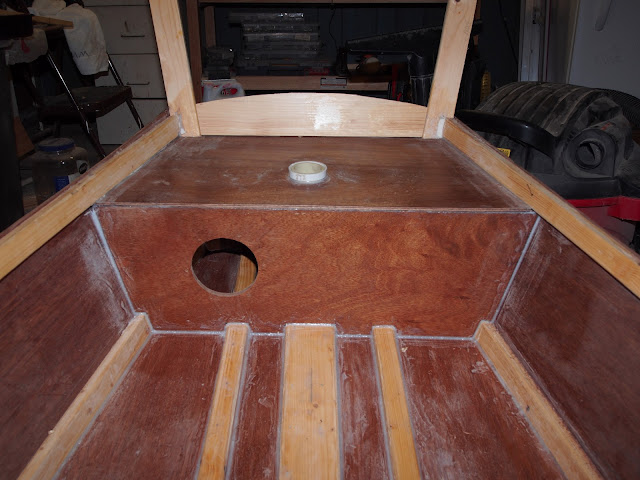
I still had the frame “legs” uncut. The center ones in particular were a real nuisance to work around so I cut them off almost to where they will be finally but since I still have work to do on the sheer as far as trimming off the plywood I left a few inches that will come off later. Now I at least wasn’t catching myself on this stick that was serving no purpose. The bow and stern legs weren’t nearly the problem and I still haven’t touched them. I went off the CABBS plans for the mast step and thwart. I saw in someone’s plans that they had enclosed this part and made a buoyancy box out of it. I used ¼” maranti for the top which I fitted up tight to the underside of the inwales. Put a few cleats along the sides and fore piece to hold it tight. I then scribed a pattern on cheap plywood for the vertical piece. For this I used ½” maranti figuring that this would be extra cross bracing since I am using ½” plywood instead of the ¾” per plans. I will cut a 2 3/8” hole at the point 11” back from the bow and into this will go a piece of 2” PVC. When finished it will be sealed with epoxy.

What I haven’t got straight (so to speak) yet is the rake of the mast and exactly how the step will be angled. The mast will be reinforced 1 ½” PVC. From what I can tell, and Kyle Leonard has said, the mast should be perpendicular to the sheer line That is what I finally did. I took a piece of 1x4 sprude, used a 2 3/8’ hole saw an cut completely though it and attached it to the keelson in just the right position so that the 2” pPVC would be perpendicular to the sheer line. Not as difficult as it may sound. Used epoxy to fasten it. I put in a 4” water tight inspection port in the vertical piece a little off center so that the area may be used to store a towel etc. I will have pictures of all this. The port cover is frm West Marine and cost less than $10. Really happy with it. As looked at the inside of the bow transom it just looked unfinished so I took a piece of 1x4 spruce, as clear as I could find, and scribed a piece to fit on the inside of the bow on top of the mast thwart. I think it looks pretty good. I am doing the same on the stern with the exception that there will be a perpendicular piece running down to the keelson. Since the gugeons will attach here the added strength makes sense. BUT all this trim work adds weight to the boat so for those wanting the lightest craft possible all this is not for you.
Read More..