Tampilkan postingan dengan label 27. Tampilkan semua postingan

October 26 and 27 Elizabeth City to Deep Point to Slade Creek 43 5 and 33 NM Respectively

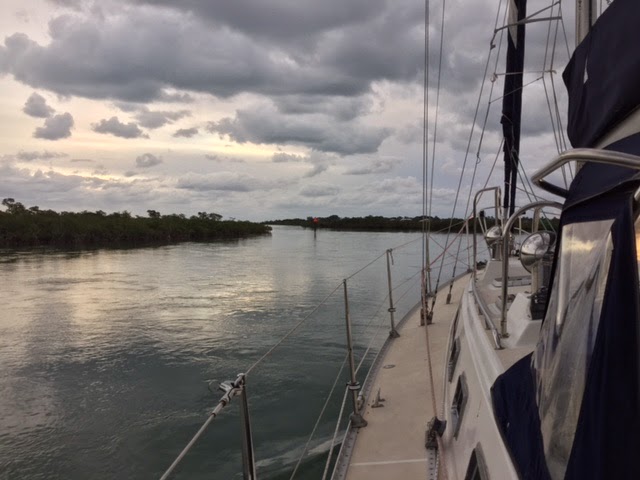
From Eliz. City we got a late, 11 A.M. start, due to marketing.  It was mostly motoring but we put up the genoa three times for about half of the passage, once even turning off the motor. We arrived at the anchorage after the sun had set, but before it got dark. Our route was to continue down the Pasquotank River, traverse Albemarle Sound and go south (up) the Alligator River to a place off Deep Point which is deep enough to anchor, moderately protected from potential winds, outside the ICW channel and reachable before dark. The little white space to the left of the word "River" in the upper right quadrant of this chart segment hit the spot. It is 2/3 of a mile long and about 700 feet wide at its widest spot.
There are about 8 boats here. We are in 11 feet of water with 60 feet of chain out. We have a potential problem because when we tried to use reverse gear to set the anchor, we heard only strange sounds. So we laid out sixty feet of chain, which, with the weight of the anchor, held us in place all night in very gentle air. If we had dragged, there was a lot of room behind us toward the channel in which the anchor, hopefully would have caught. No internet access here. Dinner, card games (Lene almost always wins), reading and in the morning we emptied the aft compartment so I could take a look at the "no reverse gear" problem. I saw how, by disconnecting the end of the cable from the shift lever at the helm, one could manually shift the boat at the engine itself. And while we had access, I added distilled water to those of the cells of the batteries that looked like they could use a few sips.
Among the boats here were "Whisper," who we met in Elizabeth City, and their buddy boat "Piper."
In fact, two of the three adorable kids who played with Witty belong to Piper, not Whisper. We accompanied them most of the next day, toward Slade Creek through the Alligator-Pungo Canal and somewhat down the Pungo River, but they had elected to go elsewhere the second day.
The AP canal is quite a bit wider and almost twice as deep as the Great Dismal Swamp Canal.
Our only scary moment was crossing under the Wilkerson Bridge, near its southern end; unlike all the other fixed bridges over the ICW, which are 65 feet high, this one got short changed and is only 64 feet high -- and we are 63.5 feet high!
Slade Creek is wide and over a mile long. We got here first, at about 2:30 after a totally motoring day, and anchored in the first bend after entry, where the wind protection was good, in eight feet of water and were later joined by two other boats. There is lots of room here.

Then chores: I dove into the brownish, tannin dyed water and cut several lengths of line from around our propeller, but the boat still makes a chattering noise in reverse. We will get this checked out in Oriental, our next stop. (Also the harvesting of leaves in the Great Dismal Swamp Canal whacked our wind speed and direction instruments making them even more in need of calibration.)  I went up the mast to reattach the halyard for the Harlem Yacht Club burgee because the halyard had worn through in the strong winds in Yorktown, completed the wiring of our two million candlepower flashlight for finding buoys at night, hung a picture, fixed a cabinet and organized our cabinets. This last in the course of looking for the two white LED interior lights that we replaced with red ones to preserve night vision. Lene does not like living in a red light district. But we have not found the white ones yet.
The problem here is flies, lots of them. Lene killed about a hundred that had invaded ILENE. She is fully screened but they got in while we were underway and the companionway was open.
Also Alphie gave Lene a scare. She was missing, Lene was crying. I looked in both the aft end and the forward end of the stack pack tube that holds our mainsail when it is not in use. No Alphie. Finally I unzipped the top of the tube to raise this sail and there she was, in the middle, perturbed that her nap disturbed.
Read More..

December 27 to January 1 Lake Sylvia to Cooleys Landing and Five Lay Days in Fort Lauderdale 2 9 Miles

Our short passage from an anchorage east of the ICW to a municipal marina up the New River to its west took place early in the morning, timed for our arrival to coincide at slack tide at our destination, at 7:30. The New is a natural river with deep enough water way up past Cooleys Landing. It has been dredged and is lined by boats on both sides, and very expensive homes. It twists extensively and is narrow. It is because our dock is perpendicular to the shore line that we had to arrive at slack -- to avoid being pushed past the slip by the tidal current at other times. Our slip is at the edge of Fort Lauderdales Riverwalk, with its arts district, close to the intersection of Las Olas Boulevard and Andrews Avenue. These streets divide the town into its four quadrants, NE, etc., i.e., the heart of town. The marina is inexpensive with good showers and wifi; its drawback was the inattentive staff. We got help tying up from a neighboring boat because the staff, who had promised to help us tie up, was no where to be hailed or found, and they did not check us in until the next day. The dock master, Matt, is helpful but his subordinates are not.
Getting here we passed under four bridges, each about a city block apart, which open on request. Well, one is for the railroad and is always open except when a train comes along. We were lucky to arrive on a weekend day because the bridges do not open during designated ninety minute periods at the morning and evening rush hours on weekdays -- and the slack was during that 90 minute period. ILENE is the boat at the left, closest to the bridge, shown at the right. View of the arts center is blocked by the tall condo.
 This next view is from the bridge with ILENE the boat on the right.
The drawback to being so close to The Marshall Bridge, named after the towns first Mayor, is that it opens and closes with a clanging bell and each car that drives across makes a loud noise on the central span which is a metal grate; but this is no worse than the traffic on Broadway and
Fourth Avenue, which serenades us at home -- we city slickers are inured to noise.
The most exciting thing happened one afternoon: the subject of the next days headlines. In addition to the four bridges there is an overhead power cable, stated on the chart to be 80 feet above the water, so of no concern to us. But a sailboat with a 75 foot high mast (or he said it was that high) hit the cable and broke it, with the ends falling into the river and shutting down a good part of the city for several hours until power could be restored. The newspapers reported that there was a loud explosion but we did not hear it. A police boat hovered off our stern, shutting traffic on the river for several hours.
Several of our activities here involved Lenes cousin, Naomi and her family. We had thought to do more with them but Naomi broke her pelvis a few days before we arrived so instead of fun activities we visited her in a Rehabilitation Center a couple of times. Each of her sons, Jeffrey and Alan, and her granddaughter, Carly, who is a Vet student came to the boat, for breakfast, to hang out, and for a trip by dink, a mile and a half further up the New River, to a shipyard where they work on mega yachts.


And this is a mega in transit down the river, with one tug pulling at the bow and another pulling and steering from the stern.


We also took in a performance of the State Ballet of Russia at the Parker Playhouse, a 1000 seat auditorium a cab ride away.


It was Sunday afternoon, with the Dolphins playing so we had a good shot at getting tickets at the door.
The program was excerpts from three Tchaikovsky ballets and the performance was skillful. One dance I had never seen was called the cat dance from the Sleeping Beauty; living with cats we saw how accurately and cutely  the choreographer had mimicked their movements.
Another day involved a trip to the Galleria Mall where the Apple store is, to replace the one Lene droped. We had Apple insurance so it did not cost an arm and a leg. The mall was 3.7 miles away per Mapquest, but after half a mile Lene balked at the walk and we discovered that the Number 40 bus ran from nearby to the mall for 85 cents for a senior. And while there, the food court provided great salads for lunch.

We did some other shopping and were picked up by Dick and Elle, former Harlemites who are selling their trawler and have sold their home in NJ for a home in an over-55 community in Boynton Beach. Dick is a Past Commodore of the Club. We were the first Harlemites to meet Elle when they came into a dock at a marina in Baltimore during May of 2006. Dick and Elle were the first Harlemites to see ILENE afloat. Dinner was at the Bimini Boatyard (more posh than the boatyards in Bimini where we stayed in 2012). They drove us back to the boat and for coffee here. In the summer of 2010 they met me and gave me a list of their favorite places to stay on the ICW, many of which we have now visited. Im very thankful for their help.
Naomi had joked that she was running a parcel service for us, and we took possession of about a dozen boxes: repair parts, cat food, mail from home, etc. And then we stowed it and iustalled the new and larger club burgee to replace the old one which had been whipped into shreds by the wind. Also a replacement dog to fasten down a side opening port. The old one had been tightened by pliers after its bakelite knob broke off about two years ago. It was not until the Annapolis Boat Show that I saw that the ports were made by Hood and ordered a new knob. And while at at, I cleaned and waxed the stainless of the starboard side ports.
Jeff took us to dinner at a local restaurant called Tarpon Bend. While enjoying blackened mahi tacos, I had the pleasure of informing our waitress how her restaurant got its name. She guessed that it was after the tarpon fish, but the first bend on the New River is called Tarpon Bend.
New Years eve was about as non posh as one can get. The number 10 bus took us to a movie theater up on Sunrise Boulevard where we saw The Imitation Game. Not bad but it would have been better if they showed the three sets of scenes: (a) at boarding school in the 1922s, (b) during the war and (c) in the early 50s -- in chronological order instead of slicing them to bits and jumbling them together. My theory is that if your story is good enough, and this one had two stories, one about code breaking and the other about Alan Turings personal relations, you dont need flashbacks. Its sort of like The Love Boat, that TVshow. Each week they had three weak stories about
 relationships among the passengers and crew, but by jumbling them they made it seem more interesting. Down, Roger! Get off that soap box!
Our non posh evening continued after the movie: Dinner at Burger King, bus ride back, walk through the five block long stretch of 2nd Street barricaded and with 20 stands selling beer and bombarded with ultra loud recorded music, in preparation for the throng to watch the ball drop at midnight, and home asleep in our berth from 10 p.m. to 6 a.m.
Our final night here was a family dinner at Islamorada Fish Company with all of Naomis family except, alas, Naomi.
 Carly, Jeff, Mary, Roger and Lene.


A better view of Carly and her three legged rescue dog, Mulligan.

Next stop Miami.


Read More..

Spira International 27 Foot Boat Plans Build Costs

This will be my first keel up boat build.Well,unless you count the single person knock together boats I have built.I have rebuilt and restored a number of boats by myself and with friends.I even held a job doing interiors and upholstery in boats.

The one main factor is the cost of building the hull and cabin.I will layout the cost to build the 27 foot trailerable Spira International boats.I am using the bill of materials(BOM) off of the study plans that are available on the Spira International website.Its good to be able to get an idea of what costs are involved before building.Most other designers require you to purchase a study plan to get an idea of whats involved to build their design.You may still be required to buy the full plan set to get the BOM.This is a bad business practice in my mind.With the BOMs in hand,I started getting the numbers together and adding up cost.I will layout the cost break down and then give some ideas on how to cut some costs.I will start laying out things and end with the boat I have chosen as the design I plan to build.

The Elements of Boat Strength

Suppliers for pricing are as follow.
Lowes Wood supplies.
Home Depot Wood supplies.
Raka Epoxy and fiberglass.
Fastenal Screws and bolts.
McMaster Carr Screws and bolts.
DuckworksBBS Duckworks carries some of the odd size screws called for in the plans.

Avoid treated woods as much as possible.Treated wood usually contains traces of copper which corrodes fasteners and any other metals that come in contact with it.Even painted it can still leech copper.Also,copper is bad for the marine environment and is illegal to use in bottom coatings in some areas.

I prefer A/B fir plywood but will accept A/C fir,if its good quality.Avoid plywood with voids and footballs if possible.

I only use stainless steel fasteners for the extra corrosion resistance.Most of them will be sealed in with epoxy.I only use Raka epoxy kits with non blush hardener.

50 inch width is considered standard width for fiberglass boat cloth.Try to purchase all of your fiberglass cloth at one time.It saves a lot of money.

Bahaman Hull only No BOM for cabin.
$105=240 ft. 2x4
$40= 38 ft. 2x8
$60=2x stock for transom splash well
$78=180 ft. 1x4
$75=170 ft 1x4 decking-You can use decking or epoxy coated and painted 1x4 choice is yours.
$50=1x stock for rail cap-A good hardwood works well but is costs more.
$297=9 sheets 1/2 in. plywood
$195=5 sheets 3/4 in. plywood
$219=500 #10x3 in. screws
$196=2000 #8x2 in. screws
$338=5 gallons epoxy
$259=50 yards 6oz fiberglass cloth
_________________________
$1912=total

You can look at the cost of other models to gain and idea of the cost to build a cabin.I estimate between $300 and $500 depending on length of the cabin.

Chubasco
Hull Only
$264=8 sheets 1/2 in. plywood
$142=10 sheets 3/8 in. plywood
$103=240 ft. 1x4
$79=180 ft. 2x4
$341=1000 #10x2 1/2 in. screws
$30=250 #8x2 in. screws
$76=5/16x4 in. machine screws
$26=5/16 in. nuts
$9=5/16 in. washers
$60=12 ft. 5/16 in. threaded rod-washers and nuts included above price
$5=four 1/4 in.x 4 in. lag screws
$338=5 gallon epoxy
$25=3 in. glass tape 50 yards
$311=60 yards 6oz fiberglass cloth
_____________________________
$1809=total

Decking
$36=80 ft. 1x4
$99 =3 sheets 1/2 plywood
$25=250 #8x1 1/2 in. screws
$30=deck finish
_____________________________
$190=total

Cabin
$29=62 ft. 1x4
$58=2 sheets 5/8 in. plywood
$165=5 sheets 1/2 in. plywood
$25=250 #8x1 1/2 in. screws
$55=2 quarts epoxy
$46=8 yards 6oz fiberglass cloth
____________________________
$378 total

$2377 total hull,deck,and cabin

Cane River
Hull only-The cost for Chubascos cabin would be close.
$284=20 sheets 3/8 in. plywood
$462=14 sheets 1/2 in. plywood
$131=300 ft. 2x4
$47=240 ft. 1x3
$50=55 ft. 2x8
$341=1000 #10x2 1/2 in. screws
$188=100 5/16x4 in. screws
$26=100 5/16 in. nuts
$9=100 5/16 in. washers
$245=2500 #8x2 in. screws
$608=10 gallon epoxy
$622=120 yards 6oz fiberglass cloth
_______________________________
$3013 total

San Miguel
Hull only-The cost for Chubascos cabin would be close.
$142=10 sheets 3/8 in. plywood
$330=10 sheets 1/2 in. plywood
$172=6 sheets 5/8 in. plywood
$105=240 ft. 2x4
$55=280 ft. 1x3
$16=32 ft. 1x4
$171=500 #10x2 1/2 in. screws
$196=2000 #8x2 in. screws
$798=15 gallons epoxy
$518=100 yards 6oz fiberglass cloth
________________________________
$2503 total

Sitka
This is the boat I am planning to build.I will stretch it to 30 feet and build the V entry bow per the plans.
This total will be to build Sitka at 27 feet.Add approximately $200 to $300 to build to 30 feet with the V bow.
Hull Only
$105=240 ft. 2x4
$85=125 ft. 2x6
$30=32 ft. 2x8
$50=100 ft. 1x4
$199=14 sheets 3/8 in. plywood
$396=12 sheets 1/2 in. plwood
$113=6 sheets 5/8 in. plywood
$451=60 yards 6oz fiberglass cloth
$498=8 gallons epoxy
$97=300 #10x3 in. screws
$98=1200 #8x1 1/2 in. screws
$176=60 ft. 1x8
_______________________________
$2298 total

Cabin
$31=64 ft. 1x4
$141=48 ft. 1x8
$462=14 sheets 1/2 in. plywood
$XXX=12 yards 6oz fiberglass cloth-price included in bulk order above
$182=2 gallon epoxy
$25=200 #8x1 1/4 in. screws
______________________________
$841

$3139 total for hull and cabin

Newfie.Some may notice that I didnt include Newfie.I really like that boat, but it has a very small interior and there was no BOM on the study plans.

Boat Building Manual

There are some ways to cutting material costs.I added a few above.

Lumber.Find a local saw mill and have the lumber cut to full boat length.You could also use trees from your property.Make a deal to get your lumber ordered filled and let the mill have the rest to sell as payment.This can be tricky as some saw mills are mobile while others require you to haul your wood to the mill.This option takes longer and requires a place to store the wood while it finishes drying out.The best option for most people will be finding a local builders supply.They get huge loads of lumber with a volume discount.If you buy enough,they sometimes will negotiate for  lower price.Also,there wood tends to be better quality than most places like Lowes and Home Depot.

Fasteners.I recommend finding a local supplier and purchasing everything at once plus 10% to build the hull and/or cabin.Later when you need fasteners and hardware to finish out the boat,you can possibly negotiate for a slight discount on pricing.Hey,every little bit helps.

Epoxy.Some epoxy manufactures set a shelf life for their products some do not.I have had epoxy either, go bad, or it was a bad batch.Which,I am not sure.Epoxy is heavy and can get expensive.Try to buy in bulk to save on cost and shipping.Its best if you can find a dealer or supplier.Be careful tho.Their mark up may be a lot higher than ordering a kit.Shop around.I like Raka because they have an easy mixing system.

PL glues.I have had bad experiences with these, so I stay away from them.My main gripe is the ability for PL and epoxy to stick together.I built a knock together plywood boat and when I sheathed it in fiberglass and epoxy,the area around the PL let go.I wont knock PL glues, but theyre not for me when boat building.


My next installment will include more ways to cut cost during fit out and finishing.


Practical Encyclopedia of Boating


Read More..

October 27 November 14 ILENE Is Ready for the Winter

White, unpainted bottom.  Six work days took place during this period, (totaling 30.75 hours - so Im not working too hard) and two fun days as well.
Why not start with the fun. There was an emergency meeting at the Club because of a failure of a quorum at an earlier meeting. This one took only five minutes and we accomplished two ministerial tasks so they can be acted upon at the next meeting. And then a delicious Moroccan style buffet was served. So this not being a food blog, I will refrain from telling you about the menu -- except for the apple cake, which, based on the flavor and moistness and icing I would have called a carrot cake, except the moistness came from chopped apple instead of grated carrot. And I ended up sitting at the table with the Clubs book group, twelve women and three men, and enjoyed their discussion of "A Man Called Ove" even though I had not read the book.
The other fun event was the 20th Annual Gow Dinner, sponsored by Tex and Maria, who we dined with in Marathon Florida last winter. Tex pays for the whole meal so the full price of the tickets, $50/capita, goes to the Dow School to sponsor a scholarship in memory of their son, who was a student there, until he tragically died in a motorcycle accident. Tex and Maria flew up from where they had left their boat on their way south. I have contributed the cost of two tickets every year for the last twenty, including those when we were south and could not attend in person. Tex is a PC at the Harlem and also a member of the Huguenot, and this year the event took place at the Huguenot. Tex and Maria have a large circle of friends at both clubs and elsewhere, so attendance was good. Somehow, I had forgotten to send in the check so they had no reservation for us, but another PC, who did have reservations could not come at the last minute so we were seated at a table of Harlemites. Tex made a speech, and in his tradition, cried.

Basically the work involved winterization of the water systems and installation of the blue canvas cover with a few other chores started or completed. I had a big problem with the winterization, having sort of forgotten one important ingredient: It is a two man job, one to pour in the pink propelyne glycol and the other turning on and off swtches and faucets and waiting till the discharge appears pink. I got stuck and called upon Ed Spallina, who came in from Connecticut to help me. I used four of his very inexpensive hours and had the pleasure of taking him to lunch at the New Rochelle diner, sort of hidden in plain sight near the Home Depot. Ed is not "certified" as a technician, but he is magically able to figure out how things work. I had drained the raw water strainer, of its sea water through a screw at the
bottom, but had never been able to remove its stainless steel filter basket, because I did not know how to get it open. Well now I know that the top screws off and it is a good thing we looked inside because the basket was substantially corroded away. With this picture and a few measurements, I expect to be able to get a replacement basket that fits. Without its straining, particles are likely to be sucked through the engine causing major problems. Ed also bypassed the hot water heater after draining it, by detaching the two hoses that (1) feed cold water to the heater and (2) take hot water from it and connecting them to each other with a black plastic piece with hose barbs at both ends. I had the piece but had not figured out how to use it. Also, we detached the hose that takes fresh water from the tanks to the fresh water pump, and inserted a three foot long piece of hosing cut from the spare hose left over from the water maker installation job of 2010, and inserted a funnel at the top end. So now I do not need to pour so much of the pink stuff into the tanks, but can pour it directly into the pump. This year I used 14 gallons of the stuff. Next year, half that amount!
The cover comes in two pieces and installing it is a bear. On the day before, I scrubbed the topsides, and removed most of the stains in the fiberglass deck caused by the decay of fallen maple leaves -- they put ILENE under a big maple. Im on deck, about 14 feet above ground with the life lines removed and have a lot of lugging and heaving to do to do to get the cover into place and zip the two halves together. It took me four hours. And the problems involved the zippers. In the spring of 2014 when I took the cover off, I noticed that the aft most zipper on the port side was broken. I meant to take the big piece in to Doyle Sailmakers to get it fixed but I forgot. So at the end of the day, the cover was on, but with one inoperative zipper, about ten feet long. I was too tired to take it that half off, fold it up, put it in the car and take it to Doyle. Plan B was to sew across the gap and that took several hours the next day, with a tough job of pushing the needle into the fabric, using the palm to get it most of the way through and then pliers to pull the end through. Good exercise for the core muscles, doing this while balancing on the top of the step ladder. And at the end of the day I noticed another bad zipper, the one that closes the cover up above the swim platform, through which we enter, though it will hold this season.
I could not remove the sensor that measures speed through the water from the through hull where it had been painted in over the years. But Ed had a pliers with a large enough jaws to grab it and that is done. And I bought butt connectors and shrink wrap tubes and spiced the five wires from it to the five that lead from there to the power source and display. Final test: I asked a man working on a nearby boat to spin the wheel that protrudes from the bottom of the boat after I turned on the instruments and got to the cockpit where I could observe the display for boat speed. When he spun the wheel with his finger the instrument changed from zero to showing speed. Hooray! Then I took the tube with the wheel out and replaced it with the attached plug. The reason that the wheel kept breaking until now was the pressure of the heavy lifting strap against it. And the boat has a little plastic sign saying "Strap" telling the yard guys where to place the straps, so that the boat will be balanced in the two straps. Yep! -- right where the speed instrument is. So next spring, after the boat is back in the water, I will pull out the plug and then quickly insert the instrument into the hole through which the water will then be spurting.
The last part of the work involved the anchor and chain. The anchor was where the gap is in the cover at the bow.
I lowered anchor and chain to the ground using the windlass. Then I used (1) rust penetrating oil, (2) heat and (3) a hammer to break the seal and detached the anchor and its shackle and took them to the locker. The surprise was at the bitter end of the 300 feet of stainless chain, the end where it it attached to a "D" clamp it the locker. It was tied on with a square knot in 3/16 inch line, and not that strong Spectra stuff either! When I put it back, this attachment will be made fast with a stainless steel shackle. I have sawed off a large part of the horizontal 3/4 inch thick plywood platform on which the former Lectrasan was seated. This gives me better access to the chain locker and, I hope, will reduce the problem of the chain piling up and jamming the windlass while we raise the anchor. By sawing this off I got the vacuum cleaner hose and my arm into the locker to remove accumulated sand and rust particles and then scrub the rust stains of its interior walls. The half of the chain that goes into the water with each anchoring, is heavily rusted but otherwise still in good condition. The other 150 feet that have lain in the locker is white in this photo.
First I tied loops of it up behind the car and dragged it several blocks through the streets to grind off the exterior rust particles. The remaining work, in addition to installing the new brackets in the spring, is to scrape off 90 percent of the rust on the interior surfaces of each link.


Below is part of the boat, with its cover. At the top is the bottom of the blue canvas. below that, to the right is the aft portion of the bottom with its several coats of grey barrier coat, partially covered with what is left of the blue anti-barnacle paint. To the left, going forward, is the white gelcoat, after the paint was removed. After I touch up this surface it will put on several coats of barrier coat and then several coats of bottom paint. But that will take place in the spring.

Read More..

HYC Cruise Days 2 and 3 July 26 27 Port Jefferson to Mattituck 29 Miles

Saturday night, Port Jeff Harbor was calm as a birdbath. PC Bruce later pointed out to me that the ferries run very slowly past the mooring field to avoid waking us.
Rain was predicted at about 11 AM on Sunday but it came at 9:30, fortunately while Lene and I were having breakfast in Toast. So it did not mar the funeral.
It was a hot day and I noted the strong wind from the west during the funeral which made it easy for Blast, North Star and Shanghai to make the eastward passage. Tively II tacked back to the Harlem and reported a peak sailing experience. Dan and Mary Jane have an imminent land vacation and could not remain with the fleet.
ILENE made the passage on Monday and the wind was not so great. We were underway from 9 to 2, motoring all the way and with the main up but not doing much good. Three times I put up the genny, but each time the wind soon veered too far directly in front of us, so it luffed and it had to be furled. Lene took the helm for about an hour and a half, while I went below.  Mattituck Creek is a scenic narrow twisty dredged passage to the basin where Strongs Marina is located. It reminded me a bit of the ICW, complete with shallow spots. Well we did come in near low. But the depth alarm that Selwyn Feinstein had programmed in for me at seven feet in 2006 beeped while we passed stretches as shallow as 6.3 feet, only about seven inches of water under the keel.
In Mattituck we missed Shanghai, because CJ and Jenny had gone ahead; we expect to see with them in Block Is. Bennett, with relatives, on "Ohana" also plans to meet us there.
Upon arrival on Sunday, the other boats here went shopping on Love Lane, Matitucks shopping district, enjoyed the pool and had a barbecue. After ILENEs arrival Monday we gave her a needed bath and filled our water tanks. We ran out, from the last fill-up in Washington DC many sailing days ago, and used bottled water to brush teeth and wash coffee cups. We joined the group at the pool and in the traditional Harlem barbecue.
Roasted meats and veggies and smores for desert. The wind ruffled the plastic table cloths that Diane brought along, but this was not a problem and as we dined the wind died down, letting the insects join us. Here is the fleet, from left to right (or from shortest to tallest) North Star, Blast and ILENE.

Read More..

January 20 Pumpkin Key to Rodriguez Key 27 7 miles

It worked like clockwork. The alarm got us up at 6:30 and after coffee we were underway at 6:50 and Angelfish, which we feared, was easy; no soundings of less than 8.2 feet. We were through it by 7:50.
The tide flowed strongly against us in the Creek, with surface eddys swirling, as in the East River back home, and the wind in our faces, both of which slowed us down, which is good if you fear a grounding. So you can chalk us up in the group that holds that Angelfish is doable in a 5 8" draft hull. (High tide was at 8:10.)

Once out in Hawk Channel the depths were in the teens and we ran under Genoa alone at speeds of up to 7.5 knots with the wind a bit forward of the port beam. Yes, we actually got to sail!!!  Yesterday and today we were greeted by dolphins again after a long absence from them in Dade County. Hawk Channel is wide and marked by buoys.

We were anchored behind Rodriguez Key by 11:30 am.  The key is a big uninhabited, wooded oval l.8 miles long and 1/4 mile wide, which lays east to west. It is a nature preserve, girded by mangroves, with no apparent means to reach it by land, sea or air. On its north side, between it and Key Largo there is room for a hundred boats to anchor in 7 to 9 feet of water. We were the only boat here when we arrived, later joined by eight others. The winds were from the SE and hence the key provided little protection from them or the waves they kick up, but mild winds were predicted for the evening and night.

We were here so early that I wondered if one could tie up a dinghy on Key Largo (Spanish for Long Island?), a mile away. Yes, but only by the payment of $20! My curiosity to explore a bit of Key Largo was not that strong. We also thought to play with the SUP which has not been used since we rented it back in Miami Beach. But the day was not pleasant, cool, grey over head and showers predicted, so we did not do that either. And not many chores -- a low tie of the genoa to its roller furler was redone, as was the lower tie of Old Glory to her staff. The hose from the gas tank to the outboard now works again. I am so lazy these days. reading, writing and laying around. Is it possible that Im slowing down?

Read More..